Summary of Rotary Encoder Interfacing with PIC Mirocontroller
Incremental rotary encoders are digital substitutes for potentiometers, providing pulse outputs that require decoding (often via a microcontroller state machine) to determine rotation direction and steps. The article describes waveform behavior, state-machine decoding, interfacing with a PIC18F458 (schematic), and provides source code/firmware download for implementation.
Parts used in the Incremental Rotary Encoder project:
- Incremental rotary encoder
- PIC18F458 microcontroller
- Wiring/connectors
- Power supply for PIC18F458
- Supporting passive components shown in schematic (resistors, capacitors)
- Optional rotary switch or potentiometer for comparison
- Programming/debugging tool for PIC
i am currently working with some power supply design and i can say using conventional pots(potentiometer) and rotary switch to adjust the voltage and other stuff is quite old school.
so i have decided to go for a bit high tech , actually bit digital.
so here is the solution
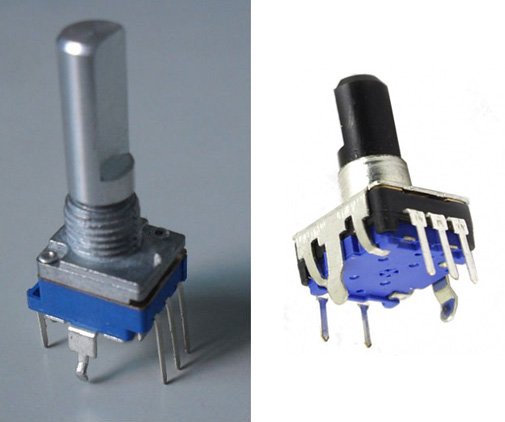
Incremental Rotary Encoder
first of all i would like to tell you , these type of rotary encoder is totally digital component so you can’t directly replace these with you conventional pots. so lets start what are Incremental Rotary Encoder ,
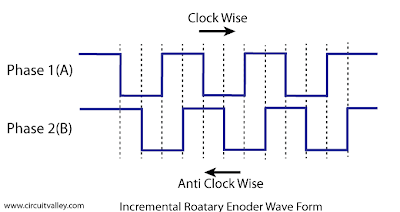
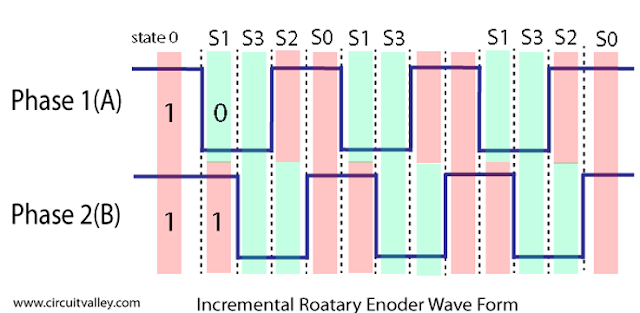
and hear the output wave form
Decoding with Microcontroller
in this examples we will be decoding the rotary encoder with the help of sate machine.
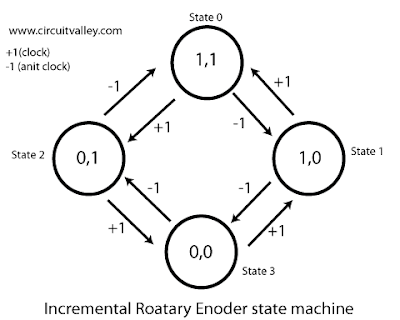
view of state machine in the wave form
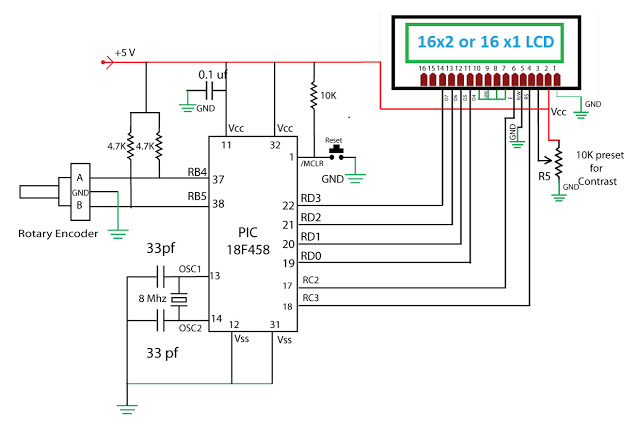
Schematic with PIC18F458
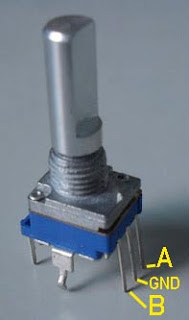
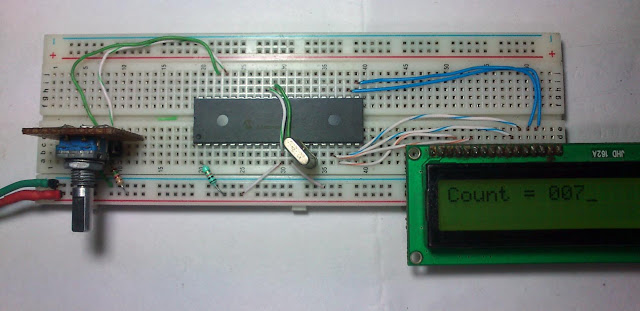
Source code and firmware
CLIK Here To download Source Code and Firmware. if you have any problem please leave in the comment section.
CLIK Here To download Source Code and Firmware. if you have any problem please leave in the comment section.
- What is an incremental rotary encoder?
An incremental rotary encoder is a totally digital component that outputs pulses representing rotational movement, used instead of conventional potentiometers. - Can an incremental rotary encoder directly replace a potentiometer?
No, it cannot be directly replaced because it is a digital component and requires decoding via electronics or a microcontroller. - How are encoder outputs decoded?
Encoder outputs are decoded with a microcontroller using a state machine to determine direction and steps from the waveform. - Does the article provide a schematic for interfacing?
Yes, the article includes a schematic showing interfacing with a PIC18F458 microcontroller. - Is source code or firmware available?
Yes, source code and firmware are available for download as mentioned in the article. - What microcontroller is used in the example?
The example uses a PIC18F458 microcontroller. - How is the state machine illustrated?
The state machine is shown in the waveform view to explain decoding steps. - What should I do if I have problems with the code?
The article asks readers to leave problems in the comment section.