


Summary of pic12f683 Microcontroller based Programmable LED
This article describes replicating Alex Weber's AVR programmable LED using a PIC 12F683 microcontroller. The project features EEPROM storage for saved sequences, software for recording and playing back patterns, and an LDR-LED communication system. It also includes instructions for building a SOIC chip prototyping board, serving as a foundational unit for collective behavior experiments.Parts used in the PIC-based Programmable LED:
- PIC 12F683 microcontroller
- EEPROM (internal to PIC)
- LDR (Light Dependent Resistor)
- Visible LED
- SOIC chip package prototyping board
This is a How-To for constructing a PIC-based programmable LED.
Following Alex Weber’s post on Instructables on 6 March 2007, I cre-ated a programmable LED on a PIC 12F683. The recorded sequence is saved to EEPROM, so it is retained when power is removed from the PIC. The software includes input codes for playing a stored sequence or recording a new sequence. Also included is a description of a simple SOIC chip package prototyping board.
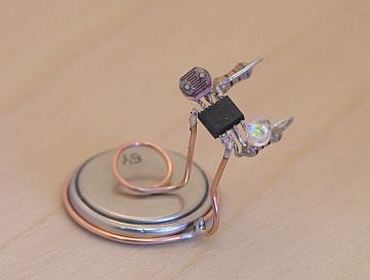
Introduction
When I saw Alex Weber’s AVR Programmable LED[1], I knew I had to
build one for myself. It was immediately clear to me (and to others, see the
comments on the Instructables post) that this was a great building block for
playing with collective behaviors. Once the basic unit is created, it can be
replicated quickly. Each unit has input and output and the use of the LDR-visible LED combination for makes it possible for units to communicate and humans to watch.
Download detailed instructions and software LEDRec.c, LEDRec.h, LEDRec.hex for a PIC-based programmable LED.
For more Detail: pic12f683 Microcontroller based Programmable LED
Quick Solutions to Questions related to PIC-based Programmable LED:
- What is the main purpose of this project?
To replicate Alex Weber's AVR programmable LED using a PIC microcontroller for playing with collective behaviors. - How is the recorded sequence stored?
The sequence is saved to EEPROM so it is retained when power is removed from the PIC. - What software components are included?
The software includes input codes for playing a stored sequence or recording a new sequence. - Can units communicate with each other?
Yes, the use of the LDR-visible LED combination makes it possible for units to communicate. - What specific microcontroller is used in this build?
The project uses a PIC 12F683 microcontroller. - Does the author provide source code?
Yes, detailed instructions and software files like LEDRec.c, LEDRec.h, and LEDRec.hex are available for download. - Is a special board required for the chip?
The article describes a simple SOIC chip package prototyping board. - Who originally created the concept being replicated?
Alex Weber over at Instructables built the original AVR-based programmable LED.
Related projects
Automotive Voltage Monitor using PIC12F683
Description Recently I got a new motorbike and on my second trip out, with only 50 miles on the clock the rectifier/regulator...
Communication & Interfacing · PIC12F683EnvStick USB Temperature Sensor using PIC12F683
The EnvStick is cheap, homemade temperature sensor that plugs into a USB port. It provides a simple way to collect a room’s...
Sensors & Temperature · PIC12F683Metal detector robot using pic microcontroller
This project describes hardware and software I have developed which allows a small 8 bit PIC microprocessor to function as a single...
LED ProjectsAn Application-Driven Microcontroller Curriculum
Understanding how to apply microcontrollers lies at the core of modern embedded systems education. This student project takes an experiential approach to...
LED ProjectsBuild this microcontroller controlled rainbow flying disc – and then throw it!
Hello all and welcome to this super simple and inexpensive instructable. If you like throwing frisbees AND you like flashing lights AND...
LED ProjectsLED Scrolling Display Project Working With Circuit Diagram
We normally use a simple static LED display screen to convey a message. Earlier, when we want to display large data, we...

Ibrar Ayyub
I am an experienced technical writer holding a Master's degree in computer science from BZU Multan, Pakistan University. With a background spanning various industries, particularly in home automation and engineering, I have honed my skills in crafting clear and concise content. Proficient in leveraging infographics and diagrams, I strive to simplify complex concepts for readers. My strength lies in thorough...