


Summary of DC motor speed control using PWM using PIC16F876
This article details a PWM-based DC motor speed control project using a PIC16F876 microcontroller. The author created a custom circuit to avoid issues with existing solutions, such as excessive component counts and audible buzzing from low-frequency PWM. The design utilizes the CCS C compiler, EAGLE for schematic/PCB layout, and specific timer/CCP configurations to adjust motor speed based on ADC input.Parts used in the Motor Speed Control Project:
- PIC16F876 microcontroller
- CadSoftUSA EAGLE software
- CCS PCM compiler
- ADC (Analog-to-Digital Converter)
- Timer 1
- Timer 2
- CCP1 module
- CCP2 module configured for PWM
- Fan motor
Here is a zip file with the EAGLE schematics and PCB layout. http://hans-w.com/MotorSpeedEAGLE.zip
New ! Source code available
C source code... requires CCS PCM compiler.
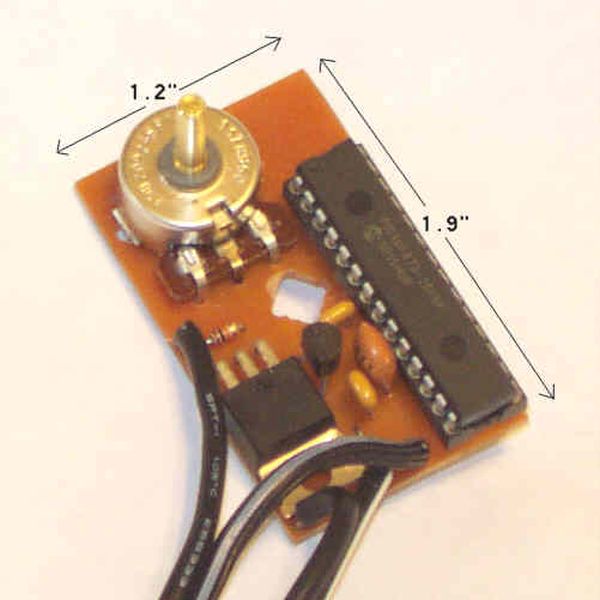
PCM is available from CCS http://www.ccsinfo.com/picc.shtml
//(C)Copyright 2002 Hans Wedemeyer Houston Texas U.S.A
// for use with Fan motor speed control
// see schematic PWM Motor Speed Control
// Aug. 10 / 2002 This matches the new EAGLE schematic and PCB layout.
//
#include "Motor.h"
long ADCValue=0;
long ADCValueOld=1;
#byte portA = 0X05
#byte portB = 0X06
#byte portC = 0X07
void main()
{
set_tris_A(0b00101011);
set_tris_B(0b00000001);
set_tris_C(0b00000000);
portA=0X00;
portB=0X00;
portC=0X00;
setup_adc_ports(ALL_ANALOG);
setup_adc(ADC_CLOCK_INTERNAL);
setup_spi(FALSE);
setup_counters(RTCC_INTERNAL,WDT_288MS);
setup_timer_1(T1_INTERNAL|T1_DIV_BY_1);
setup_timer_2(T2_DIV_BY_1,255,1);
setup_ccp1(CCP_OFF);
setup_ccp2(CCP_PWM);
enable_interrupts(global);
set_adc_channel(0);
delay_us(10);
while(1)
{
ADCValue = Read_ADC();
delay_ms(100); // monitor 10 times a second
if ( ADCValue != ADCValueOld )
{
set_pwm2_duty(ADCValue);
ADCValueOld = ADCValue;
}
}
}
Source code and Hex files are available here: http://hans-w.com/motorspeed.zip
////////////////////////////////////The original text and pictures://////////////////////////////////////////////////////////////
I tried several ready made PWM speed control circuits. Of the few I tried, there were problems that I did not like.
Here is the schematic.
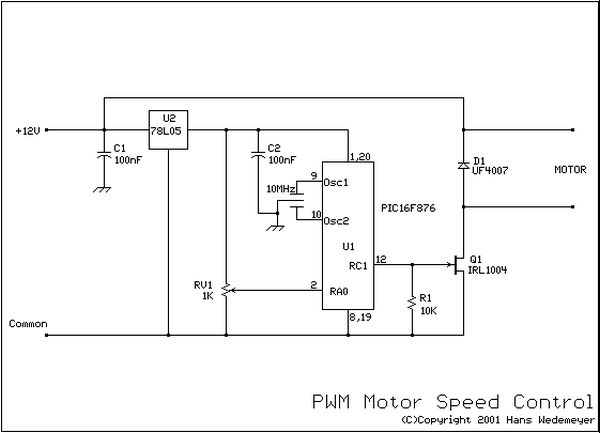
1) Lots of components.
2) PWM running as a low frequency which became audible as a loud buzzing sound from the motor.
3) I needed to build it now, and did not have all the components.
My solution, although it's much like cracking nuts with a sledge hammer, solved these problems.
For more detail: DC motor speed control using PWM using PIC16F876
Quick Solutions to Questions related to Motor Speed Control Project:
- Where can I download the EAGLE schematics?
A zip file containing the EAGLE schematics and PCB layout is available at http://hans-w.com/MotorSpeedEAGLE.zip. - What compiler is required for the source code?
The C source code requires the CCS PCM compiler which is available from ccsinfo.com. - Why did the author create a new circuit instead of using ready-made ones?
Ready-made circuits had problems including too many components, audible buzzing from low frequency PWM, and lack of immediate availability of all parts. - How often does the system monitor the ADC value?
The system monitors the ADC value ten times a second using a 100-millisecond delay. - Which CCP module is configured for PWM output?
The setup_ccp2 function is called with CCP_PWM to configure the second Capture Compare Pulse Width Modulation module. - What internal clock source is used for the ADC?
The code uses setup_adc(ADC_CLOCK_INTERNAL) to select the internal clock for the analog-to-digital converter. - Is there a way to get the compiled hex files?
Source code and Hex files are available for download at http://hans-w.com/motorspeed.zip. - What date was the schematic updated to match the new layout?
The schematic and PCB layout were matched on August 10, 2002.
Related projects
Ultrasonic Range Finder Circuit AD605 PIC16F876
Ultrasonic distance measurement, detection circuit pic16f876 microcontroller and ad605 (Dual Low Noise Variable Gain Amplifier singlesupply) integrated circuit diagrams used are C...
Sensors & Temperature · PIC16F876AInterfacing Temperature Sensor with Microchip PIC16F876A
The tutorial aims at providing the necessary information for interfacing an analog type temperature sensor with a Microchip PIC Microcontroller. PIC (Peripheral...
Beginner Tutorials · PIC16F876AHomemade Scope Clock DG7 tube and PIC16F876
Powersupply and CRT deflection and microcontroller test circuit. I was lucky to purcase two used but working DG7 tubes and a transformator...
Motors & RoboticsReal-Time CAN-Based Vehicle Monitoring System with PIC MCU
INTRODUCTION The Controller Area Network (CAN) is a robust vehicle communication bus standard that was primarily developed for automobile applications but has...
Motors & RoboticsEasy Way to Learn Robotics Using Microcontrollers: A Beginner’s Guide
The title, "Easy Way to Learn Robotics Using Microcontrollers," promises an accessible entry point for those curious about the exciting world of...
Motors & Robotics · PIC16F877AEfficient Sun-Following Robot: A Solar Tracker with Microcontroller Control
Abstract The impending global challenge of dwindling non-renewable fuel resources underscores the urgency of transitioning towards renewable energy alternatives like solar power....

Ibrar Ayyub
I am an experienced technical writer holding a Master's degree in computer science from BZU Multan, Pakistan University. With a background spanning various industries, particularly in home automation and engineering, I have honed my skills in crafting clear and concise content. Proficient in leveraging infographics and diagrams, I strive to simplify complex concepts for readers. My strength lies in thorough...