


Summary of Projects on Speed Checker To Detect Rash Driving On Highways
This article describes inexpensive highway speed checker systems to detect rash driving by measuring vehicle time between two sensor points. It outlines three controller-based designs—timer, microcontroller, and logic-based—using IR sensors, timing/counting circuitry, displays, and alarms to calculate speed, display results, and alert authorities when limits are exceeded.Parts used in the Speed Checker for Highways:
- IR transmitter
- IR receiver
- Timer (e.g., 555 timer or timing circuit)
- Counter
- Logic gates
- Microcontroller
- Seven-segment display
- Buzzer/alarm
- Control circuit
- Power supply and miscellaneous electronic components (wires, resistors, capacitors)
While driving on highways, drivers should not exceed the maximum speed limit permitted for their vehicle. However, accidents keep on occurring due to speed violations as drivers follow their speedometers and control their speed according to them, and reduce the speed if they find it to be exceeding and beyond their control. A highway speed checker comes handy for the traffic police, especially against the speed limit violators because it provides the digital display as well as buzzing sound or alarm to detect any vehicle speed if the vehicle exceeds the permitted speed limit.
The make up of these highways, sometimes leads to accidents because most of the times, there is no rule to govern speed limits on these highways. To overcome this problem, we have implemented a circuit called as a speed checker for highways. This kit is inexpensive and it is used for considering the average and high speed of vehicles that move on the highways or roads.
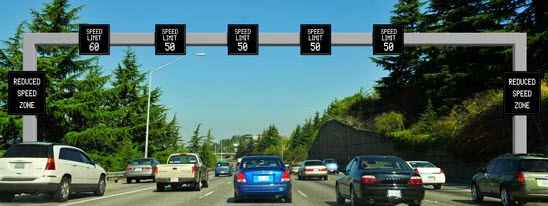 By taking all these considerations in mind, we have designed a highway- speed checker circuit to detect the rash driving by using different electronic components such as timer, counter, logic gates, microcontroller, seven segment display and all other components. To understand this circuit better, the following paragraphs describe a project report on speed-checker for highways, which covers three types of speed checker projects that can be controlled using three types of controllers.
1. A Speed Checker to Detect Rash Driving on Highways Using a Timer
Nowadays, in our daily life most of the accidents occur due to rash driving on highways which may lead to the loss of many lives. Therefore, to overcome this problem, the following project implements a speed checker to detect rash driving on highways by using a timer.
The main objective of this system is to develop a highway speed-checker device that detects rash driving on highways and alerts, traffic authorities if the speed checker finds any vehicle violating the set speed limits on highways.
The proposed system checks rash driving by calculating the speed of a vehicle by using the time taken to travel between the two set points placed on the road at a certain distance. A set point consists of a couple of sensors comprising an IR transmitter and an IR receiver, which are placed on either side of the road. The speed limit is set by the police who use the system depending on the traffic at each location.
The time taken by the vehicle to travel from one set point to the other is calculated by the control circuit. Based on the time that has elapsed between the two sensors, the control circuit calculates the speed and displays the result on a seven segment display. If a vehicle exceeds the speed limit between transmitter and receiver, then this system emanates a buzzing sound as an alarm and alerts the police.
 2. A Speed Checker to Detect Rash Driving on Highways by Using a Microcontroller
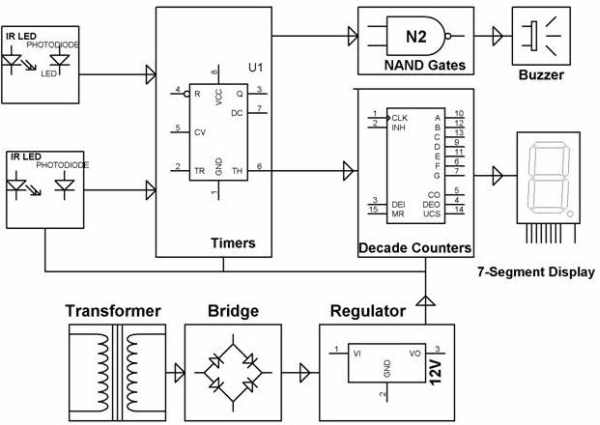
The main purpose of this system is to develop a speed checker for highways using a microcontroller and to alert the traffic authorities in case of any speed violation. Many passengers and drivers, including commuters have lost their lives due to rash and rude driving on highways.
In olden days, for detecting rash driving, highway police used to target vehicles by using radar guns at the vehicle and would record their speeds. If a vehicle would exceed its speed, automatically the information would reach to the nearest police station for controlling the speed of the vehicle. Due to this system a lot of time would get wasted.
For more detail: Projects on Speed Checker To Detect Rash Driving On Highways
- What is the primary objective of the highway speed checker?
The main objective is to detect rash driving on highways and alert traffic authorities when vehicles exceed set speed limits. - How does the timer-based speed checker calculate vehicle speed?
It measures the time a vehicle takes to travel between two set points with IR sensor pairs and calculates speed from elapsed time and known distance. - What sensors are used at each set point on the road?
Each set point uses a pair of sensors: an IR transmitter and an IR receiver. - How does the system notify authorities when a vehicle exceeds the speed limit?
The system emits a buzzing sound as an alarm and alerts the police when a vehicle exceeds the permitted speed. - What display is used to show the calculated speed?
The calculated speed is displayed on a seven-segment display. - What controllers are mentioned for implementing the speed checker?
The article describes implementations using a timer, logic gates and counters, and a microcontroller. - Why is a microcontroller-based system preferred over traditional radar methods according to the article?
The microcontroller-based system aims to automate detection and alerting, reducing time wasted compared to older radar gun methods that required manual recording and communication. - Can the speed limit be set by police using this system?
Yes, the speed limit is set by the police depending on traffic at each location.
Related projects
Determine capacitance by measuring the charging time using PIC16F688
When TEST botton is pressed, RA3 pin is set to "1". R2 and R3 are divide the voltage to 1/2 Vra3 which...
Meters & Test InstrumentsFrequency Meter Using Microcontroller
This tutorial simply states how to calculate frequency of a pulse source using a microcontroller. Story https://youtu.be/NAoj-HLRIro This tutorial simply states how...
Meters & Test Instruments · PIC16F84ADigital thermometer with PIC16F84 circuit
This electronic project is a very simple thermometer that is based on the PIC16F84A microcontroller, designed by Microchip. Why to use a...
Meters & Test InstrumentsDigital Ammeter circuit using pic microcontroller
In this project we have a tendency to design a circuit to build an electronic voltmeter while not making use of any...
Meters & Test InstrumentsTampered Energy Meter Monitoring Conveyed to Control Room by GSM with User Programmable Number Features
The main concept of this project is to reduce the power theft by using an integrated energy meter such that whenever an...
Meters & Test Instruments · PIC16C71PIC16c71 four channel digital voltmeter
This electronic circuit project is a simple four channel digital voltmeter with display and keyboard . This four channel digital voltmeter is...

Ibrar Ayyub
I am an experienced technical writer holding a Master's degree in computer science from BZU Multan, Pakistan University. With a background spanning various industries, particularly in home automation and engineering, I have honed my skills in crafting clear and concise content. Proficient in leveraging infographics and diagrams, I strive to simplify complex concepts for readers. My strength lies in thorough...