


Summary of Alarm Phone Dialer with MT8880 and PIC 16F84A
This project is an Alarm Phone Dialer that uses a PIC16F84A microcontroller and an MT8880 DTMF dialer to call programmed phone numbers when a monitored sensor input is triggered, allowing remote alerts for conditions like high water or open windows. Users program numbers via a phone on the same line, then the device dials stored numbers (tone or pulse) and stops when the called party presses #. The system learns up to 64 characters including * and #; microcontroller code is provided on the project site.Parts used in the Alarm Phone Dialer:
- MT8880 DTMF dialer chip
- PIC16F84A microcontroller
- Pushbuttons (Program and Pokreni dojavu alarma start button)
- Telephone line connector
- Jumper for tone or pulse selection
- Sensor or input connection to replace start button
- Power supply
- Wiring and prototyping board or PCB
Just hook this Alarm Phone Dialer up to something you would like to monitor, for example, a high water alarm, low temperature alarm, back window, garage door, etc. When the system is activated it will call a number of programmed numbers to let you know the alarm has been activated. This would be great to get alerts of alarm conditions from your home when you are at work. The microcontroller code is provided on the site.
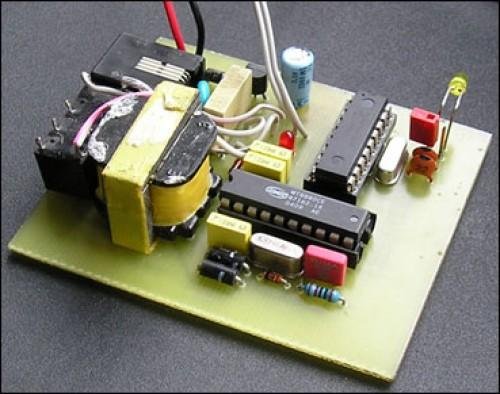 The circuit uses a MT8880 DTMF dialer chip and a PIC 16F84A microcontroller.
After putting together this little device, you must enter programming-mode to learn some phone numbers which this module will call after detecting an input on it’s sensor pin
After programming just supply power to the device. After pressing the button “Pokreni dojavu alarma” it will start to dial (tone or pulse, depending on the jumper setup). When the phone call is successfully established, the called party should press pound key “#” to stop the device from calling another number or again.
You should put a sensor instead of button “Pokreni dojavu alarma”.
Programming the numbers
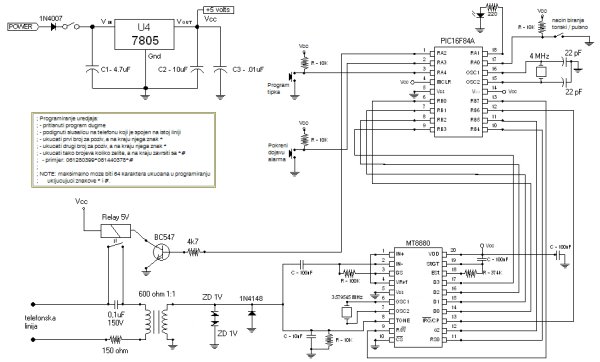 1. press the “program” button
2. pick up the phone that is connected to the same phone-line as this device
3. punch-in first number and then “*” key
4. punch-in then next number and then “*” key
5. punch-in the rest of numbers, if more, and finalise with “*#” (example: 061123123*061456456*#)
Please note: The device will learn 64 characters/digits including * and # keys.
For more detail: Alarm Phone Dialer with MT8880 and PIC 16F84A
Quick Solutions to Questions related to Alarm Phone Dialer:
- How do I program phone numbers into the device?
Press the program button, pick up a phone on the same line, enter a number followed by * for each entry, and finish with *#. - How many characters can the device learn?
The device will learn 64 characters/digits including * and # keys. - How does the device stop calling further numbers?
The called party presses the pound key # to stop the device from calling another number or again. - Can I replace the start button with a sensor?
Yes, you should put a sensor instead of the start button to trigger the alarm dialing. - What chips are used in the circuit?
The circuit uses an MT8880 DTMF dialer chip and a PIC16F84A microcontroller. - Does the dialer support tone and pulse dialing?
Yes, dialing mode is selectable by a jumper for tone or pulse. - Where do I enter the microcontroller code?
The microcontroller code is provided on the project site for programming the PIC16F84A. - How do I initiate a call after programming?
Supply power to the device and press the start button Pokreni dojavu alarma to begin dialing.
Related projects
PIC Stepper Motor Controller using PIC16F84A with Proteus Simulation
Introduction Stepper motors are widely used in embedded systems and DIY electronics projects where precise position control is required. This PIC Stepper...
Programmers & ICSP · PIC16F84APIC Musical Doorbell using PIC16F84A with Proteus Simulation
IntroductionThis microcontroller project demonstrates a musical doorbell built around a PIC16F84A and a simple piezo sounder.Using two push buttons, the system allows...
Beginner Tutorials · PIC16C84Exploring the World of PIC Microcontrollers: An Architectural Overview
A Peripheral Interface Microcontroller (PIC), developed by General Instruments Microcontrollers in 1993, operates under software control and is programmed to execute various...
Wireless & IoTExploring Various Applications of Microcontrollers: A World of Tiny Brains
Exploring Various Applications of Micro Controller Microcontrollers have become ubiquitous in the modern world with applications in nearly every industry. This student...
Wireless & IoTIntelligent Sips: Revolutionizing Dining with the SmartCup
Abstract The SmartCup Attachment is a comprehensive system designed for restaurants to monitor the liquid levels in their customers' cups. This system...
Wireless & IoTMaximizing Wi-Fi Capabilities with the Explorer 16 Development Board
As society progresses, the necessity for wireless communication is evolving from a mere luxury to an essential requirement. Wi-Fi, extending beyond conventional...

Ibrar Ayyub
I am an experienced technical writer holding a Master's degree in computer science from BZU Multan, Pakistan University. With a background spanning various industries, particularly in home automation and engineering, I have honed my skills in crafting clear and concise content. Proficient in leveraging infographics and diagrams, I strive to simplify complex concepts for readers. My strength lies in thorough...