
Summary of SKY WRITER using PIC12F629 Microcontroller
Summary: This project creates stable, readable words displayed in midair using a microcontroller-driven LED array and an inertia switch for registration. The inertia switch detects the sweep start so characters reappear in the same position. Two prototypes use surface-mount LEDs or paired super-bright white LEDs per output. The design supports long displays (100+ pixels) at 5 pixels high and can be reprogrammed for different messages via a PIC programmer.
Parts used in the Sky Writer:
- PIC12F629 microcontroller
- Surface-mount LEDs (prototype option)
- Super high-bright white LEDs (two LEDs per output, prototype option)
- Inertia switch (ferrule-and-wire or ball-bearing incline type)
- Tinned copper wire (for inertia switch spring)
- Resistor for LED test
- Printed circuit board
- Plastic molding for inertia switch housing
- PIC programmer (for loading software)
We have seen many projects using a set of LEDs to produce words “in the air,” but none have the clever feature we have included.
Most of the projects are “shaken in the air” and produce messages that are “all over the place.” But if the words are jumping they are difficult to read.
Our project solves this. It produces words that re-appear in the same position so they are easy to read.
The secret is called REGISTRATION.
Our design detects the start of the sweep and starts to display the letters.
This is due to the inclusion of a switch called an INERTIA SWITCH that detects rapid deceleration and starts the display. More about this later.
THE CIRCUIT
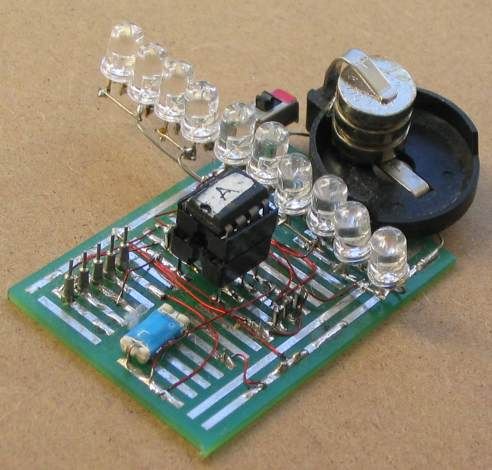
The circuit is very simple. All the work is done by the micro. We have produced two different prototypes to show the effect using surface-mount LEDs and super high-bright white LEDs with two LEDs per output and this is really effective.
THE INERTIA SWITCH
There are two types of inertia switch. One is a weight on a spring and the other is a ball riding up an incline.
We have used both and they work equally-well and it’s just a matter of which type you want to use.
To make the inertia switch yourself, it is a small ferrule on a wire. A length of tinned copper wire wound around it and pulled tight and acts as a spring to keep the contacts open. These contacts are connected to pin 4 of the microcontroller.
You can check the operation of this switch by connecting a LED and resistor to the supply and waving the PC board. You will find the LED illuminates at almost the exact same place “in space” making it an ideal registration-mark for aligning the words.
Once you have a reliable starting-point for creating the display, you can make almost any effect using the 5 LEDs. There are almost no limits as the display can be 100 or more pixels long, and 5 pixels high.
You can change the wording and add more features. To do this you need a programmer and software. For details on this, see Pick A PIC Project.
The table we have used in the program occupies nearly all the space available (for a table), however you can add other features by studying some of our other projects.
The circuit has two super high-bright LEDs on each output to give a very impressive display. The “inertia switch is shown as the blue rectangular component. It has a ball-bearing that hits both the top and bottom conductors (without jamming) when the ball rolls in one direction. The plastic molding prevents the ball touching both conductors when it rolls in the opposite direction.
For more detail: SKY WRITER using PIC12F629 Microcontroller
- How does the project ensure words reappear in the same position?
The project uses an inertia switch to detect the start of the sweep (registration) so the microcontroller begins displaying letters at the same point each time. - What is the role of the inertia switch?
The inertia switch detects rapid deceleration at the sweep start and provides a reliable starting-point (registration) for the display. - Can different LED types be used in prototypes?
Yes; two prototypes were made using surface-mount LEDs and super high-bright white LEDs with two LEDs per output. - How tall and long can the display be?
The display can be 5 pixels high and can be 100 or more pixels long. - Do you need additional tools to change wording or features?
Yes; changing wording and adding features requires a PIC programmer and software. - What materials are used to make the inertia switch?
An inertia switch can be made from a small ferrule on a wire with tinned copper wire wound around it as a spring, or a ball-bearing on an incline housed in plastic molding. - How can you test the inertia switch operation?
Connect an LED and resistor to the supply and wave the PCB; the LED will illuminate at the same place in space where the switch triggers. - Does the microcontroller handle most circuit functions?
Yes; the circuit is simple and all the work is done by the microcontroller.
