


Summary of pic18f458 Microcontroller based Solar Recorder
This article describes a low-cost solar recorder designed to measure daily insolation using a PIC18F458 microcontroller and a 128MB Multimedia Memory Card. A calculator solar cell serves as the sensor, with data sampled every minute. The system interfaces via SPI, uses an LCD for real-time display, and allows quick data transfer to a PC.Parts used in the Solar Recorder:
- PIC18F458 Microcontroller
- 128MB Multimedia Memory Card (MMC)
- Calculator Solar Cell
- CMOS CD4050 Logic Level Translator
- Text LCD Display
- TLV2451 Current to Voltage Converter
- +5V Voltage Regulator
- Thermistor (for Channel 1 input)
The device used for measuring daily insolation has been developed. The device was built with a PIC18F458 and the 128MB Multimedia Memory Card, MMC. The solar radiation is measured by a calculator solar cell. The PIC chip interfaces the MMC using SPI mode. The interval between samples is set to one minute. The firmware detects the memory card, assignes the file name and begins recording automatically. The LCD displays the file name, current sample and real-time ADC data. With the MMC flash technology and a cheap media card reader, the devices will be able to record huge amount of data and quick data uploading to the PC.
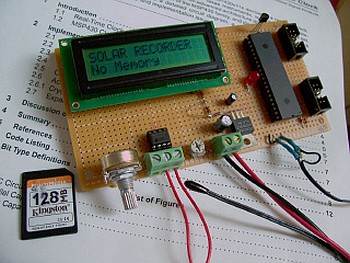
The Solar Recoder with a 128MB Multimedia Memory Card. The righhand shows the input sensor made with a calculator solar cell.
Introduction
To estimate the sun energy for a given location, we record the irradiance (W/m^2) with time. Figure 2 shows a sample plot of irradince with time (5mins interval). The daily insolation can be computed easily by integraing the curve. For accurate total radiation measurement, we use the expensive pyranometer. However for simplicity and cheap instrument we can replace it with a small colar cell as the input sensor. The article shows the use of PIC microcontrolller and the Multimedia Memory Card for data storage.
Hardware Schematic
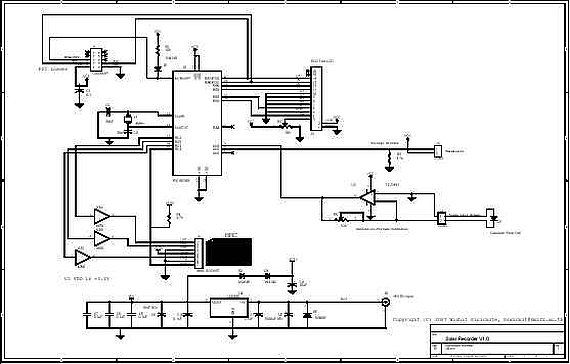
The complete hardware schematic is shown in Figure 1. The MCU is PIC18F458 running at 4MHz clock. The SPI port RC2-RC5 is used to interface the MMC card. Since the memory card is +3.3V logic, we use CMOS CD4050 to translate from +5V logic to +3.3V logic. RC5 is MMC command shifted out from the MCU. The shift clock is RC3. Data out from the memory card is read back by RC4. The text LCD is interfaced to the PORTB using 4-bit mode. U2, TLV2451 is current to voltage converter. It converts the short circuit current from the solar cell to voltage signal. The output voltage is short circuit current multiplied with R5. We may adjust R5 to provide +5V full scale. The signal is tied to analog input channel 0. Channel 1 is available for thermistor input. U4 is +5V voltage regulator, the +3.3V is derived from the +5V through the use of D3 and D4.
For more Detail: pic18f458 Microcontroller based Solar Recorder
- What is the primary purpose of this device?
The device measures daily insolation by recording irradiance over time. - How is the memory card interfaced with the microcontroller?
The PIC chip interfaces the MMC using SPI mode. - What is the sampling interval set to?
The interval between samples is set to one minute. - Which component converts the solar cell current to a voltage signal?
The TLV2451 acts as a current to voltage converter. - Why is the CMOS CD4050 used in the circuit?
It translates from +5V logic to +3.3V logic required by the memory card. - Can the device measure temperature as well as radiation?
Yes, channel 1 is available for a thermistor input. - How does the firmware handle data storage?
The firmware detects the memory card, assigns a file name, and begins recording automatically. - What information is displayed on the LCD screen?
The LCD displays the file name, current sample number, and real-time ADC data.
Related projects
Rotary Encoder Interfacing with PIC Mirocontroller
i am currently working with some power supply design and i can say using conventional pots(potentiometer) and rotary switch to adjust the...
Wireless & IoT · PIC18F458Nokia 3315 / 3310 LCD interfacing with Microcontroller
Displaying content on a normal alphanumeric display is very limited ,we have to be limited with the font size and we can't...
Programmers & ICSP · PIC18F458In-Circuit PIC Loader using PIC18F458 microcontroller
This loader connects the PC printer port and works with WinPic800. The loader gets DC supply from application board and provides +12V...
Sensors & TemperatureSpectrum Analyzer using TMS320F28023DA with Proteus Simulation
Introduction This project demonstrates a real-time audio spectrum analyzer using the TMS320F28023DA Piccolo microcontroller, simulated in Proteus VSM. The system captures an...
Sensors & TemperatureDHT22 Low Cost Humidity Sensor using PIC18F25K20 with Proteus Simulation
IntroductionThis microcontroller project demonstrates how to interface a DHT22 (RHT03) digital temperature and humidity sensor with a PIC18F25K20 using Proteus simulation.The project...
Sensors & TemperatureCrafting a Microcontroller-Based Temperature Monitoring System
Abstract As technological advancements progress, processes become increasingly intricate, demanding a corresponding expansion in the parameters necessary for efficient analysis. Data acquisition,...

Ibrar Ayyub
I am an experienced technical writer holding a Master's degree in computer science from BZU Multan, Pakistan University. With a background spanning various industries, particularly in home automation and engineering, I have honed my skills in crafting clear and concise content. Proficient in leveraging infographics and diagrams, I strive to simplify complex concepts for readers. My strength lies in thorough...