


Summary of Harmonic Distortion Meter using PIC18F2550
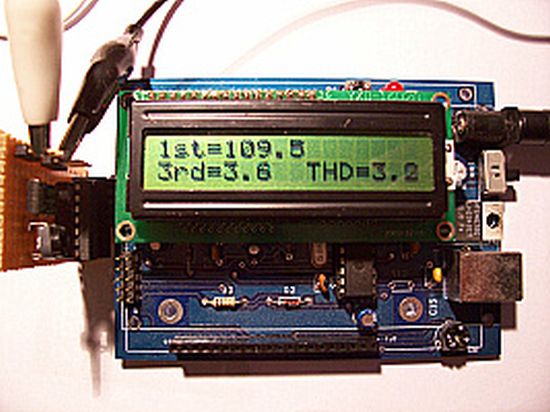
The article describes a 3rd harmonic distortion meter built with a PIC18F2550 project board and a full-wave rectifier front end. It measures 220 VAC via a step-down isolation transformer, samples the rectified signal with a 10-bit ADC, and computes DFT to extract the fundamental and 3rd harmonic amplitudes. Distortion is reported as the ratio of 3rd harmonic amplitude to the fundamental. Tested values: 33% for a square wave and about 3% for low-voltage 220 V utility. The design can be adapted for high-voltage systems with appropriate signal conditioning.Parts used in the 3rd harmonic distortion meter:
- PIC18F2550 project board
- Step-down isolation transformer (for 220 VAC)
- Full-wave rectifier circuit
- 10-bit ADC (on PIC18F2550)
- Signal conditioning components (resistors, capacitors) for front-end
- Software implementing DFT calculation
- Power supply components for PIC board
The 3rd harmonic distortion meter has been designed for measuring the quality of AC supply. The meter is built with a PIC18F2550 project board and the full wave rectifier front-end circuit. The AC power line, 220VAC is measured through the step down isolation transformer. The input signal to the 10-bit ADC is full wave rectified. The software performs DFT calculation finding the amplitude of the fundamental frequency and the 3rd harmonic. The distortion is computed by the ratio of the amplitude of the 3rd harmonic to the fundamental frequency. The meter has been tested with the square wave signal resulting 33% distortion. For low voltage AC utility, 220V, the reading showed approx. 3%. The meter can be applied for high voltage application with the appropriate signal conditioning.
Introduction
Nowadays an increasing of the electronic devices having nonlinear characteristics are many used at home and office. Such devices mostly are computer based equipment with a low power factor switch mode power supply. The input circuit of the power supply uses a diode-capacitor at the front-end circuit. The current drawn is charging capacitor only near the peak voltage. Thus for a given feeder having finite impedance, there will be a lost from voltage dropped near the peak voltage resulting flattened top distortion of the AC voltage. To measure how high the distortion of AC voltage is, we may decompose it into the summation of sinusoid waves using DFT. The PIC harmonic distortion meter shows a method for finding the amplitude of the fundamental frequency and the 3rd harmonic. The reading shows percentage of the 3rd harmonic distortion.
Total Harmonic Distortion, THD
To measure the waveshape distortion, we use the quantity of the Total Harmonic Distortion, THD (equation 1). THD is the ratio of the power of harmonic components to the power of fundamental frequency. Our concern is the voltage distortion, we can just find the sum of the rms of the harmonic components, Vn and the rms of the fundamental frequency, V1.
For more detail: Harmonic Distortion Meter using PIC18F2550
Quick Solutions to Questions related to 3rd harmonic distortion meter:
- What microcontroller is used in the project?
The project uses a PIC18F2550 project board. - How is the AC mains signal sampled?
The 220 VAC is measured through a step-down isolation transformer and then full-wave rectified before ADC sampling. - What ADC resolution is used for measurements?
The design uses a 10-bit ADC. - How are the harmonic amplitudes calculated?
The software performs DFT calculations to find the amplitudes of the fundamental frequency and the 3rd harmonic. - How is the 3rd harmonic distortion reported?
Distortion is computed as the ratio of the amplitude of the 3rd harmonic to the fundamental frequency. - What distortion values were observed in tests?
The meter measured 33% distortion for a square wave and approximately 3% for low-voltage 220 V utility. - Can the meter be used for high-voltage applications?
Yes, it can be applied to high-voltage applications with appropriate signal conditioning. - Why is harmonic distortion important in modern power systems?
Many electronic devices with nonlinear characteristics create waveform distortion; THD quantifies the harmonic content relative to the fundamental.
Related projects
Pinguino Project: A PIC Microcontroller Based Arduino
This is a complete tutorial to make a PIC Microcontroller based Arduino. This is a complete tutorial to make PIC microcontroller based...
Audio, Sound & Radio · PIC18F2550LM386 based stereo audio amplifier with digital volume control using PIC18F2550
Due to its simplicity (requires minimum external components) and high availability, LM386 is very popular among hobbyists for use in low-voltage audio...
Communication & Interfacing · PIC18F2550PIC Harmonic Distortion Meter
The 3rd harmonic distortion meter has been designed for measuring the quality of AC supply. The meter is built with a PIC18F2550...
Meters & Test Instruments · PIC16F688Determine capacitance by measuring the charging time using PIC16F688
When TEST botton is pressed, RA3 pin is set to "1". R2 and R3 are divide the voltage to 1/2 Vra3 which...
Meters & Test InstrumentsFrequency Meter Using Microcontroller
This tutorial simply states how to calculate frequency of a pulse source using a microcontroller. Story https://youtu.be/NAoj-HLRIro This tutorial simply states how...
Meters & Test Instruments · PIC16F84ADigital thermometer with PIC16F84 circuit
This electronic project is a very simple thermometer that is based on the PIC16F84A microcontroller, designed by Microchip. Why to use a...

Ibrar Ayyub
I am an experienced technical writer holding a Master's degree in computer science from BZU Multan, Pakistan University. With a background spanning various industries, particularly in home automation and engineering, I have honed my skills in crafting clear and concise content. Proficient in leveraging infographics and diagrams, I strive to simplify complex concepts for readers. My strength lies in thorough...