


Summary of Digital Temperature Sensor Circuit
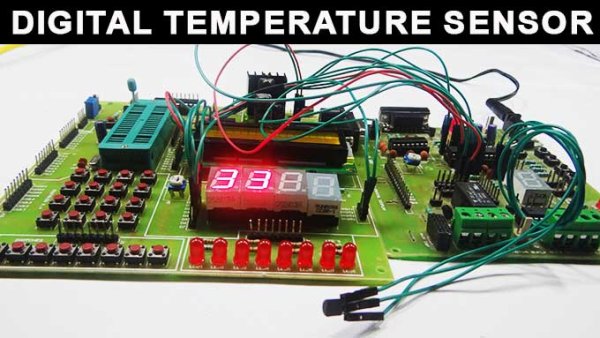
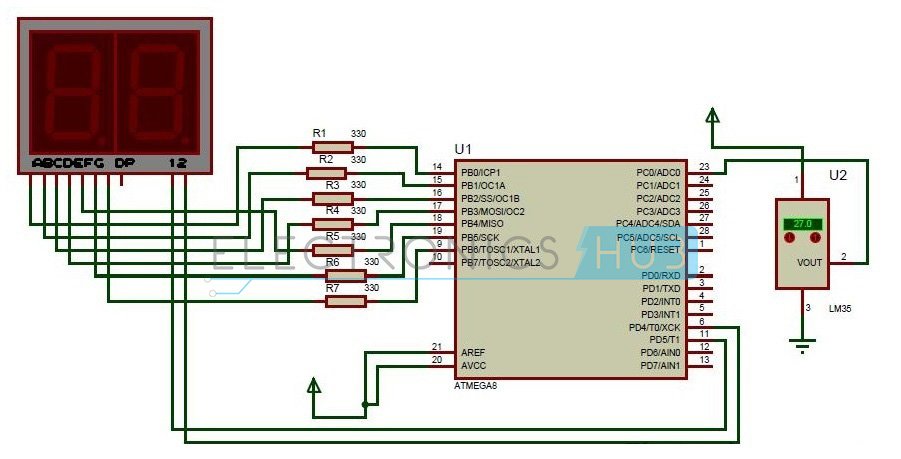
This article explains a digital temperature sensor using an ATmega8 microcontroller and an LM35 sensor. The LM35 analog output connects to the ATmega8 ADC (PC0), which performs 10-bit successive approximation conversions; results drive a common-cathode 7-segment display on Port B through current-limiting resistors. Vref and AVcc must be connected for ADC operation, and ADC registers configured to enable Port C ADC function. Multiple ADC channels (PC0–PC5) are available but only one channel converts at a time.Parts used in the Digital Temperature Sensor:
- Resistors R1 to R7 (330 Ohms each)
- LM35 Temperature sensor
- ATmega8 Microcontroller
- 7 Segment Display (common cathode)
Digital Temperature Sensor Circuit Principle:
Digital Temperature Sensor Circuit Diagram:
- Resistors – R1 to R7 having the value of 330 Ohms each.
- LM35 Temperature sensor
- ATmega8 Microcontroller
- 7 Segment Display
Digital Temperature Sensor Circuit Design:
For more detail: Digital Temperature Sensor Circuit
- How is the analog temperature value converted to digital?
The ATmega8 internal ADC uses successive approximation to convert the LM35 analog output to a 10-bit digital value. - Which ADC channel is the LM35 connected to?
The LM35 output is connected to ADC channel PC0 of the ATmega8. - Do I need an external ADC IC for this project?
No, the ATmega8 has an inbuilt ADC with six multiplexed channels, so no external ADC IC is required. - What display is used to show temperature?
A common cathode 7-segment display connected to Port B is used to show the temperature. - How are the 7-segment pins connected to the microcontroller?
The seven segment pins (excluding the decimal point) are connected to PB0 through PB6; A to PB0, B to PB1, up to G to PB6, with current-limiting resistors. - What is the ADC resolution of the ATmega8?
The ATmega8 ADC resolution is 10 bit. - Are Vref and AVcc connections required?
Yes, Vref and AVcc must be externally connected for proper ADC conversion as shown in the circuit. - How many analog inputs does the ATmega8 provide?
The ATmega8 provides six ADC channels at Port C (PC0–PC5) for analog inputs.
Related projects
An Application-Driven Microcontroller Curriculum
Understanding how to apply microcontrollers lies at the core of modern embedded systems education. This student project takes an experiential approach to...
LED ProjectsBuild this microcontroller controlled rainbow flying disc – and then throw it!
Hello all and welcome to this super simple and inexpensive instructable. If you like throwing frisbees AND you like flashing lights AND...
LED ProjectsLED Scrolling Display Project Working With Circuit Diagram
We normally use a simple static LED display screen to convey a message. Earlier, when we want to display large data, we...
LED Projects8051 MICROCONTROLLER
8051 Microcontroller based electronic locker system CIRCUIT DESCRIPTION Security is a prime concern in our day-today life. Everyone wants to be as...
LED ProjectsPassword Based Door Lock System using 8051 Microcontroller
Traditional lock systems using mechanical lock and key mechanism are being replaced by new advanced techniques of locking system. These techniques are...
LED Projects · PIC16F67630 volts Panel Volt Meter Using PIC MCU
This is a simple application of internal 10-bit ADC(analog to digital converter) of PIC16F676 microcontroller.you can use this circuit to measure up...

Ibrar Ayyub
I am an experienced technical writer holding a Master's degree in computer science from BZU Multan, Pakistan University. With a background spanning various industries, particularly in home automation and engineering, I have honed my skills in crafting clear and concise content. Proficient in leveraging infographics and diagrams, I strive to simplify complex concepts for readers. My strength lies in thorough...