


Summary of PIC16F1787 Programmer Board (for Almost all 40 pin 16Fxxx)
This project builds a PIC16F1787 development/programmer board on a ready-made PCB, with connections for programming (MCLR, Vdd, Vss, PDAT, PCLK), a 5V regulator, 40-pin socket, headers for peripheral access, optional LED and PC jack, and using PICKIT3 and MPLAB X for programming. The board can also program other 40-pin 16Fxxx devices with datasheet checks.Parts used in the PIC16F1787 Development Board:
- PIC16F1787 microcontroller
- Ready made PCB board
- 5V regulator (LM7805)
- 40 pin jack
- Male connecting pins
- Female connecting pins/headers
- Push button
- 8.7k resistor
- Connecting wires
- LED (optional)
- Computer's jack (optional)
Intro
This is my first Instructable so I'm sorry for mistakes. Critics are always welcome 🙂
So in this project I made a development board for PIC16F1787. Now most of you guys aren't familiar with this particular model. Some might even think why I chose 16Fxxxx series IC when I could have easily used 18Fxxxx series and had more fun.
Well for my project DC to 3 phase AC pure sinewave Inverter (I'll try to make an instructable for that also), I found this IC very interesting indeed. You guys should check out its datasheet for its applications. It has built in 3 phase PWM generator and other cool stuff. Im attaching its datasheet.
Step 1: Items you will be needing
Items Needed:-
Must needed:-
- PIC16F1787 (ofcourse)
- Ready made PCB board
- 5v Regulator (LM7805 in my case)
- 40 pin jack
- Male and Female connecting pins
- Push Button
- 8.7k Resistor
- Connecting wires
Optional:-
- LED
- Computer's Jack
Step 2: Circuit
The connections are all described in the picture attached. So feel free to observe it and ask where you don't understand something.
MCLR, Vdd, Vss, PDAT, PCLK are needed to program the IC and they are connected to a male header/connecter so that Picket 3 can be used.
+5V DC are to be applied for PIC to work, remember NO MORE THAN 5 Volts. It will permanently damage the IC.
LED is optional as it is applied just to check whether
the PIC IC is working or not by using a toggling code.
Female headers are connected with the 40pin jack. These can be used in switching of many programs.
Step 3: Programming
Use Picket 3 for Programming. It is the best and trouble free programmer 🙂
I made a C++ based code for LED toggling. The compiler used my me is MPLAB X. It is user friendly and easy to make C programs.
My LED toggling Program is attached below.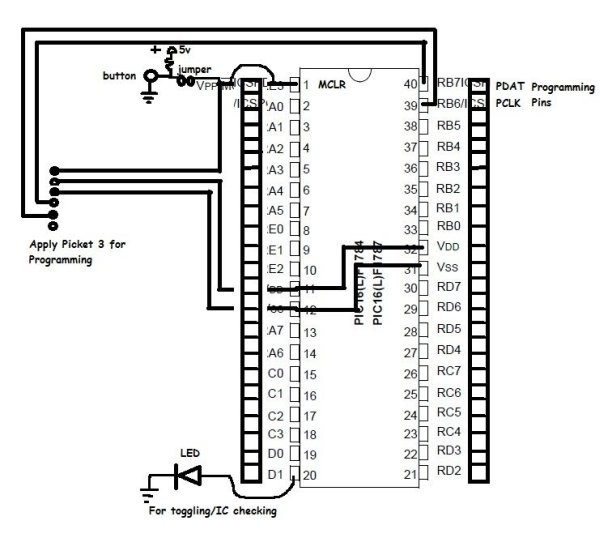
Step 4: Finished!!!
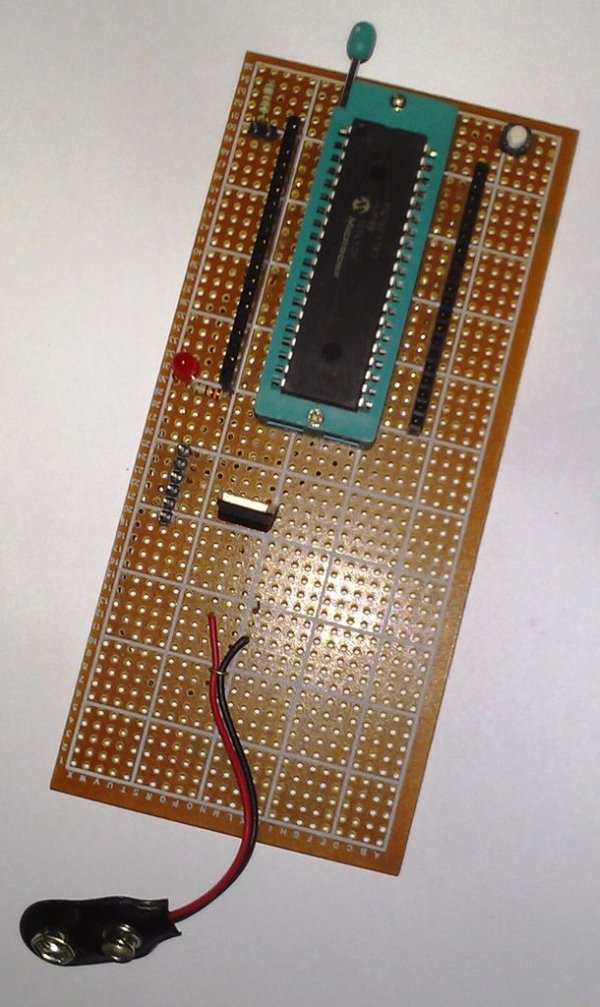
This is the final form after soldering the parts altogether. Hope you liked it. I will add more details in my future instructables. Stay tuned...........
Thankx for reading
P.S= 16F877 and 16F877A were also programmed by the same board. Consult datasheet before using this board for other 40 pin PIC controllers.
For more detail: PIC16F1787 Programmer Board (for Almost all 40 pin 16Fxxx)
- What microcontroller is used in this project?
PIC16F1787 is used in this project. - What voltage should be applied to power the PIC?
Apply +5V DC and do not exceed 5 volts. - Which programmer is recommended for programming the board?
PICKIT3 is recommended for programming the board. - Which pins are required for programming the IC?
MCLR, Vdd, Vss, PDAT, and PCLK are connected for programming. - What regulator is used to provide 5V?
An LM7805 5V regulator is used. - Is an LED required on the board?
The LED is optional and used to check the PIC with a toggling code. - Can this board program other 40-pin 16Fxxx PICs?
Yes, 16F877 and 16F877A were programmed with the same board, but consult datasheets before use. - What software and language were used for the example code?
MPLAB X was used and the example code is written in C/C++. - How are peripherals accessed from the board?
Female headers are connected to the 40-pin jack and provide access to peripheral pins.
Related projects
Voltage Measurement with A PIC Microcontroller
Voltage Measurement with PIC Microcontroller articulates a methodical framework for facilitating analog voltage measurement using the PIC18F4520, an advanced member of Microchip’s...
Development Boards & KitsUltra-Low Power: Microcontroller Standby Current to 130uA with OPEnS Power Control Board
At the OPEnS Lab, a key focus for our projects is achieving exceptionally long battery life. This was particularly true for the...
Development Boards & KitsAn Integrated Approach to Developing Applications with Microchip PIC Microcontrollers
1. Introduction In our daily lives, a variety of devices such as telephones, household appliances, and cars incorporate "smart" electronics, typically manifested...
Development Boards & KitsMicrocontroller-Driven AC Voltage Control with Soft Start Feature
1. INTRODUCTION PWM-based AC voltage controllers find extensive application in uninterruptible power supplies (UPS) and high-power flexible AC transmission systems. This variable...
Development Boards & KitsPIC Microcontroller-Based IC Tester for Efficient Integrated Circuit Verification
1. INTRODUCTION Within the electronics industry[1], as circuit complexity undergoes a drastic increase and the demand for higher reliability rises, a significant...
Development Boards & Kits · PIC16F887Hands-On Microcontroller Projects: BK300 Development Board Featuring PIC16F887 Chip Lab
1. INTRODUCTION The study of microcontroller systems is experiencing a global surge across various fields within science, engineering, and technology departments of...

Ibrar Ayyub
I am an experienced technical writer holding a Master's degree in computer science from BZU Multan, Pakistan University. With a background spanning various industries, particularly in home automation and engineering, I have honed my skills in crafting clear and concise content. Proficient in leveraging infographics and diagrams, I strive to simplify complex concepts for readers. My strength lies in thorough...