


Summary of PIC Microcontrollers By Lucio Di Jasio E-Book
This compilation presents comprehensive PIC microcontroller theory and hands-on projects across assembly, PicBasic, MBasic, and C. Covering PIC families (including 16F84A, 12F675, 16F876), peripherals, I/O, communications, timers, interrupts, sensors, stepper motors, and development tools, it offers over 900 pages of examples, applications, and appendices including instruction sets and datasheets for professional embedded engineers.Parts used in the PIC Microcontrollers By Lucio Di Jasio Project:
- PIC 16F84A microcontroller
- PIC 1250x series (8-pin PIC microcontrollers)
- PIC 12F675 microcontroller
- PIC 16F876 microcontroller
- Parallel ports
- Power supply
- Clock oscillator
- Prototype hardware/development boards (DIZI-2 board referenced)
- Stepper motors
- Digital temperature sensors
- Real-time clocks
- Infrared remote controls
- Keypads for keypad scanning
- Various peripherals and devices for PIC applications
- MBasic, PicBasic Pro, and C compilers/tools
Book Introduction:
The Newnes Know It All Series takes the best of what our authors have written over the past few years and creates a one-stop reference for engineers involved in markets from communications to embedded systems and everywhere in between.
PIC design and development a natural fit for this reference series as it is one of the most popular microcontrollers in the world and we have several superbly authored books on the subject. This material ranges from the basics to more advanced topics. There is also a very strong project basis to this learning. The average embedded engineer working with this microcontroller will be able to have any question answered by this compilation. He/she will also be able to work through real-life problems via the projects contained in the book. The Newnes Know It All Series presentation of theory, hard fact, and project-based direction will be a continual aid in helping the engineer to innovate in the workplace.
Section I. An Introduction to PIC Microcontrollers
Chapter 1. The PIC Microcontroller Family
Chapter 2. Introducing the PIC 16 Series and the 16F84A
Chapter 3. Parallel Ports, Power Supply and the Clock Oscillator
Section II. Programming PIC Microcontrollers using Assembly Language
Chapter 4. Starting to Program-An Introduction to Assembler
Chapter 5. Building Assembler Programs
Chapter 6. Further Programming Techniques
Chapter 7. Prototype Hardware
Chapter 8. More PIC Applications and Devices
Chapter 9. The PIC 1250x Series (8-pin PIC microcontrollers)
Chapter 10. Intermediate Operations using the PIC 12F675
Chapter 11. Using Inputs
Chapter 12. Keypad Scanning
Chapter 13. Program Examples
Section III. Programming PIC Microcontrollers using PicBasic
Chapter 14. PicBasic and PicBasic Pro Programming
Chapter 15. Simple PIC Projects
Chapter 16. Moving On with the 16F876
Chapter 17. Communication
Section IV. Programming PIC Microcontrollers using MBasic
Chapter 18. MBasic Compiler and Development Boards
Chapter 19. The Basics-Output
Chapter 20. The Basics-Digital Input
Chapter 21. Introductory Stepper Motors
Chapter 22. Digital Temperature Sensors and Real-Time Clocks
Chapter 23. Infrared Remote Controls
Section V. Programming PIC Microcontrollers using C
Chapter 24. Getting Started
Chapter 25. Programming Loops
Chapter 26. More Loops
Chapter 27. NUMB3RS
Chapter 28. Interrupts
Chapter 29. Taking a Look under the Hood
*Over 900 pages of practical, hands-on content in one book
*Huge market - as of November 2006 Microchip Technology Inc., a leading provider of microcontroller and analog semiconductors, produced its 5 BILLIONth PIC microcontroller
*Several points of view, giving the reader a complete 360 of this microcontroller.
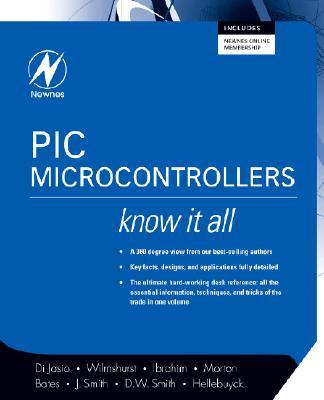
Audience: Professional
Format: Paperback
Language: English
Number Of Pages: 928
Published: 30th July 2007
Publisher: Elsevier Science & Technology
Dimensions (cm): 23.5 x 19.1 x 4.7
Weight (kg): 1.56
Table of Contents:
| An Introduction to PIC Microcontrollers | |
| The PIC Microcontroller Family | |
| Introducing the PIC 16 Series and the 16F84A | |
| Parallel Ports, Power Supply and the Clock Oscillator | |
| Programming PIC Microcontrollers using Assembly Language | |
| Starting to ProgramAn Introduction to Assembler | |
| Building Assembler Programs | |
| Further Programming Techniques | |
| Prototype Hardware | |
| More PIC Applications and Devices | |
| The PIC 1250x Series (8-pin PIC microcontrollers) | |
| Intermediate Operations using the PIC 12F675 | |
| Using Inputs | |
| Keypad Scanning | |
| Program Examples | |
| Programming PIC Microcontrollers using PicBasic | |
| PicBasic and PicBasic Pro Programming | |
| Simple PIC Projects | |
| Moving On with the 16F876 | |
| Communication | |
| Programming PIC Microcontrollers using MBasic | |
| MBasic Compiler and Development Boards | |
| The BasicsOutput | |
| The BasicsDigital Input | |
| Introductory Stepper Motors | |
| Digital Temperature Sensors and Real-Time Clocks | |
| Infrared Remote Controls | |
| Programming PIC Microcontrollers using C | |
| Getting Started | |
| Programming Loops | |
| More Loops | |
| Numbers | |
| Interrupts | |
| Taking a Look under the Hood | |
| Appendices | |
| PIC 16 Series Instruction Set | |
| The Electronic Ping-Pong | |
| DIZI-2 Board and Lock Application | |
| Program M | |
| Program N | |
| Program O | |
| Program P | |
| Program Q | |
| Useful PIC Data | |
| PIC 16F84A Datasheet | |
| Table of Contents provided by Publisher. All Rights Reserved. |
Link to Purchase E-Book:
PIC Microcontrollers By Lucio Di Jasio E-Book
- What PIC series does the book introduce?
The book introduces the PIC microcontroller family and the PIC 16 series including the 16F84A. - Can I learn assembly programming for PICs from this book?
Yes, the book includes sections on starting to program with assembler, building assembler programs, and further programming techniques. - Does the book cover PicBasic and PicBasic Pro?
Yes, there is a section on PicBasic and PicBasic Pro programming and related projects. - Are there projects for MBasic users?
Yes, the book covers MBasic compiler, development boards, outputs, digital input, stepper motors, sensors, real-time clocks, and infrared remote controls. - Does the book teach PIC programming in C?
Yes, sections include getting started with C, programming loops, numbers, interrupts, and deeper insights under the hood. - Are real hardware examples included?
Yes, the book contains prototype hardware, projects, and appendices like the DIZI-2 board and lock application. - Is there reference material and datasheets in the book?
Yes, appendices include the PIC 16 series instruction set, useful PIC data, and the PIC 16F84A datasheet. - Does the book address inputs and keypad scanning?
Yes, chapters cover using inputs and keypad scanning with PIC microcontrollers.
Related projects
PIC Microcontroller Project Book By John Iovine E-Book
Book Introduction: The PIC microcontroller is enormously popular both in the U.S. and abroad. The first edition of this book was a...
PDFs & E-booksAdvanced PIC Microcontroller Projects in C By Dogan Ibrahim E-Book
Book Introduction: This book is ideal for the engineer, technician, hobbyist and student who have knowledge of the basic principles of PIC...
PDFs & E-booksProgramming and Customizing the PIC Microcontroller By Myke Predko E-Book
Book Introduction: Tap into the latest advancements in PIC technology with the fully revamped Third Edition of McGraw-Hill's "Programming and Customizing the...
PDFs & E-booksMaking PIC Microcontroller Instruments and Controllers By Harprit Singh Sandhu E-Book
Book Introduction: Essential Design Techniques From the Workbench of a Pro Harness the power of the PIC microcontroller unit with practical, common-sense...
PDFs & E-booksThe PIC Microcontroller Your Personal Introductory Course By John Morton E-Book
Book Introduction: John Morton offers a uniquely concise and practical guide to getting up and running with the PIC Microcontroller. The PIC...
PDFs & E-booksPIC Microcontrollers: 50 Projects for Beginners & Experts By Bert Van Dam E-Book
Book Introduction: This hands-on book covers a series of exciting and fun projects with PIC microcontrollers. For example a silent alarm, a...

Ibrar Ayyub
I am an experienced technical writer holding a Master's degree in computer science from BZU Multan, Pakistan University. With a background spanning various industries, particularly in home automation and engineering, I have honed my skills in crafting clear and concise content. Proficient in leveraging infographics and diagrams, I strive to simplify complex concepts for readers. My strength lies in thorough...