
Summary of dsPIC33 Recorder using dsPIC33FJ12GP201 with Proteus Simulation
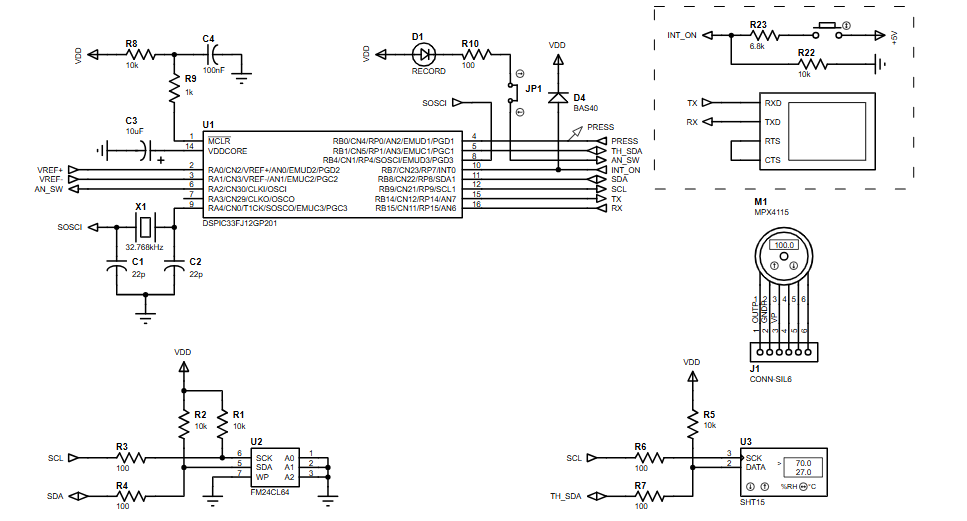
The dsPIC33 Recorder is a low-power data-logging project using a dsPIC33FJ12GP201 to periodically read temperature, humidity, and analog pressure, store records in I²C ferroelectric EEPROM, and return to ultra-low-power sleep. It uses timer and external interrupts, ADC averaging for pressure, UART command interface, and is fully simulated in Proteus VSM for educational and portable environmental monitoring applications.
Parts used in the dsPIC33 Recorder:
- dsPIC33FJ12GP201 microcontroller
- Digital temperature and humidity sensor (SHT series)
- Analog pressure sensor
- I²C Ferroelectric EEPROM
- 32.768 kHz crystal oscillator
- UART serial interface (for terminal)
- Resistors
- Capacitors
- Power conditioning components
- Proteus VSM simulation environment (for testing)
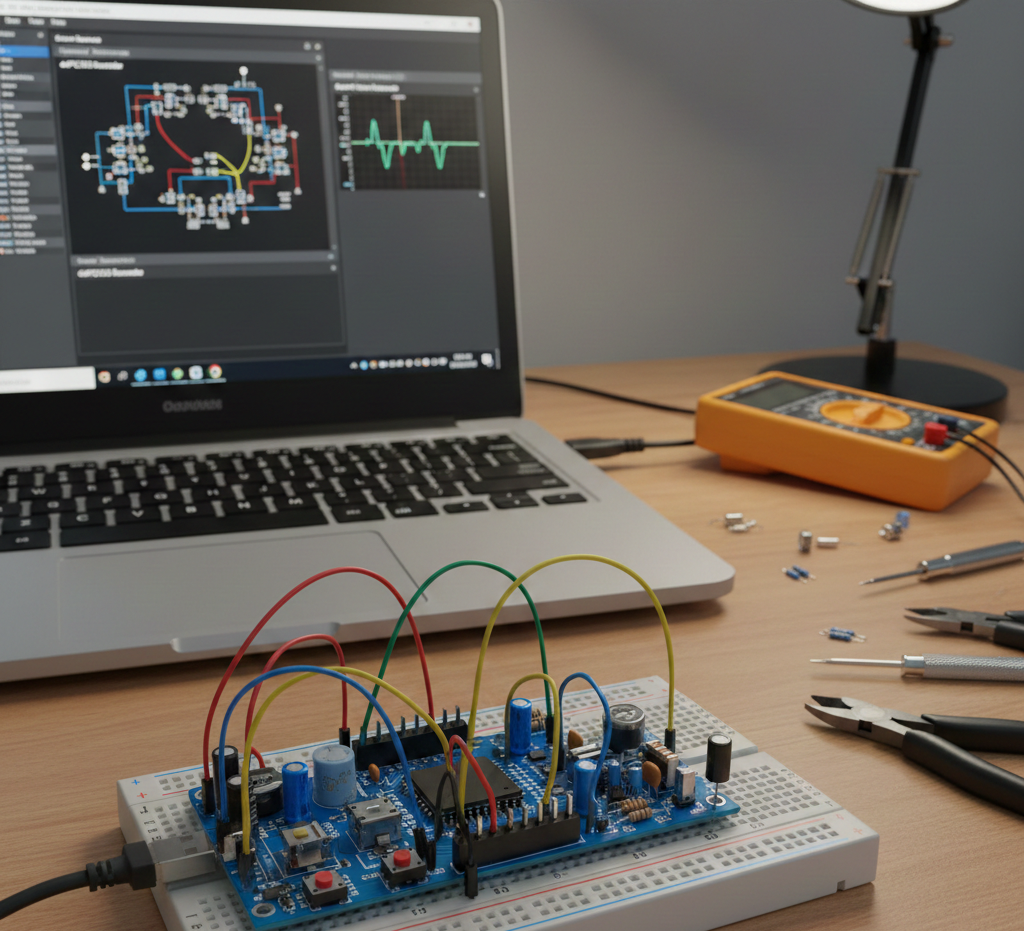
- Why does the Proteus simulation pause periodically?
Because the dsPIC enters sleep mode between timer interrupts. - Can I change the sampling interval?
Yes, modify the time-base value stored in the EEPROM header. - Why is I²C turned off during sensor reading?
To avoid bus conflicts since sensors and EEPROM share clock lines. - Can this run on other dsPIC33 devices?
Yes, with minor pin-mapping and configuration changes. - Why is data averaged for pressure readings?
Averaging improves ADC stability and noise reduction. - Can I log more sensors?
Yes, if memory space and I/O pins are available. - Why use ferroelectric EEPROM?
It offers fast writes and very low power consumption. - How does the system wake up to take measurements?
Timer1 driven by a low-power oscillator wakes the dsPIC at the programmed interval. - How can a user interrupt recording?
An external INT0 interrupt from a serial terminal can pause logging and process commands.
