


Summary of Mood vase using PIC12F683 microcontroller
This article details a DIY "Mood Vase" project using a PIC12F683 microcontroller to create unique ambient lighting with pulse effects. The system includes light detection to activate only in darkness and low-battery protection for lithium-ion or AA/AAA power sources. It is designed for electronics enthusiasts familiar with microcontrollers and circuits, offering source code and schematic guidance for building the device.Parts used in the Mood Vase:
- PIC12F683 microcontroller
- 1x 18650 lithium-ion cell or 3x AA/AAA batteries
- 220uF electrolytic capacitor
- 10k resistor and zener diode (or 1N4001)
- 3x 150R resistors
- 3x NPN transistors
- 3x high-intensity LEDs
- 3x 20R resistors
- 40k resistor
- Phototransistor
DIY Mood Vase Using LEDs and PIC Microcontroller
A DIY Mood Vase is a simple LED lighting project that turns an ordinary vase into a decorative ambient light. The design uses three high-intensity LEDs controlled by a PIC12F683 microcontroller to produce changing colors and smooth pulsing light effects.
The electronic unit sits behind the vase, allowing the light to pass through the glass and create a soft glow. A suitable translucent vase can improve the effect, especially when water is added.
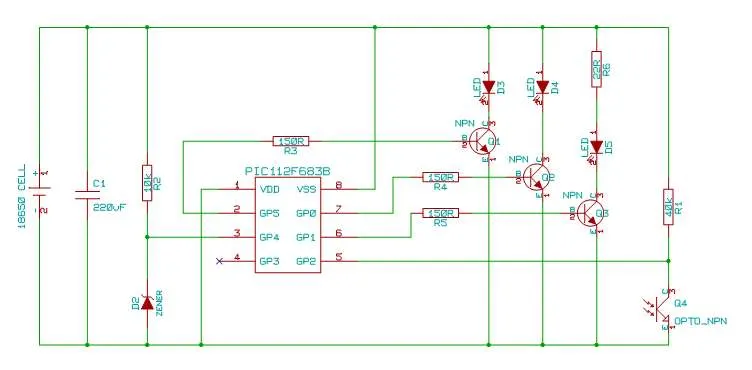
How the DIY Mood Vase Works
The circuit is mainly divided into five sections:
- PIC12F683 microcontroller for controlling the LEDs
- Battery power supply
- Light detection circuit
- Low-battery voltage detection
- Three high-intensity LEDs
The project can run from a single 18650 lithium-ion battery or three AA/AAA batteries, provided the supply voltage remains suitable for the microcontroller.
Automatic Light Detection
A phototransistor can be added so the DIY Mood Vase automatically switches on when the surrounding area becomes dark.
The light sensor changes the voltage received by the microcontroller depending on the amount of ambient light. The controller can then decide when to activate the LEDs.
Low-battery detection can also be included, which is particularly useful when rechargeable lithium-ion cells are used.
LED Control
The three LEDs are connected through NPN transistors so the microcontroller does not need to supply the full LED current directly.
Current-limiting resistors should be selected according to the LED specifications and supply voltage. This helps protect the LEDs from excessive current.
Building the Circuit
The circuit can be assembled on a small prototype board and installed inside a battery holder or another compact enclosure.
Mount the LEDs so they face the vase, connect the battery and sensor circuit, and program the PIC12F683 with the required C code.
The original project code was written for the HI-TECH C compiler, although the basic control logic may be adapted for other compatible microcontrollers and development environments.
Creating the Mood Lighting Effect
Once assembled, the LEDs gradually fade in and out to create smooth pulses of colored light.
The timing, number of pulses, automatic shut-off period, and light-detection behaviour can be adjusted in the program. This makes the DIY Mood Vase a useful project for experimenting with LEDs, sensors, microcontrollers, and decorative lighting.
For more detail: Mood vase using PIC12F683 microcontroller
- What is the main function of the phototransistor?
The phototransistor allows the circuit to turn on only when it detects darkness. - Can I use AA batteries instead of a lithium-ion cell?
Yes, the circuit works perfectly well using 3 AA or AAA batteries. - How does the voltage reference help the project?
It enables low-battery detection by comparing the battery voltage to prevent over-discharging. - Does the PIC12F683 require a voltage regulator?
No, this microcontroller can run off any voltage supply from 2V up to 5.5V without a regulator. - What components are needed for the light detection feature?
You need a phototransistor and a resistor, such as a 40k resistor paired with a photodiode and transistor combo. - Is the low-battery detection necessary for alkaline batteries?
No, for Alkaline AA or AAA cells, the voltage reference for low-battery detection is not important. - How long will the circuit run on a single charge?
Depending on the battery type, the circuit typically runs for a week up to a month. - Can the source code be used with other microcontrollers?
Yes, the code is provided for the PIC12F683 but can likely be ported to Atmel or other microcontrollers.
Related projects
Automotive Voltage Monitor using PIC12F683
Description Recently I got a new motorbike and on my second trip out, with only 50 miles on the clock the rectifier/regulator...
Communication & Interfacing · PIC12F683EnvStick USB Temperature Sensor using PIC12F683
The EnvStick is cheap, homemade temperature sensor that plugs into a USB port. It provides a simple way to collect a room’s...
Sensors & Temperature · PIC12F683Metal detector robot using pic microcontroller
This project describes hardware and software I have developed which allows a small 8 bit PIC microprocessor to function as a single...
Home Automation & SecurityVoice Activated Power Sockets (Home Automation)
Yet another voice controlled home automation system! As shown in the picture, the system can control any electrical appliance, by turning ON...
Home Automation & SecurityHome Security System with GSM Using 8051 Microcontroller
Security is a big challenge everywhere because thefts are increasing day by day owing to the unsafe and insecure security systems in...
Home Automation & SecurityHome Automation and Security System using Microcontroller ATMEGA8 with Arduino Programming
Home automation and security systems have become very popular these days, today industrial automation techniques are widely adopted by luxurious homes and...

Ibrar Ayyub
I am an experienced technical writer holding a Master's degree in computer science from BZU Multan, Pakistan University. With a background spanning various industries, particularly in home automation and engineering, I have honed my skills in crafting clear and concise content. Proficient in leveraging infographics and diagrams, I strive to simplify complex concepts for readers. My strength lies in thorough...