


Summary of 48 Channel Mono / 16 Channel RGB LED Controller using PIC18F2550 microcontroller
The Chromation Systems 48 Channel Mono/16 Channel RGB LED Controller independently manages up to 48 mono-color or 16 RGB LED groups using a PIC 18F2550 microcontroller running at 48MHz. It employs three TLC5940 drivers via a modified SPI interface with 8-bit PWM and a 1.5kHz frequency. The device supports direct soldering, screw terminals, or headers for connections and is primarily controlled by ColorMotion software, though sample code for basic control is available.Parts used in the 48 Channel Mono / 16 Channel RGB LED Controller:
- PIC 18F2550 microcontroller
- TLC5940 LED driver (x3)
- USB connectivity module
- Screw down terminal blocks
- Headers/housings
- Direct soldering points
48 Channel Mono / 16 Channel RGB LED Controller
The 48 Channel Mono 16 Channel RGB LED Controller is a microcontroller-based LED control board designed for projects that require independent control of multiple LEDs. It can control up to 48 channels of single-color LEDs or 16 common-anode RGB LEDs, making it suitable for lighting effects, infinity mirrors, arcade projects, computer case lighting, and other custom LED installations.
The controller uses a PIC18F2550 microcontroller together with three TLC5940 LED driver ICs. The PIC operates at 48 MHz and provides USB connectivity, while the LED drivers handle multiple output channels. The default firmware provides 8-bit PWM with 256 brightness levels and operates at approximately a 1.5 kHz PWM frequency.
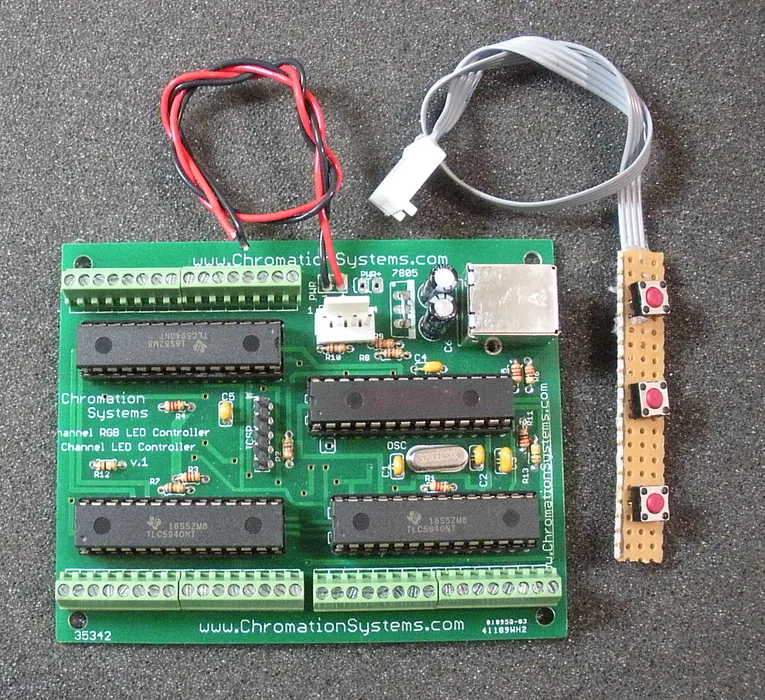
Main Features
Key features of the controller include:
- 48 independently controlled mono LED channels
- Support for 16 common-anode RGB LEDs
- Up to 120 mA per output channel
- PIC18F2550 microcontroller
- Three TLC5940 LED drivers
- USB connectivity through an emulated serial COM port
- 256 brightness levels using 8-bit PWM
- Approximately 1.5 kHz PWM frequency
- Direct solder, screw-terminal, or header LED connections
- Standalone pattern playback
- Live LED control from a computer
The controller works by sinking current, which means the LED anodes are connected to the positive supply while the cathodes connect to the controller outputs.
Parts Required
The main electronic components include a PIC18F2550, three TLC5940 ICs, resistors, capacitors, a 20 MHz oscillator, USB connector, push buttons, sockets, PCB, and suitable LED connectors.
A 7805 voltage regulator can also be installed when the controller is powered from a voltage above 5V. The logic circuit requires 5V, while the LED supply can use a different voltage depending on the LED configuration.
Connecting the LEDs
Single-color LEDs and common-anode RGB LEDs can both be used with the controller.
For RGB LEDs, the common anodes are connected together to the positive LED supply. The red, green, and blue cathodes are then connected to separate controller outputs.
LEDs can be attached using:
- Screw-down terminal blocks
- Pin headers and housings
- Direct solder connections
Using connectors can make installation and future maintenance easier, while direct soldering may be useful for permanent installations.
Firmware and USB Control
The controller supports different firmware depending on the type of LED setup.
ColorMotion firmware is designed for RGB LED control, while MonoMotion firmware is intended for single-color LED projects. These applications can be used to create lighting patterns and upload them to the controller so that effects can run without a continuous computer connection.
The firmware can also accept live commands through USB using an emulated serial COM port. This allows compatible software or programming languages that support serial communication to send LED data directly to the controller.
Programming and Bootloader
An optional ICSP header can be installed for connecting a PIC programmer. The project also includes a HID bootloader that can be used to upload compatible firmware without removing the microcontroller from the board.
Holding the appropriate controller button during startup places the board into bootloader mode, allowing new firmware to be loaded.
Applications
The 48 Channel Mono 16 Channel RGB LED Controller can be used in projects such as:
- Infinity mirrors
- Arcade button lighting
- Computer case modifications
- Decorative RGB lighting
- Interactive lighting projects
- Custom USB-controlled LED displays
- Projects requiring multiple independently controlled LED channels
Its combination of multiple outputs, PWM brightness control, USB communication, and standalone firmware makes it a flexible option for DIY LED and microcontroller projects.
For more detail: 48 Channel Mono / 16 Channel RGB LED Controller using PIC18F2550 microcontroller
Quick Solutions to Questions related to 48 Channel Mono / 16 Channel RGB LED Controller:
- How many channels can this controller manage?
It can control 48 groups of mono-color LEDs or 16 groups of common anode RGB LEDs. - What microcontroller is used in the project?
The device utilizes a PIC 18F2550 microcontroller that runs at 48mhz. - Does the controller support USB connectivity?
Yes, the PIC microcontroller includes USB connectivity for communication. - What is the PWM frequency of the default firmware?
The default firmware operates with a 1.5khz PWM frequency. - Can I use different connection methods for the LEDs?
Yes, there are three options: direct soldering, screw down terminal blocks, and headers/housings. - Which software is compatible with the primary firmware?
The primary firmware is compatible with the Chromation Systems ColorMotion Software. - Is the source code for the ColorMotion Compatible Firmware available?
No, the source code for the ColorMotion Compatible Firmware is not available. - How much current can each group handle?
Each group or channel can handle up to 120ma.
Related projects
Pinguino Project: A PIC Microcontroller Based Arduino
This is a complete tutorial to make a PIC Microcontroller based Arduino. This is a complete tutorial to make PIC microcontroller based...
Audio, Sound & Radio · PIC18F2550LM386 based stereo audio amplifier with digital volume control using PIC18F2550
Due to its simplicity (requires minimum external components) and high availability, LM386 is very popular among hobbyists for use in low-voltage audio...
Meters & Test Instruments · PIC18F2550Harmonic Distortion Meter using PIC18F2550
The 3rd harmonic distortion meter has been designed for measuring the quality of AC supply. The meter is built with a PIC18F2550...
Communication & Interfacing · PIC18F4520CAN FD Node based on a PIC18 Microcontroller
The introduction sets the stage for an embedded systems project that involves developing a Embedded C CAN FD project using the MCP2517FD...
Communication & InterfacingLAN9662 Gigabit Switch: Optimized for Industrial Ethernet
Introduction It should come as little surprise therefore that one element of what is now more commonly referred to in some circles...
Communication & InterfacingPIC Microcontroller: Fundamentals & Applications for Students
Introduction Microcontrollers are the key components in the embedded systems market. A variety of embedded systems was formed and developed after the...

Ibrar Ayyub
I am an experienced technical writer holding a Master's degree in computer science from BZU Multan, Pakistan University. With a background spanning various industries, particularly in home automation and engineering, I have honed my skills in crafting clear and concise content. Proficient in leveraging infographics and diagrams, I strive to simplify complex concepts for readers. My strength lies in thorough...