


Tuck professor Constance Helfat proposes a new theory of firm integration based on the costs of technological innovation
When Jack Kilby invented the integrated circuit—now known as a microchip—at Texas Instruments in the late 1950s, he unwittingly launched a multi-trillion-dollar industry that facilitated the information age.
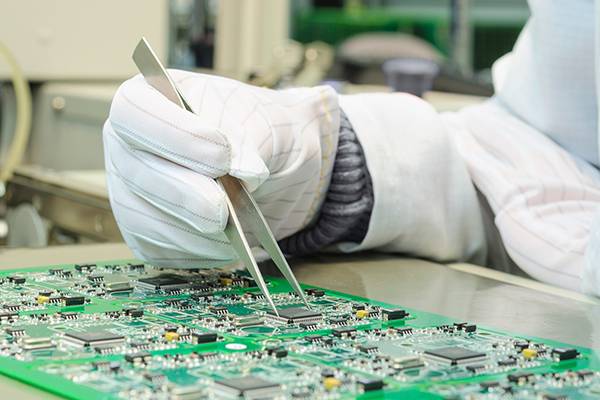
Because of the nature of the invention, Gordon Moore, another inventor of the microchip, was able to predict that the chips would evolve at regular intervals into the future. Moore’s Law is still valid today, and it drives firms like Intel to design and manufacture chips in-house, where they can closely align the two processes.
For Tuck professor Constance Helfat, an expert in technology and strategy, there couldn’t be a better poster child for vertical integration—when one firm controls each step of production—than the microchip industry. The innovation cycle is predictable, so it makes sense to keep product designers on staff. And new chips can’t be manufactured without custom machinery built to the exact specifications of the new designs, necessitating constant communication between many divisions of a firm.
The question Helfat considers in a new theoretical paper is why specialized microchip firms coexist with vertically integrated companies. Logically, specialized firms have lower costs because they don’t need to communicate across departments. Academics have long argued that leaner specialized firms will eventually push out the big, vertically integrated brands. But that hasn’t happened.
Helfat proposes a new theory in “Integrative Capabilities, Vertical Integration, and Innovation,” which was published recently in the journal Organization Science. In it, she asserts that a firm’s decision to integrate or specialize is based mostly on the costs and benefits of the particular style of organization.
As Helfat explains, when a new technology is introduced and becomes successful it also usually becomes standardized, which means smaller firms can enter the market that just focus on manufacturing. Competition from these lower-cost firms can drive the originators of the technology out of business, or force them to shrink and focus solely on one piece of the supply chain, such as design.
But vertically integrated firms have another choice: to stay integrated, in the hope that they can introduce a new technology that only they can produce. In this case, integrated firms may have to endure a period of high costs and low profit margins until they can reap the benefits of the new technology. The advantage of this is the firm can retain its integrative capabilities of communication and coordination, rather than bearing the cost and delay of firing and hiring staff.
This means firms have a distinct forecast to make. “If a firm is going to have a long period of time where the technology is very standardized, then it might not be willing to bear those short term costs of hiring and firing,” Helfat says. “But if the firm’s managers think there’s going to be a new technology that needs to be coordinated with manufacturing, then they might be willing to bear those costs during the time when the technology is standardized.”
The lesson for managers is to think about the type of technological change that’s likely to occur. Is this a stable industry with no big changes on the horizon? If so, dis-integrating might make sense. But if the technology is frequently changing, like with microchips, firms would be wise to retain all the divisions that will allow them to design, manufacture, and market a new product.
Executive Summary
Vertical integration makes the most sense in industries where technology is rapidly changing. In this context, firms are wise to retain their integrative capabilities, such as coordination and communication, even if the costs of those capabilities lead to low profit margins during short periods of technological stability.
Source: What Managers Can Learn From the Microchip Industry
Related projects
Voltage Measurement with A PIC Microcontroller
Voltage Measurement with PIC Microcontroller articulates a methodical framework for facilitating analog voltage measurement using the PIC18F4520, an advanced member of Microchip’s...
Development Boards & KitsUltra-Low Power: Microcontroller Standby Current to 130uA with OPEnS Power Control Board
At the OPEnS Lab, a key focus for our projects is achieving exceptionally long battery life. This was particularly true for the...
Development Boards & KitsAn Integrated Approach to Developing Applications with Microchip PIC Microcontrollers
1. Introduction In our daily lives, a variety of devices such as telephones, household appliances, and cars incorporate "smart" electronics, typically manifested...
Development Boards & KitsMicrocontroller-Driven AC Voltage Control with Soft Start Feature
1. INTRODUCTION PWM-based AC voltage controllers find extensive application in uninterruptible power supplies (UPS) and high-power flexible AC transmission systems. This variable...
Development Boards & KitsPIC Microcontroller-Based IC Tester for Efficient Integrated Circuit Verification
1. INTRODUCTION Within the electronics industry[1], as circuit complexity undergoes a drastic increase and the demand for higher reliability rises, a significant...
Development Boards & Kits · PIC16F887Hands-On Microcontroller Projects: BK300 Development Board Featuring PIC16F887 Chip Lab
1. INTRODUCTION The study of microcontroller systems is experiencing a global surge across various fields within science, engineering, and technology departments of...

Muhammad Bilal
I am a highly skilled and motivated individual with a Master's degree in Computer Science. I have extensive experience in technical writing and a deep understanding of SEO practices.