


Summary of Propeller Clock Mechanically Scanned LED Clock using PIC16C84
This article details a DIY propeller clock that uses a spinning motor and seven LEDs to create a 7x30 LED array illusion via precise timing. It requires mechanical skills, prior electronics experience, and a salvaged motor from a VCR or floppy drive. The project includes downloadable schematics, source code for PIC16C84/16F84 microprocessors, and PCB layouts, all under the GNU General Public License.Parts used in Propeller Clock Mechanically Scanned LED Clock:
- Motor from a dead VCR, floppy drive, or disk drive
- PIC16C84 or 16F84 microprocessor
- Seven LEDs
- Programmer for PIC16C84 or 16F84
- Printed Circuit Board (PCB)
How this clock works:
A motor spins the "propeller", and a small microprocessor keeps track of time and changes the pattern on seven LEDs with exact timing to simulate a 7 by 30 array of LEDs. It is an illusion, but it works nicely.
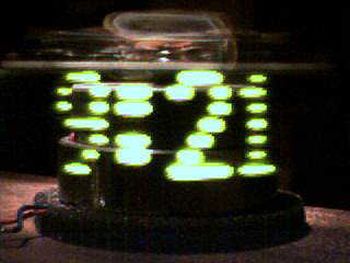
If you want to build this clock, you will need a few things, including:
Skill with motors and mechanical things.
Prior electronic experience.
A dead VCR or floppy drive or other source of a suitable motor and miscellaneous parts.
A programmer that will program a PIC16C84 or 16F84 microprocessor.
I have provided (almost)everything else:
The Next Page with drawings and plans.
Download:
mclock.txt A full description how to build it.
mclkpart.txt The parts list.
mclock8.asm The source code in Microchip MPASM format.
mclock8.hex The hex code ready to load into a PIC16C84 or 16F84 chip.
mclksch2.gif A large and very readable schematic diagram.
mclkmoto.gif A drawing of the modifications to the motor.
If you can't get that kind of motor, you can use the motor from an old disk drive. This page has a lot of pictures and will take some time to load. If you use a disk drive motor or any other DC motor with brushes 180 degrees apart, you'll need the slightly revised code:
Download:
mclockt3.asm The source code.
mclockt3.hex The hex code ready to put in a chip.
If you don't have any way to put the program into a PIC 16C84 or 16F84 chip, you can build your own programmer.
Printed Circuit Board Layout for a version of the clock.
License:
The hardware design and software are covered under the GNU General Public License.
For more detail: Propeller Clock Mechanically Scanned LED Clock using PIC16C84
Quick Solutions to Questions related to Propeller Clock Mechanically Scanned LED Clock:
- How does this clock work?
A motor spins a propeller while a microprocessor changes the pattern on seven LEDs with exact timing to simulate a 7 by 30 array of LEDs. - What skills are needed to build this clock?
You need skill with motors and mechanical things as well as prior electronic experience. - Where can I get a suitable motor for the project?
You can use a motor from a dead VCR, floppy drive, or other similar source. - Can I use a disk drive motor instead of a VCR motor?
Yes, you can use a motor from an old disk drive or any DC motor with brushes 180 degrees apart. - Which microprocessor is required for this project?
The project uses a PIC16C84 or 16F84 microprocessor. - Is there a programmer available for the microprocessor?
You will need a programmer that can program a PIC16C84 or 16F84, or you can build your own if you do not have one. - What files are provided for building the clock?
Downloads include mclock.txt, mclkpart.txt, mclock8.asm, mclock8.hex, mclksch2.gif, and mclkmoto.gif. - Under what license are the hardware design and software covered?
The hardware design and software are covered under the GNU General Public License.
Related projects
Exploring the World of PIC Microcontrollers: An Architectural Overview
A Peripheral Interface Microcontroller (PIC), developed by General Instruments Microcontrollers in 1993, operates under software control and is programmed to execute various...
LCD & Display Projects · PIC16C842-Wire LCD Interface using PIC16C84
Alphanumeric LCD displays have become very popular for microcontroller applications because they can add a lot to a project in a variety...
LCD & Display Projects · PIC16C84Using an LCD’s for Graphics Animation using PIC16C84
This project uses Myke's 2-Wire LCD Interface from last week and will help teach you "Graphics Animation" using LCD's. Last week, I...
Clocks & TimersAdaptive Alarm Clock: Build a Smart, User-Centric wake-Up system
Project Overview The goal of this ambitious undergraduate project was to develop a novel alarm clock capable of analyzing a person's unique...
Clocks & TimersDesigning Your Ideal Alarm Clock: An Introduction to PIC18
Within this laboratory session, you'll employ the C language to create an alarm clock, delving into the implementation of "C" programs on...
Clocks & TimersBuilding your Dream Alarm Clock Using the PIC18
Objective: In this laboratory session, your objective is to create an alarm clock using the C programming language. You will gain proficiency...

Ibrar Ayyub
I am an experienced technical writer holding a Master's degree in computer science from BZU Multan, Pakistan University. With a background spanning various industries, particularly in home automation and engineering, I have honed my skills in crafting clear and concise content. Proficient in leveraging infographics and diagrams, I strive to simplify complex concepts for readers. My strength lies in thorough...