


Introduction
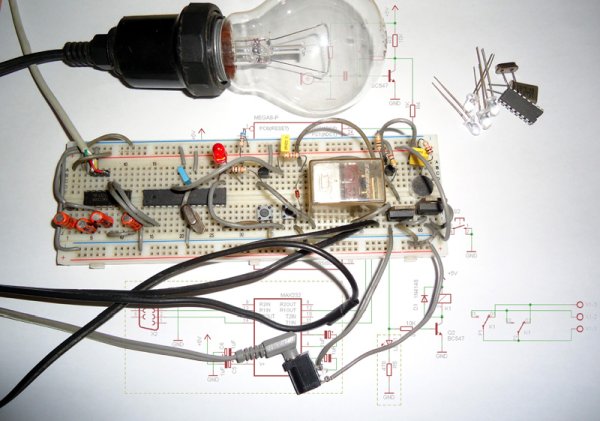
I always thought the clapper so cool. For those who are lazy like me, turn on or off the bedroom light without getting out of bed, simple clap your hands is amazing. Thinking about it I projected one for me. Several projects of clappers can be found on the Internet, and most of them do not use microcontroller.
I chose to use a micro planning future updates, such as turn on or off the light with 2 claps, the TV with 3 claps, DVD player with 4 and so on. Another update can be a time to turn off the device automatically.
Hardware
The hardware is very simple, just a microcontroller, a electret mic, a relay and some discrete components. The microcontroller is the brain of the project, I used a atmega8 because it was the only I had available.
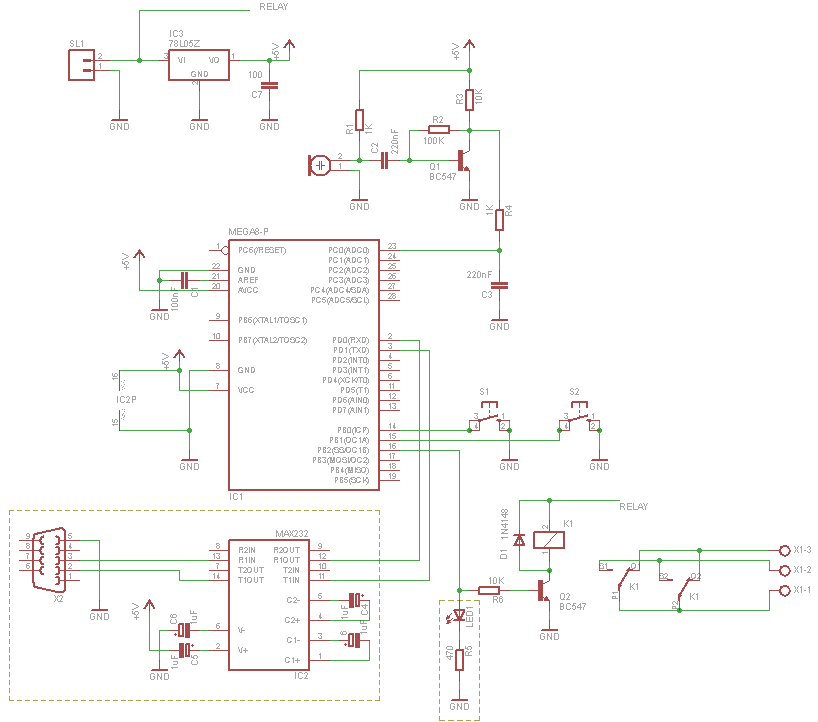
The signal is captured by the mic and amplified by the transistor (BC548), this signal run through a lowpass filter that remove the high frequencies and go to mega8 ADC. To keep the circuit simple, only one transistor is used on signal amplification. Two buttons are used to up or down the sensibility of the signal. You can see the complete schematic below. The components on dotted line are optional.
The circuit can be powered with 7 ~ 12V and the relay must be for that voltage.
Software
The software was written in C using AVR Studio and WinAVR library. The ADC is read constantly, and the returned value is compared with a variable. This variable can be changed if the user press the button S1 or S2.
So, the user can increase or decrease the intensity of the signal necessary to trigger the circuit. If the value of the ADC is less than the variable, nothing happens, otherwise the timer0 is activated and begins counting. At each timer overflow, a variable called timer is incremented.
The value of variable timer is compared with three constants, burst_time, ready_time and time_out. If the value of the variable is equal to the constant burst_time the value of global variable burst become 1. If the value of timer is equal the constant ready_time the value of variable burstbecomes 0 and variable ready becomes 1. If value of timer is equal time_out all the variables become equal to 0.
For more detail: Microcontroller Clapper Switch
Related projects
Calculator Test using PIC24FJ64GA006 with Proteus Simulation
Introduction The Calculator Test using EASYHDL is a practical microcontroller project built on the PIC24FJ64GA006 and simulated in Proteus. This project demonstrates...
Programmers & ICSPPID Controlled Oven using TMS320F28027PT with Proteus Simulation
IntroductionThis project demonstrates a PID controlled oven implemented using a PICCOLO TMS320F28027PT microcontroller and verified through Proteus simulation.It is a practical microcontroller...
Programmers & ICSPPICCOLO Motor Controller Sample Design using TMS320F28023PT with Proteus Simulation
IntroductionThis project demonstrates a PICCOLO motor controller sample design implemented using the TMS320F28023PT Piccolo microcontroller and tested through Proteus simulation. It focuses...
Programmers & ICSP · PIC16F84APIC Musical Doorbell using PIC16F84A with Proteus Simulation
IntroductionThis microcontroller project demonstrates a musical doorbell built around a PIC16F84A and a simple piezo sounder.Using two push buttons, the system allows...
Programmers & ICSP · PIC16F877AEPE PIC/LCD Demo using PIC16F877 with Proteus Simulation
IntroductionThe EPE PIC/LCD Demo is a classic microcontroller project that demonstrates how a PIC16F877 can fully control a PG12864F graphical LCD.Designed as...
Programmers & ICSP · PIC16F628ADHT11 Low Cost Humidity Sensor using PIC16F628A with Proteus Simulation
IntroductionThis microcontroller project demonstrates how to interface a low-cost DHT11 temperature and humidity sensor with a PIC16F628A using a Proteus simulation environment.The...

Ibrar Ayyub
I am an experienced technical writer holding a Master's degree in computer science from BZU Multan, Pakistan University. With a background spanning various industries, particularly in home automation and engineering, I have honed my skills in crafting clear and concise content. Proficient in leveraging infographics and diagrams, I strive to simplify complex concepts for readers. My strength lies in thorough...