
Summary of Speed Synchronization of Multiple Motors In Industries using PIC Microcontroller
This project wirelessly synchronizes multiple BLDC motors using RF communication: one motor acts as transmitter setting target speed, while receivers adjust PWM via closed-loop feedback from shaft-mounted IR RPM sensors. A microcontroller compares RPM to a user-entered percentage (via keypad) shown on a display, and adjusts pulse width to maintain desired speed. Motor driving uses an opto-isolator and MOSFET. This system suits conveyors in textile, steel, and paper industries to eliminate differential speed error and ensure balanced tension.
Parts used in the Speed Synchronization of Multiple Motors In Industries using PIC Microcontroller:
- BLDC motors
- RF transmitter module (for master motor)
- RF receiver modules (for slave motors)
- PIC microcontroller
- Keypad
- Display unit
- Shaft-mounted IR sensor (for RPM feedback)
- Opto-isolator
- MOSFET (motor driver)
- Power supply / DC power source
The aim of this project is synchronization of multiple motors using wireless technology. This project uses radio frequency to synchronize motor speeds. This is applicable to many industries like textile mills, steel plants, and paper plants wherein all the motors used on conveyor are desired to be synchronized.
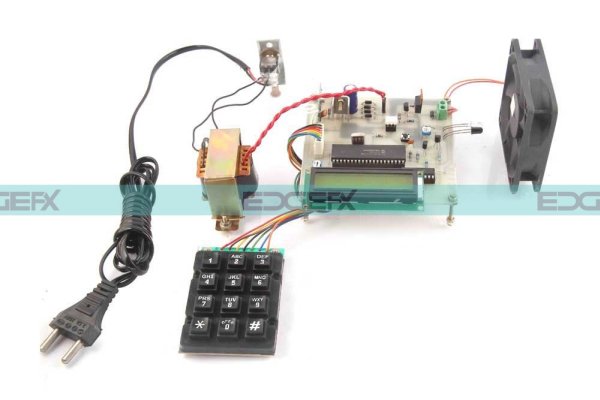 For example, in textile mills where multiple motors work simultaneously on a conveyor belt to draw clothes, it is essential that all the motors there should run at same speed, so that balanced tension is achieved to avoid clothes getting damaged. In this project motors are wirelessly synchronized to make the differential speed error among multiple motors to zero.
One motor acts as transmitter and all the rest as receivers. Thus, if a particular speed is set in the transmitter then all other motors speed would be matched to the same speed of the main motor. The mode of communication is radio frequency. BLDC motors used operate on the basis of PWM control.
Each motor has a closed loop feedback mechanism providing RPM reference by a shaft mounted IR sensor arrangement whose output is fed to the controller in the circuit. A display unit displays the full speed and one can enter the desired percentage with help of a keypad to obtain the required speed for all the motors.
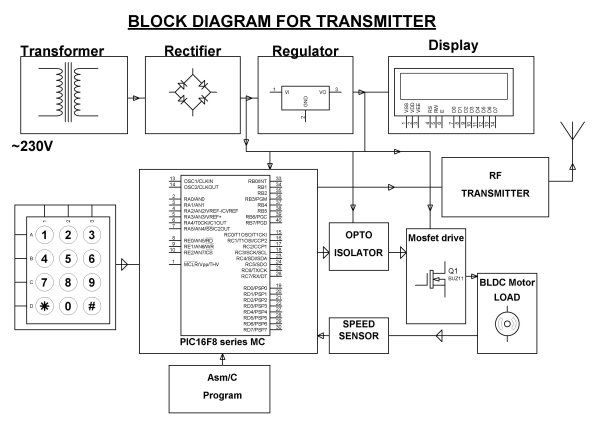 The pulse width output from the microcontroller would be automatically adjusted to maintain the DC power to the motor such that the entered speed percentage matches the running RPM. The above operation is carried out by using one opto isolator and a MOSFET for driving the BLDC motor duly interfaced from the microcontroller.
For more detail: Speed Synchronization of Multiple Motors In Industries using PIC Microcontroller
- How are multiple motors synchronized in this project?
One motor acts as transmitter sending speed over RF; receivers adjust their PWM via closed-loop feedback to match the transmitter RPM. - Can the desired speed be set by the user?
Yes, the user enters the desired percentage via a keypad and the display shows the full speed and selection. - What feedback method is used to measure motor RPM?
A shaft-mounted IR sensor provides RPM feedback to the controller. - How is PWM adjusted to maintain target speed?
The microcontroller automatically adjusts pulse width output to maintain DC power so the entered speed percentage matches running RPM. - What communication mode is used between motors?
Radio frequency (RF) communication is used to transmit speed from the master to slave motors. - Does the motor driver use isolation?
Yes, an opto-isolator is used along with a MOSFET for driving the BLDC motor from the microcontroller. - What types of industries is this applicable to?
Textile mills, steel plants, and paper plants with conveyors where motors must run at the same speed. - What role does the master motor play?
The master motor transmits the set speed so all other motors match its speed.