


Summary of FM RDS Tuner Module for mobile applications using PIC18F46k20
This article describes a portable Stereo FM band receiver with RDS decoding for mobile use. Powered by two AA batteries or a 2.4V–3.0V supply, it features a PIC18F46K20 microcontroller and Si4731/4735 tuner chip. The system supports full RDS data output via RS232, including Radio Text and TMC. It includes an optional 96x64 RGB OLED display and is controlled via a 5-way micro joystick. The module functions as a standalone unit or with serial interface control, offering analog stereo output and customizable frequency zones for USA, Europe, and Japan.Parts used in the Stereo FM Band Receiver with RDS Decoding:
- PIC18F46K20 Microcontroller
- Si4731/4735 Tuner Chip
- OLED Module 1 (96x64 pixels RGB)
- TPS61080 Voltage Regulator
- MCP1640 DC-DC Step-Up Converter
- 5-Way Micro Joystick
- Two AA (HR6) Ni-Mh Batteries
- RS232 Serial Interface
- Analog Line Stereo Output
- Antenna Wire (30cm to 2m)
- Stereo FM band receiver with RDS decoding for mobile applications.
- Continuous full RDS data output through RS232: RDS PS, PI, TA/TP/TMC, CT, TMC.
- Full Radio Text supported: 2x64 characters.
- Raw TMC data output.
- Low power operation with two AA (HR6) 1V2 Ni-Mh batteries or power supply.
- Power input range is +2.4V ... +3.0V, 50..60mA without OLED and 80..90mA with OLED.
- Runs on a PIC18F46K20 at 16 MhZ.
- Full user control (volume, tune, save preset) with a 5-way micro joystick.
- Module works as stand-alone without OLED as well.
- Optional OLED Module 1 with RGB OLED 96x64 pixels shows PS (station name), frequency, TA/TP/TMC, PI, mono/stereo, RT (2 alternating lines of radio text)
- Serial interface control so the module may be used as a stand-alone module.
- Analog line stereo output.
- Antenna connection, suggest use of a 30cm -> 2m wire.
- Assembled and fully tested KIT1 now available.
- Project source code can be purchased separately.
Circuit explanation / Getting started:
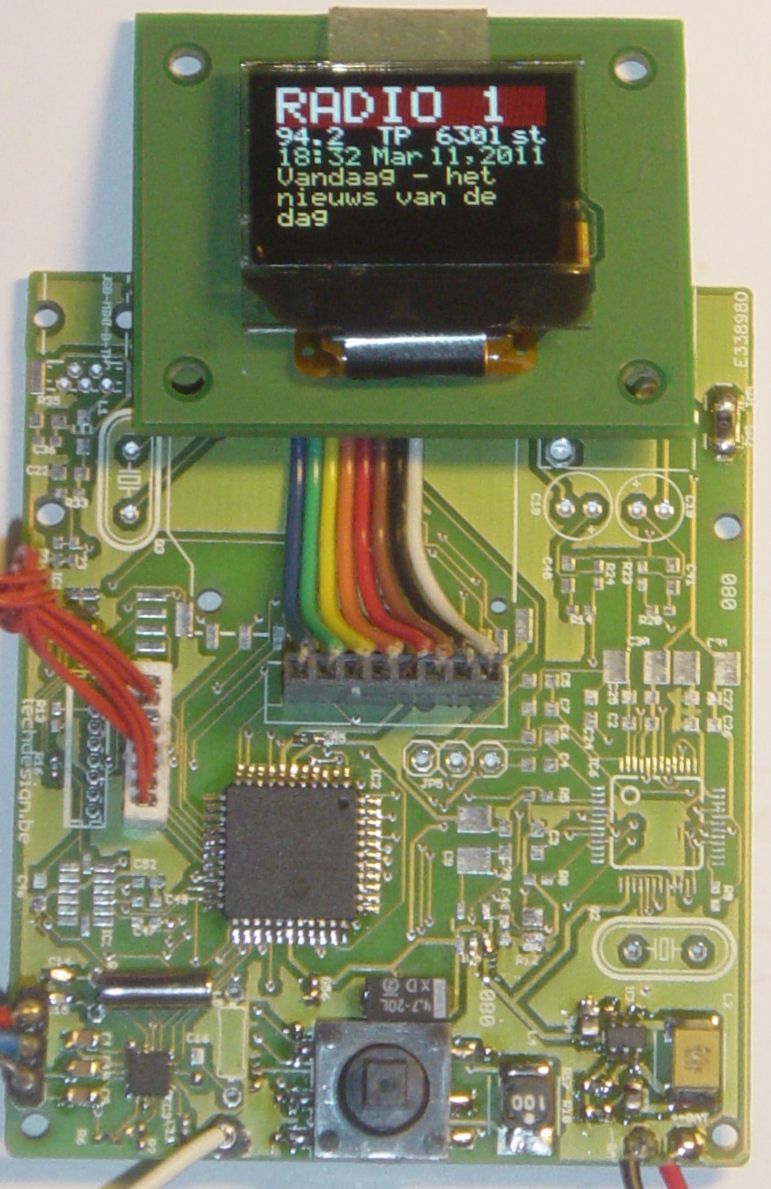
| PIC18F46k20 | The 18F46k20 offers high speed and low power operation. Well suited for a portable application such as this one. | |
| Si4731/4735 | Small tuner chip, includes a RDS demodulator. | |
| OLED | OLED Module 1 with 96x64 pixels RGB OLED, Size: 0.95"Needs a +14V Vdd, this is generated by a TPS61080. | |
| Controls | With the micro joystick, there are several user controls available. Two for volume (up & down) , tune (left & right) and save preset (short enter.) Zone can be selected on boot:Zone 1 (USA): FM 87,50 -> 108.0 MhZ (75µS setting) To select this zone: left joystick and release on bootup or restart.
Zone 2 (EURO): FM 87,50 -> 108.0 MhZ (50µS setting): Up joystick. Zone 3 (JAPAN): FM 76,0 -> 108.0 MhZ (50µS setting): Right joystick. Serial interface: tune up and down (tup & tdn) , set frequency (setxxx.x), save preset (sav), get frequency (get), show basic rds info (rds ), reset module (res) Preset and zone are stored and reloaded on reboot. |
|
| Power | The MCP1640 DC-DC step-up converter makes it possible to power the whole circuit from only one AA battery. We have chosen two AA batteries for enhanced stability and endurance. Power input range is +2.4V ... +3.0V Do not exceed this! | |
| PCB: | We used as much SMD-parts as possible. The PCB from our shop is a double sided and 100% connection tested PCB with plated-through-hole connections. All holes are drilled already. PCB size = 66,50 x 54.90 mm |
Schematics: (eagle-files and library can be downloaded below.)
Full resolution image: schematic and pcb (GIF format) Right-click and save as, then open in an image viewer (sch is too large for some browsers.)
Bill of Materials (Parts List)
Important note: The following sections from the schematic are not needed in this particular setup, and are left out on assembly: EE_PROG, USB+SD, MP3, ACCELERATOR.
For more detail: FM RDS Tuner Module for mobile applications using PIC18F46k20
- How does the device handle power consumption?
The device operates on low power using two AA batteries or a power supply within the +2.4V to +3.0V range. - Can the module function without the OLED screen?
Yes, the module works as a stand-alone unit without the OLED display. - What microcontroller runs this project?
The project runs on a PIC18F46K20 operating at 16 MHz. - How can users select different frequency zones?
Users can select zones by pressing specific joystick directions during bootup: left for USA, up for EURO, and right for JAPAN. - Does the receiver support Radio Text?
Yes, it fully supports Radio Text with 2 alternating lines of 64 characters each. - What type of antenna is suggested for operation?
A wire between 30cm and 2m is suggested for the antenna connection. - Is the MCP1640 used for voltage conversion?
Yes, the MCP1640 is a DC-DC step-up converter that allows the circuit to run from a single AA battery. - How are presets managed on the device?
Preset and zone settings are stored and automatically reloaded upon reboot.
Related projects
PIC18F46K20 6-LEGGED ROBOT PROJECT
6-Legged Robot Project PIC18F46K20 microcontroller and XBee modules based on two robot’s body, legs and so on. parts such as printed circuit...
Beginner Tutorials · PIC18F46K20Echo Mp3 DIY Audio player using PIC18F46K20
The EchoMp3 is a small DIY* Audio player. Mp3, Wav, Ogg-Vorbis, Wma and Mid formats are supported. 4, 8, 16 GB SDHC...
Wireless & IoT · PIC18F46K20GSM Voice Dialer with Automation Control using PIC18F46K20-I/PT
Connected to a burglar alarm or fire alarm in the event of making phone calls playing voice messages. Controlled via DTMF actuators...
Wireless & IoTExploring Various Applications of Microcontrollers: A World of Tiny Brains
Exploring Various Applications of Micro Controller Microcontrollers have become ubiquitous in the modern world with applications in nearly every industry. This student...
Wireless & IoTIntelligent Sips: Revolutionizing Dining with the SmartCup
Abstract The SmartCup Attachment is a comprehensive system designed for restaurants to monitor the liquid levels in their customers' cups. This system...
Wireless & IoTMaximizing Wi-Fi Capabilities with the Explorer 16 Development Board
As society progresses, the necessity for wireless communication is evolving from a mere luxury to an essential requirement. Wi-Fi, extending beyond conventional...

Ibrar Ayyub
I am an experienced technical writer holding a Master's degree in computer science from BZU Multan, Pakistan University. With a background spanning various industries, particularly in home automation and engineering, I have honed my skills in crafting clear and concise content. Proficient in leveraging infographics and diagrams, I strive to simplify complex concepts for readers. My strength lies in thorough...