


Summary of PIC18F452 LED Blinking Code and Proteus Simulation
This article provides LED blinking code for the PIC18F452, compiled with MPLAB and HI-TECH C, plus a Proteus simulation and downloadable project files. It uses a 10 MHz crystal with the PIC18F452's PLL to run at 40 MHz internal clock, yielding 10 MIPS (one instruction per 4 cycles). The article includes circuit diagram, compilation/simulation details, and a download link for the complete code and Proteus model.Parts used in the PIC18F452 LED Blinking Project:
- PIC18F452 microcontroller
- 10 MHz crystal
- Capacitors for crystal (typically 18pF each)
- LED(s)
- Current-limiting resistor(s) for LED(s)
- Power supply (Vcc and GND)
- Optional pull-up or reset components (MCLR circuitry)
- Proteus simulation files (software component)
- MPLAB and HI-TECH C compiled code (software component)
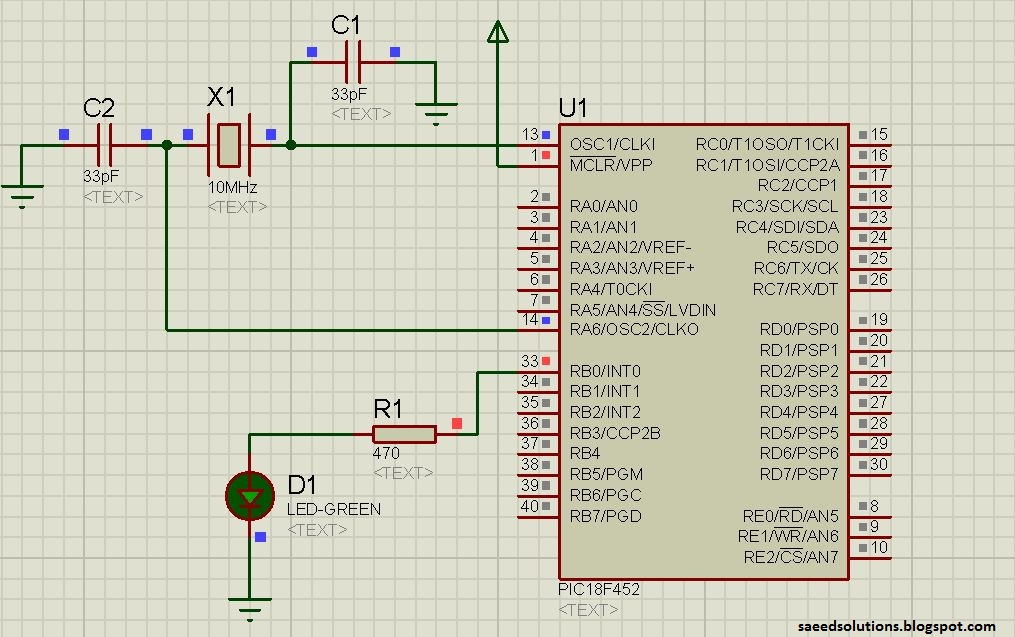
In this project a crystal of 10MHz is used with PIC18F452. This crystal frequency is fed into PLL of PIC18F452, which boosts it to 40MHz. As we know that any PIC micro controller has an architecture which executes an instruction in 4 CPU cycles, hence this 10Mhz crystal + PLL makes this PIC run at 10MIPS (Million of instructions per second). The code for this project is shown below.
Downloads
The code was compiled in MPLAB v8.76 with HI-TECH C and simulation was made in Proteus v7.7.
To download code and proteus simulation click here.
For more detail: PIC18F452 LED Blinking Code and Proteus Simulation
Quick Solutions to Questions related to PIC18F452 LED Blinking Project:
- What microcontroller is used in this project?
The PIC18F452 microcontroller is used in this project. - What crystal frequency is used?
A 10 MHz crystal is used. - Does the project use the PIC18F452 PLL?
Yes, the 10 MHz crystal frequency is fed into the PIC18F452 PLL which boosts it to 40 MHz. - What is the effective instruction rate (MIPS) of the PIC in this setup?
With the 40 MHz internal clock and 4-cycle instruction architecture, the PIC runs at 10 MIPS. - Which tools were used to compile the code?
The code was compiled in MPLAB v8.76 using HI-TECH C. - Which tool was used for simulation?
Simulation was performed in Proteus v7.7. - Can I download the complete project code and simulation files?
Yes, the complete project code and Proteus simulation can be downloaded from the Downloads section linked in the article. - Is a circuit diagram provided?
Yes, the article shows the required circuit diagram for the project.
Related projects
Precision Temperature Monitoring in Boiling Water with PIC Microcontroller
ABSTRACT In the industrial setting, accurately measuring the temperature of boiled water is a crucial undertaking. This paper presents the design and...
Home Automation & Security · PIC18F452Dual programmable keypad code lock using PIC18F452
Open electrical doors with your secret code only! Here are the technical specifications: Up to two keypads may be connected to drive...
Motors & Robotics · PIC18F452Weather station using PIC18F452 Microcontroller
Weather station with pressure reading, relative humidity, indoor & remote outdoor temperature display. Both Celsius or Fahrenheit & mbar/hPa or mm Hg...
LED ProjectsAn Application-Driven Microcontroller Curriculum
Understanding how to apply microcontrollers lies at the core of modern embedded systems education. This student project takes an experiential approach to...
LED ProjectsBuild this microcontroller controlled rainbow flying disc – and then throw it!
Hello all and welcome to this super simple and inexpensive instructable. If you like throwing frisbees AND you like flashing lights AND...
LED ProjectsLED Scrolling Display Project Working With Circuit Diagram
We normally use a simple static LED display screen to convey a message. Earlier, when we want to display large data, we...

Ibrar Ayyub
I am an experienced technical writer holding a Master's degree in computer science from BZU Multan, Pakistan University. With a background spanning various industries, particularly in home automation and engineering, I have honed my skills in crafting clear and concise content. Proficient in leveraging infographics and diagrams, I strive to simplify complex concepts for readers. My strength lies in thorough...