
Summary of LCD-VFD CONTROL CIRCUITS PIC16F873 PIC16F628 USB RS232
This article describes two HD44780-based LCD/VFD controller projects: a USB version using a PIC16F873 and an RS-232 version using a PIC16F628. Both support standard LCD interfaces, various display sizes (e.g., 16×2, 20×4), custom characters, splash screens, and GPO outputs. The USB model includes an FT232BM chip for bus-powered operation, while the RS-232 model offers hardware serial input.
Parts used in the USB LCD/VFD Controller:
- PIC16F873 Microcontroller Unit
- FTDI FT232BM Chip
- LCD/VFD Module (16x2, 20x2, 20x4, or 40x2)
- 4x4 Keypad
Parts used in the Serial LCD/VFD Controller:
- PIC16F628 Microcontroller Unit
- LCD/VFD Module (16x2, 20x2, 20x4, or 40x2)
- GPO Outputs
USB LCD/VFD Controller is a HD44870 based LCD/VFD controller via USB interface. The control command is compatible with Matrix-Orbital’s LCD module. So, you can use any MO friendly software to control this baby. Such as LCDC.The firmware are based… Electronics Projects, LCD-VFD Control Circuits PIC16F873 PIC16F628 USB RS232 “microchip projects, microcontroller projects, pic assembly example, pic16f628 projects,
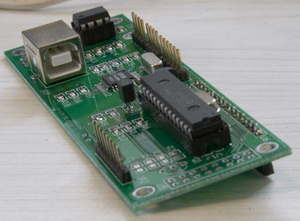
USB LCD/VFD Controller is a HD44870 based LCD/VFD controller via USB interface. The control command is compatible with Matrix-Orbital’s LCD module. So, you can use any MO friendly software to control this baby. Such as LCDC.The firmware are based on David Potter’s Serial LCD/VFD Display, but I almost rewrite the entire code.
I build this controller based on a PIC16F873 MCU. The main feature are:
Use a FTDI FT232BM chip as the USB bus controller.
The whole device are work in Bus-Power mode, and no external power are needed.
Supports industry-standard LCD interface (Hitachi HD44780 or “14/16 pin” interface)
Configured for 16×2,20×2,20×4,40×2 LCD/VFD module.
Hareware 19200-baud RS-232 input, 96 bytes of receive buffer. Flow control are not supported Standard software commands such as clear screen, cursor move, etc.
Supports custom characters,The LCD/VFD can configured via commands
The Splash screen can changed to whatever you want
2 GPO,4×4 Keypad,The LCD contrast could be configured by software
Serial LCD/VFD Controller is a HD44870 based LCD/VFD controller via RS-232. The control command is compatible with Matrix-Orbital’s LCD module.
So, you can use any MO friendly software to control this baby. Such as LCDC.The firmware are based on David Potter’s Serial LCD/VFD Display, but I almost rewrite the entire code.
I build this controller based on a PIC16F628 MCU. The main feature are:
Supports industry-standard LCD interface (Hitachi HD44780 or “14/16 pin” interface)
Configured for 16×2,20×2,20×4,40×2 LCD/VFD module.
Hareware 19200-baud RS-232 input, 96 bytes of receive buffer. Flow control are not supported Standard software commands such as clear screen, cursor move, etc.
Supports custom characters,The LCD/VFD can configured via RS232
The Splash screen can changed to whatever you want,2 GPO
Source: hyper.sunjapan.com.cn LCD-VFD Control Circuits PIC16F873 PIC16F628 USB RS232 alternative link:
FILE DOWNLOAD LINK LIST (in TXT format): LINKS-788.zip
Source: LCD-VFD CONTROL CIRCUITS PIC16F873 PIC16F628 USB RS232
- What is the basis of the control commands?
The control command is compatible with Matrix-Orbital's LCD module. - Can I use LCDC software with this project?
Yes, you can use any MO friendly software like LCDC to control the device. - Does the USB version require external power?
No, the whole device works in Bus-Power mode and needs no external power. - Which microcontroller is used for the USB controller?
The USB controller is built based on a PIC16F873 MCU. - Which microcontroller is used for the RS-232 controller?
The Serial controller is built based on a PIC16F628 MCU. - What baud rate does the RS-232 input support?
The hardware supports a 19200-baud RS-232 input. - Does the system support flow control?
No, flow control is not supported. - Can the splash screen be changed?
Yes, the splash screen can be changed to whatever you want via commands. - Does the firmware come from David Potter?
The firmware is based on David Potter's Serial LCD/VFD Display but was almost entirely rewritten.
