


Summary of Building the Mongoose Mechatronics Robot: Part 1 Chassis & Gearbox using PIC18F2525
This article outlines the first part of assembling the Mongoose Mechatronics Robot, focusing on chassis and gearbox preparation. It details modifications to a Tamiya Double Gearbox (Part T4) to accommodate dual optical rotation sensors, including cutting casing material and applying aluminum foil to blue gears for IR opacity detection.Parts used in the Mongoose Mechatronics Robot:
- PIC18F2525 microcontroller
- SN754410 H-Bridge with thermal shutdown
- 114.75:1 gearbox (Tamiya Double Gearbox Part T4)
- Low drag steel ball caster with steel rollers
- Dual optical rotation sensors
- In circuit programming / debugging connector
- TTL Serial port (EUSART)
- Solderless prototyping area
- Top mounted 20pin I/O connector
- Forward facing standoffs with 10pin I/O connector
- 10K trimpot
- High brightness LED headlight
- 4x AA NiMH batteries
- Self adhesive aluminum foil
- Blue gears
- Toothpick or soft burnishing tool
- Sharp hobby knife
Building the Mongoose Mechatronics Robot: Part 1 Chassis & Gearbox
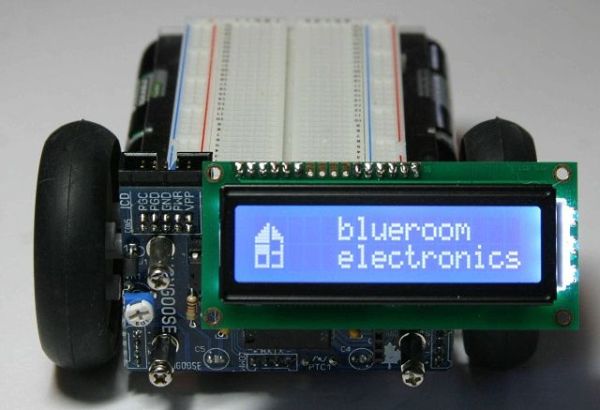
This is the first of a series of illustrated instructions for assembling the Mongoose Robot kit available from blueroomelectronics
Mongoose highlights:
-
- Powerful PIC18F2525 microcontroller (32KHz to 32MHz)
- Hardware PWM controlled SN754410 H-Bridge with thermal shutdown
- Differential drive with powerful 114.75:1 gearbox
- Low drag steel ball caster with steel rollers
- Dual optical rotation sensors (108 transitions per revolution)
- Dedicated in circuit programming / debugging connector
- Dedicated TTL Serial port (EUSART)
- Generous 400 hole solderless prototyping area
- Top mounted 20pin I/O for breadboard or LCD display
- Forward facing standoffs with 10pin I/O connector (0.1" PCB compatible)
- 10K trimpot and high brightness LED headlight (programmable)
- Very low center of gravity for stable operation
- Small enough to take anywhere 115mm x 110mm x 60mm
Requires 4x AA NiMH batteries
Programmable in ASM, Swordfish BASIC SE & C18 SE
Part 1: Chassis & Gearbox
Part 2: Electrical, motors & battery holders
Part 3: Electronics, 18F2525 Controller & SN754410 H-Bridge
Part 4: Final assembly, Main driving wheels, solderless breadboard
Part 5: Programming & Testing using Swordfish BASIC SE (free) & the Junebug (PICkit2)
Part 6: Demo code LCD, PWM and Tachometer examples
- Requires a PIC programmer, see the blueroomelectronics site for details.
Preparing the Gearbox for the Dual Rotation Sensors
The Mongoose uses a Tamiya Double Gearbox. Part T4 requires a simple modification to allow the optical rotation sensors to monitor wheel rotation.
Simply remove by sanding or cutting away 5mm of material (plastic) from the main gearbox casing as shown in the illustration below.
Adding the rotation encoders to two blue gears.
The blue gears as shown below are IR transparent, so we're going to add IR opaque aluminum foil to a set of gears one for either side of the gearbox (the blue gears are all identical so any two will do)
The kit includes a small piece of self adhesive aluminum foil with a hole punched in the center.
You will need two of the blue gears as supplied with the kit.
- Cut the foil into four pieces using the hole as the center.
- Remove the adhesive backing from the foil only when you're ready to apply it
- Apply two foil pieces to each gear, each foil piece should be opposite each other.
- Carefully burnish the foil onto the gear with a toothpick or soft burnishing tool (the example below use a piece of spruce from the gearbox assembly)
- Carefully trim away excess foul by slowly running a sharp hobby knife through the foil as show in the pictures below.
For more detail: Building the Mongoose Mechatronics Robot: Part 1 Chassis & Gearbox using PIC18F2525
Quick Solutions to Questions related to Mongoose Mechatronics Robot:
-
What is required to modify the gearbox for rotation sensors?
You must remove 5mm of plastic material from the main gearbox casing by sanding or cutting. -
Which specific gearbox model does the Mongoose use?
The robot uses a Tamiya Double Gearbox, specifically Part T4. -
How do you prepare the blue gears for the optical sensors?
You apply two pieces of self-adhesive aluminum foil to each gear, placing them opposite each other. -
Can any two blue gears be used for the modification?
Yes, all blue gears supplied in the kit are identical, so any two will work. -
What tools are recommended for applying the aluminum foil?
A toothpick or soft burnishing tool is recommended to carefully burnish the foil onto the gear. -
How should excess aluminum foil be removed?
Excess foil should be trimmed away slowly using a sharp hobby knife. -
What programming languages support this robot?
The robot is programmable in ASM, Swordfish BASIC SE, and C18 SE. -
What type of batteries power the Mongoose robot?
The project requires four AA NiMH batteries.
Related projects
Real-Time CAN-Based Vehicle Monitoring System with PIC MCU
INTRODUCTION The Controller Area Network (CAN) is a robust vehicle communication bus standard that was primarily developed for automobile applications but has...
Motors & RoboticsEasy Way to Learn Robotics Using Microcontrollers: A Beginner’s Guide
The title, "Easy Way to Learn Robotics Using Microcontrollers," promises an accessible entry point for those curious about the exciting world of...
Motors & Robotics · PIC16F877AEfficient Sun-Following Robot: A Solar Tracker with Microcontroller Control
Abstract The impending global challenge of dwindling non-renewable fuel resources underscores the urgency of transitioning towards renewable energy alternatives like solar power....
Motors & RoboticsInnovative Robotics: A Comprehensive Project Exploration
A DC motor functions as an electromechanical device, translating electrical signals into mechanical movements. The rotation of the motor correlates directly with...
Motors & RoboticsAdvanced Techniques for Fault Detection, Indication, and Protection in Induction Motors
1. INTRODUCTION The impact of microcontroller usage on our daily lives is remarkable. This versatile device is now prevalent in various control...
Motors & RoboticsExploring Versatility: GSM-Based Robotic Vehicle Technology
Introduction To Robotics The term 'Robot' remains elusive, defying a precise definition due to its evolving usage. Initially, it referred to humanoid...

Ibrar Ayyub
I am an experienced technical writer holding a Master's degree in computer science from BZU Multan, Pakistan University. With a background spanning various industries, particularly in home automation and engineering, I have honed my skills in crafting clear and concise content. Proficient in leveraging infographics and diagrams, I strive to simplify complex concepts for readers. My strength lies in thorough...