


Summary of IK3OIL 16F84 PIC Frequency Counter Files
This page documents the low-cost IK3OIL PIC16F84-based frequency counter project (design and code by Francisco IK3OIL), shared parts, hex/source files, layout/schematic, and community-built variants (OM3CPH, VK3BHR). Builders report easy construction, optional prescaler for GHz ranges, LCD options, and programming help from contributors like Dave (WB4CHK). Links to the original PDF, Microchip AN592 note, layouts, and photos are provided.Parts used in the IK3OIL Frequency Counter:
- PIC16F84 microcontroller (18-pin DIP)
- Character LCD (e.g., Seiko L1671BIP 1x16 backlit)
- Tactile switches (normally open)
- Single input transistor for signal conditioning
- Passive components (resistors, capacitors)
- Crystal oscillator (4 MHz)
- PCB (custom artwork/layout)
- 16-pin ribbon cable (for LCD connection)
- 18-pin DIP socket
- Optional prescaler for GHz counting
IK3OIL Frequency counter built by Wayne McFee. This is from IK3OIL’s web site, and the cost of the counter was about $2, minus the display, which was about $7. Wayne got the source was www.shopeio.com. They are located in Gardenia, California.
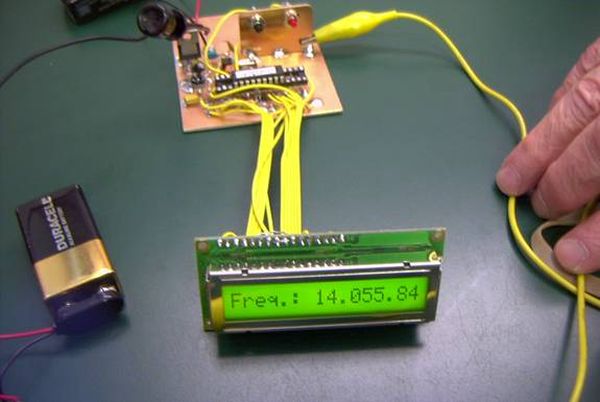
Design and Code by Francisco IK3OIL
This frequency counter was mentioned on the QRP-L mailing list.
I offered to put up some more information on the counter on this web page.
I have not built one (yet) nor do I have any further information than what is here.
UPDATE!: I did build a counter it was not an IK3OIL counter but based on comments by PIC Elmer WB8RCR on Echolink, I built instead an OM3CPH counter.
It works FB! Thanks for the hints and the great work with the PIC Elmer course John!
Davewb4 at aol.com provided these files
Here are some comments he made to the QRP-L list:
HI All: Wayne got the hex code for the counter  from me. I got it from
Francisco (IK3OIL). I have built 5 of these counters and  all work from the git-go.
I have the hex code and can supply it to anyone who  wants it. I also have
redone the art work for Francisco's board. He used some NO  tactile switches that
are hard to find so I changed the board slightly. I will  be happy to supply
that to any one who wants it. The counter costs about $ 10 to  build since you
can get the PIC16F84 chip from Micro-Chip as samples. If you are  going to
Orlando this week end for the ham fest I will be there at the ARCI  meeting with
a IK3IOL micro counter and some Unicounters and a 2N2/20. IF anyone  wants to
build a Microcounter but cannot program a chip, just send me an 18pin  Dip
16F84 and I will be happy to program one for you. I also have the schematic  for
the Micro-counter.
73
Dave Rogers
WB4CHK
Plantation, FL

---

www.eio.com/lcdprodt.htm

Here is a good  place to purchase the LCD. Click on character LCD and in the
middle of the page  find Seiko L1671BIP...... A 1x16 character LCD, its back
lit and the $ 6.00  price is nice.

I must say I am overwhelmed by the interest
73
Dave

---

Since there is so much interest in this project,  here is what you get.

1. A very nice stand alone frequency counter for  the bench or
2. A digital readout for any rig. With the mode switch you can  set the IF
offset to any of three combinations i.e.: VFO+IF.... VFO-IF or  IF-VFO
3. With some additions it can count into the Gig region. It has a  pre-scaler
option. ( Wayne McFee NB6M has some mods for that, so if you are  interested
in counting that high you should contact him. I use them for rigs I  build.  I
installed one in my 2N2/20. It has an 11meg IF & a 3meg VFO  so I use VFO+IF
to read 14MHZ
4. A typical 14mhz count would be  14.060.45
If you use my art work for the PC board, please note I use MS paint  and
everything is oversize. I suggest first of course, reverse the design then  print
a copy of the board. Place an 18pin dip socket on the print and compare  the
hole line up. It will probably be to large. I then use the size program on  my
HP laser jet program to reduce the size. Try 74% that should be close. Once
you get the Dip to exactly the correct size all the rest will be OK. I use PnP
blue to make the boards. If you want to build the counter and do not have a
programmer for the PIC16F84, just send me one and I will program it for you.
Any  questions just ring. I also have some pictures of the completed board, the
 switch change, the LCD connections and the finished counter. It's a large
file  3.5MB.
73
Dave
Here is the link to the PDF file by IK3OIL:
http://digilander.libero.it/ik3oil/_private/Frequenzimetro_eng_2003.pdf
Here is a link to the AN592 MicroChip Application note referenced in
Francesco's Frequency Counter above:
http://ww1.microchip.com/downloads/en/AppNotes/00592d.pdf
Here is a link to the NorCal meeting where the counter was mentioned:
http://www.norcalqrp.org/mtg2005_02.htm
Here is a copy of the PIC source code that I got from Dave ( Davewb4 at aol.com )
ik3oilcounter.hex
Here are the layout/schematic files compressed into a zip file
layout.zip
NOTE: Daveb4 at aol.com has agreed to be a contact person re this counter as I know nothing more
than what is here.
-----
Here is a note from ve7wrs re a similar PIC Counter project
 All,

You might also want to check-out the frequency counter that Phil Rice,
VK3BHR,  in Australia produced. It is an almost identical design; PIC 16F84
with a single input transistor. In fact he gives credit to IK3OIL for
inspiring the design.
http://ironbark.bendigo.latrobe.edu.au/~rice/

Phil even makes the source code available if you want to tweak it. On the
web site click on the Updated Frequency Counter. I haven't built it, but I
did email Phil for ideas about using a TCXO instead of the 4 Mhz crystal. He
was very helpful.

Phil also has a PIC16F84  L/C meter project which I did build. It functions
very much like the Almost all Digital meter (which I don't own).  Mine works
great, and is really useful for sorting out unmarked or illegible inductors
and capacitors. Highly recommended.

-Walter
VE7WRS
-----Here are some photos from Dave for the ik3oil counter

K3OIL Micro-counter mounted in a K8IQY 2N2/20
Mounted in a 2N2/20 with the PC board separate from the LCD and connected by a 16 pin cable

Source: IK3OIL 16F84 PIC Frequency Counter Files
Quick Solutions to Questions related to the IK3OIL Frequency Counter:
- What is the main microcontroller used in the project?
The project uses the PIC16F84 microcontroller in an 18-pin DIP. - Can the counter be used as a bench standalone or rig readout?
Yes; it can function as a standalone bench counter or as a digital readout for a rig with IF offset modes. - How much does the counter cost to build?
According to contributors, the counter costs about $10 to build excluding the LCD; one estimator said about $2 plus a $7 display. - Where can I get the LCD recommended in the article?
The article points to eio.com (lcd product page) and recommends the Seiko L1671BIP 1x16 backlit LCD at about $6. - Is source code or hex available for programming the PIC?
Yes; ik3oilcounter.hex and source code were shared by contributors and are available from the links mentioned. - Can the counter measure frequencies into the GHz range?
Yes; with a prescaler option and mods (noted by Wayne NB6M) it can count into the gigahertz region. - Are there alternate or derived designs mentioned?
Yes; variants include OM3CPH and a similar VK3BHR design inspired by IK3OIL. - What programming help is available for builders without a PIC programmer?
Dave (WB4CHK) offered to program PIC16F84 chips if builders send an 18-pin DIP 16F84 to him. - Does the project include PCB artwork and layout files?
Yes; layout and schematic files were provided (layout.zip) and artwork revisions were offered by contributors. - Where can I find the original IK3OIL documentation?
The IK3OIL PDF is linked: Frequenzimetro_eng_2003.pdf on digilander.libero.it as cited in the article.
Related projects
Adaptive Alarm Clock: Build a Smart, User-Centric wake-Up system
Project Overview The goal of this ambitious undergraduate project was to develop a novel alarm clock capable of analyzing a person's unique...
Clocks & TimersDesigning Your Ideal Alarm Clock: An Introduction to PIC18
Within this laboratory session, you'll employ the C language to create an alarm clock, delving into the implementation of "C" programs on...
Clocks & TimersBuilding your Dream Alarm Clock Using the PIC18
Objective: In this laboratory session, your objective is to create an alarm clock using the C programming language. You will gain proficiency...
Clocks & TimersBuild a DIY Smart Watch Using Microcontroller
Introduction Wearables (Smart Watch) are becoming increasingly more prevalent in today's markets; however cost continues to limit the demand for such devices....
Clocks & Timers · PIC16F84AIN-8 single nixie tube clock using PIC16F84
After receiving one IN-8 tube from a friend (thanks), I decided to build myself a clock. This clock is more an ornament...
Clocks & Timers · PIC16F84APIC16F84A timer0 code and Proteus simulation
This post provides the timer0 code for PIC16F84A microcontroller. This code is written in C language using MPLAB with HI-TECH C compiler....

Ibrar Ayyub
I am an experienced technical writer holding a Master's degree in computer science from BZU Multan, Pakistan University. With a background spanning various industries, particularly in home automation and engineering, I have honed my skills in crafting clear and concise content. Proficient in leveraging infographics and diagrams, I strive to simplify complex concepts for readers. My strength lies in thorough...