
Summary of BRIDGE BIDIRECTIONAL DC MOTOR SPEED CONTROL PWM PIC12F629
This project describes a lightweight, fully solid-state bidirectional DC motor speed controller using a PIC12F629 microcontroller and PWM. Designed for model aircraft or small boats, it features SMD construction, 10A current capacity, automatic low-voltage cutoff (6–12V), and a 1A BEC. The circuit uses an H-bridge with 2N7002 MOSFETs and includes safety arming logic to prevent startup unless the throttle is neutral.
Parts used in the Bridge Bidirectional DC Motor Speed Control:
- PIC12F629 Microcontroller
- 2N7002 MOSFETs
- SMD Components
- H-Bridge Circuit
- Battery Eliminator Circuit (BEC)
Bridges connected motor speed control circuit 12f629 controller based on the PWM method and the motor is driven integrated outputs 2N7002 MOSFETs reinforced with assembly language prepared by the source. Asm,. Hex code and eagle prepared with diagrams, printed… Electronics Projects, Bridge Bidirectional DC Motor Speed Control PWM PIC12F629 “microchip projects, microcontroller projects, pic assembly example, pwm circuits,
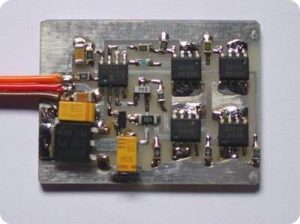
Bridges connected motor speed control circuit 12f629 controller based on the PWM method and the motor is driven integrated outputs 2N7002 MOSFETs reinforced with assembly language prepared by the source. Asm,. Hex code and eagle prepared with diagrams, printed circuit board files there.
Fully solid-state, bi-directional output (without relays)
Lightweight materials SMD (surface mount)
10 A Maximum motor current (with MOSFETs)
Auto LVC (Low Voltage Cutoff) for 6 ~ 12V input voltage
For the smooth and efficient control of high-frequency PWM (3kHz)
1 A low dropout BEC (Battery Eliminator Circuit)
Author motor control circuit used for speed control model aircraft projects
AIRCRAFT MOTOR SPEED CONTROL
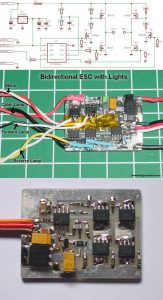
Whilst there are many commercially reversible speed controllers available, most are designed for high performance model cars or boats, and therefore are large and expensive. I wanted a lighweight ESC for fitting into a small scale boat or submarine.
Fully solid state, bi-directional output (no relay!), Lightweight SMD (Surface Mount Device) construction, Up to 10A maximum motor current (with suitable output FETs) Automatic LVC (Low Voltage Cutoff) handles 6~12V batteries, Throttle neutral at standard 1.5mS, or 1.37mS for offset stick, Safety Arming. Motor won’t start until throttle is set to neutral High frequency PWM (3KHz) for smooth and efficient control 1A low dropout BEC (Battery Eliminator Circuit)
Source: homepages.paradise.net.nz Bridge Bidirectional DC Motor Speed Control pcb schematic diagram PIC12F629 pic assembly source code alternative link:
FILE DOWNLOAD LINK LIST (in TXT format): LINKS-703.zip
Source: BRIDGE BIDIRECTIONAL DC MOTOR SPEED CONTROL PWM PIC12F629
- What type of motor control method does this circuit use?
The circuit uses the PWM method for smooth and efficient control at high frequency. - Can this controller drive motors in both directions?
Yes, it provides a fully solid-state bi-directional output without relays. - How much maximum current can this circuit handle?
The system supports up to 10 A maximum motor current when using suitable output FETs. - What input voltage range does the Low Voltage Cutoff support?
The Auto LVC feature handles input voltages between 6 and 12 volts. - Does the motor start immediately upon power-up?
No, the motor will not start until the throttle is set to the neutral position. - Is there a power supply circuit included for peripherals?
Yes, it includes a 1 A low dropout BEC for powering other components. - What is the PWM frequency used for operation?
The circuit operates with a high-frequency PWM of 3 kHz.
