


When doing astronomy observing at night preserving night vision is critical. This requires using the minimum amount of light that makes the sky charts readable. What is this minimum level depends on how dark are your surroundings, how much time you have spent in darkness, how well your eyes adapt for night vision, what type of charts are you using, what object are you observing, and so on. My old astronomy light was not very convenient - it only had two brightness levels, "too bright" and "not quite that bright", and it was eating batteries like crazy. This one is a huge improvement and is a real pleasure to use.
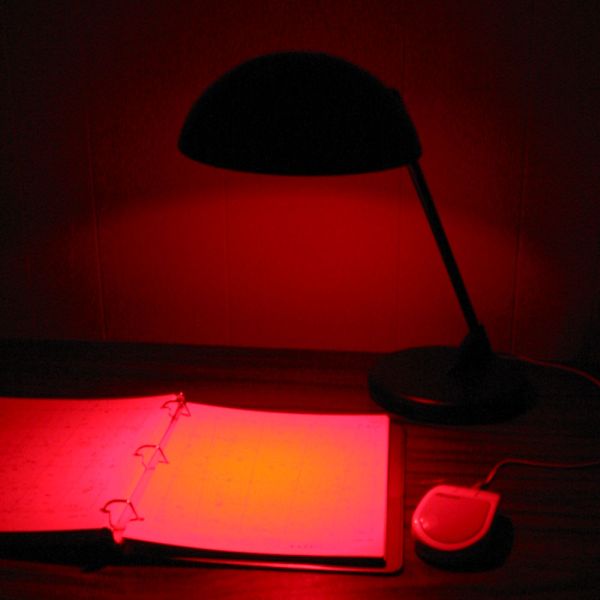
The PIC light has a brightness level that can be adjusted anywhere between comfortably bright and almost invisible with 128 steps of adjustment. Those 128 levels are distributed exponentially, to match the non-linear light sensitivity of the eye. In addition, there is a button for temporary brightness boost. This is convenient in the cases where you want to have the light really low, and bring it up a bit for a second only when you are trying to see some tiny detail on the star charts. The "boost" level is also fully adjustable.
The light consists of two parts - an old desk lamp with a patch of LCDs in place of the bulb, that is connected through an audio jack to a box containing the controller and the battery. I'm using an old computer mouse as controller/battery enclosure - this way, I can have the control buttons in a convenient place next to my charts. Instead of having an on/off switch, the light is turned on simply by plugging the lamp jack into the "mouse" (this required a slight modification of the female jack by bending a bit one of the contacts - you could figure it out by looking at the schematics). When I'm packing the light the mouse part goes into my crowded toolbox - with no on/off switch there is no danger that it will get turned on and I'll discover the battery drained next time I need it.
For more detail: Red Light for Astronomy Observing using PIC12F683
Related projects
Automotive Voltage Monitor using PIC12F683
Description Recently I got a new motorbike and on my second trip out, with only 50 miles on the clock the rectifier/regulator...
Communication & Interfacing · PIC12F683EnvStick USB Temperature Sensor using PIC12F683
The EnvStick is cheap, homemade temperature sensor that plugs into a USB port. It provides a simple way to collect a room’s...
Sensors & Temperature · PIC12F683Metal detector robot using pic microcontroller
This project describes hardware and software I have developed which allows a small 8 bit PIC microprocessor to function as a single...
Home Automation & SecurityVoice Activated Power Sockets (Home Automation)
Yet another voice controlled home automation system! As shown in the picture, the system can control any electrical appliance, by turning ON...
Home Automation & SecurityHome Security System with GSM Using 8051 Microcontroller
Security is a big challenge everywhere because thefts are increasing day by day owing to the unsafe and insecure security systems in...
Home Automation & SecurityHome Automation and Security System using Microcontroller ATMEGA8 with Arduino Programming
Home automation and security systems have become very popular these days, today industrial automation techniques are widely adopted by luxurious homes and...

Ibrar Ayyub
I am an experienced technical writer holding a Master's degree in computer science from BZU Multan, Pakistan University. With a background spanning various industries, particularly in home automation and engineering, I have honed my skills in crafting clear and concise content. Proficient in leveraging infographics and diagrams, I strive to simplify complex concepts for readers. My strength lies in thorough...