


Summary of PIC16F84 LED SHOW CIRCUIT PROTON IDE EXAMPLE
This project demonstrates an LED display circuit using the PIC16F84 microcontroller, featuring 8 LEDs and 4 distinct operating modes. Users can select between gradual fading effects or key-based switching via a commutator. The design includes schematic diagrams, Proton IDE source code, and Proteus ISIS simulation files for comprehensive testing and implementation.Parts used in the PIC16F84 LED Show Circuit:
- PIC16F84 Microcontroller
- 8 LEDs
- Commutator (Switch)
- Proteus ISIS Simulation File
- Proton IDE Code
he circuit can be controlled 8 led 4 mode with pic16f84 effect can be gradual or key with choice in commutator welding proton codes and proteus isis simulation file LED Show Circuit Schematic LED Show Proton ide code and... Electronics Projects, PIC16F84 LED Show Circuit Proton ide Example "led projects, microchip projects, microcontroller projects, pic16f84 projects,

The circuit can be controlled 8 led 4 mode with pic16f84 effect can be gradual or key with choice in commutator welding proton codes and proteus isis simulation file
LED SHOW CIRCUIT SCHEMATIC
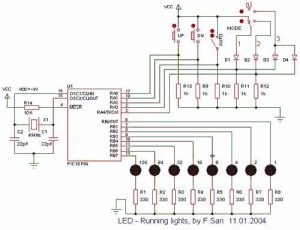
LED Show Proton ide code and schematic:
FILE DOWNLOAD LINK LIST (in TXT format): LINKS-9168.zip
Source: PIC16F84 LED SHOW CIRCUIT PROTON IDE EXAMPLE
Quick Solutions to Questions related to PIC16F84 LED Show Circuit:
- How many LEDs does this circuit control?
The circuit is designed to control 8 LEDs. - What number of modes are available for the LED effects?
There are 4 different modes available for controlling the LED effects. - Can the effect be set to gradual or key based on user choice?
Yes, the effect can be gradual or key with a choice made via the commutator. - Which microcontroller is used in this project?
The PIC16F84 microcontroller is used to build this circuit. - What software tools are provided for simulation and coding?
Proteus ISIS simulation files and Proton IDE codes are provided. - Where can I find the source code and schematic files?
The files are available for download in a ZIP format linked as LINKS-9168.zip. - Does the circuit support different visual effects?
Yes, it supports both gradual fading and key-based switching effects. - Is this project suitable for microchip enthusiasts?
Yes, it is listed under microchip projects and microcontroller projects.
Related projects
PIC Stepper Motor Controller using PIC16F84A with Proteus Simulation
Introduction Stepper motors are widely used in embedded systems and DIY electronics projects where precise position control is required. This PIC Stepper...
Programmers & ICSP · PIC16F84APIC Musical Doorbell using PIC16F84A with Proteus Simulation
IntroductionThis microcontroller project demonstrates a musical doorbell built around a PIC16F84A and a simple piezo sounder.Using two push buttons, the system allows...
Beginner Tutorials · PIC16C84Exploring the World of PIC Microcontrollers: An Architectural Overview
A Peripheral Interface Microcontroller (PIC), developed by General Instruments Microcontrollers in 1993, operates under software control and is programmed to execute various...
LED ProjectsAn Application-Driven Microcontroller Curriculum
Understanding how to apply microcontrollers lies at the core of modern embedded systems education. This student project takes an experiential approach to...
LED ProjectsBuild this microcontroller controlled rainbow flying disc – and then throw it!
Hello all and welcome to this super simple and inexpensive instructable. If you like throwing frisbees AND you like flashing lights AND...
LED ProjectsLED Scrolling Display Project Working With Circuit Diagram
We normally use a simple static LED display screen to convey a message. Earlier, when we want to display large data, we...

Muhammad Bilal
I am a highly skilled and motivated individual with a Master's degree in Computer Science. I have extensive experience in technical writing and a deep understanding of SEO practices.