


Summary of 16F84A VGA Test
This article details a project demonstrating how to generate VGA signals for PC monitors using the PIC16F84A microcontroller. The author adapted an existing design, modified the circuit for real-world use, and resolved a software timing issue that caused monitor flickering. The setup includes a simple schematic connecting the microcontroller directly to a 15-pin VGA connector, with specific configuration settings required for the firmware.Parts used in the PIC16F84A VGA Output Project:
- PIC16F84A Microcontroller
- 15 pin female VGA connector
- VGA signal generation software (modified)
- Proteus 7 Model files
- Source code and Hex file
I found an old web page containing this project http://tinyvga.com/pic-vga . I just made some minor modification on that project and put it into a real circuit. I found that the there is a small timing issue in this software that makes the monitor flicker repeatedly.
The circuit is very simple. It consists of the Microcontroller PIC16F84A and the 15 pin female VGA connector.
This is the schematic diagram of the circuit
This is the pinout of the VGA connector
There is a simple hint for your when downloading the software on the Microcontroller . Make sure that the configuration is :
PRTE ON
XT
WDT OFF
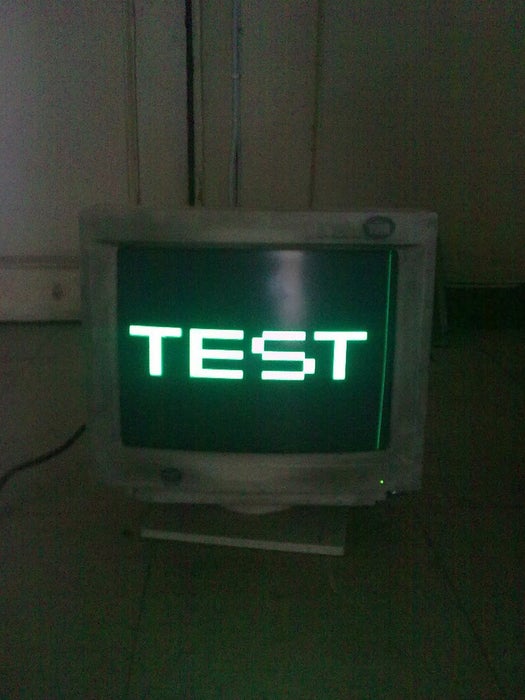
I took this pictures for the monitor after running the program.
This picture shows the circuit.
VGA Connector on Aliexpress , Amazon US
Wish you the best. And have fun ,Live free And Read Books on Amazon
يمكنك قراءة هذه المقالة على مدونتى باللغة العربية
http://arabic-embedded-egypt.blogspot.com.eg/2010/07/pic-16f84a.html
You can read this post on my blog in English
http://embedded-egypt.blogspot.com.eg/2010/07/16f84a-vga-output.html
Here is the link for the Proteus 7 Model , source code and Hex file :
Thank you for reading my instructable.
You can also find my book Learn By Making on Amazon website.
If you like this instructable you can support us by many ways:
------------------------------------------------------------------
1. Leave comments stating your point of view about this article.
2. Buy our book on Amazon Learn By Making.
That's all. Thank you for reading.
Here are some of my latest books on Amazon.
Learn By Making
Backyard Wind Turbines
Here is my Channel on Youtube:
Source: 16F84A VGA Test
-
Can you generate VGA signals using a PIC16F84A?
Yes, the article confirms that any kind of signals, including VGA signals appearing on a PC monitor, can be generated using the PIC16F84A. -
What modification was made to the original project found online?
The author made minor modifications to the original project found at tinyvga.com/pic-vga and implemented it into a real circuit. -
What issue was identified with the original software?
A small timing issue in the original software was found that caused the monitor to flicker repeatedly. -
How complex is the circuit described in the article?
The circuit is described as very simple, consisting only of the PIC16F84A microcontroller and a 15-pin female VGA connector. -
What configuration settings are required when downloading the software?
The configuration must be set to PRTE ON, XT, and WDT OFF. -
Where can one find the Proteus model and source code?
The Proteus 7 Model, source code, and Hex file are available via a provided Google Docs link in the article. -
Is there a video demonstration of this project?
Yes, a YouTube video link is provided showing the project in action.
Related projects
PIC Stepper Motor Controller using PIC16F84A with Proteus Simulation
Introduction Stepper motors are widely used in embedded systems and DIY electronics projects where precise position control is required. This PIC Stepper...
Programmers & ICSP · PIC16F84APIC Musical Doorbell using PIC16F84A with Proteus Simulation
IntroductionThis microcontroller project demonstrates a musical doorbell built around a PIC16F84A and a simple piezo sounder.Using two push buttons, the system allows...
Beginner Tutorials · PIC16C84Exploring the World of PIC Microcontrollers: An Architectural Overview
A Peripheral Interface Microcontroller (PIC), developed by General Instruments Microcontrollers in 1993, operates under software control and is programmed to execute various...
Wireless & IoTExploring Various Applications of Microcontrollers: A World of Tiny Brains
Exploring Various Applications of Micro Controller Microcontrollers have become ubiquitous in the modern world with applications in nearly every industry. This student...
Wireless & IoTIntelligent Sips: Revolutionizing Dining with the SmartCup
Abstract The SmartCup Attachment is a comprehensive system designed for restaurants to monitor the liquid levels in their customers' cups. This system...
Wireless & IoTMaximizing Wi-Fi Capabilities with the Explorer 16 Development Board
As society progresses, the necessity for wireless communication is evolving from a mere luxury to an essential requirement. Wi-Fi, extending beyond conventional...

Muhammad Bilal
I am a highly skilled and motivated individual with a Master's degree in Computer Science. I have extensive experience in technical writing and a deep understanding of SEO practices.