
Summary of Circuit-Zone.com – Electronic Projects
The article describes building a PICkit2 programmer based on Microchip's original schematic. The author selected this design over modified versions due to reliability concerns, despite component availability challenges in their region. The project involves sourcing specific parts like the 16F2550 PIC microcontroller and transistors to create a functional device for programming EEPROMs and processors.
Parts used in the PICkit2 Programmer:
- 16F2550 PIC microcontroller
- Transistor
- Resistors
- EEPROM
- Processor (mentioned as part of the main prize)
Circuit-Zone.com – Electronic Projects
For a long time I needed a good programmer pussy, even if it is programming, so from time to time the application gets where it is used. So I decided to build the programmer. I chose between a couple of projects from different authors, but eventually won PICkit2. Microchip released the schema directly in the user manual for the programmer.
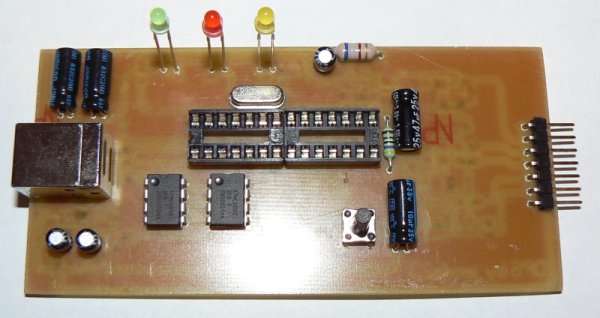 On the Internet there are multiple versions of the programmer, it’s usually cropped version of the log analyzer features, UART terminal, etc., 12V inverter is a modified version of it and control the MOSFETs, unlike bipolar transistors used in the original design. And it also showed that becomes due to the switching inductance feta leave. Finally, I chose to use the original scheme, although it is quite complicated and the parts used in our country can not normally buy, but my problems with finding parts easily solved. I bought a transistor, the 16F2550 PIC and a few other things, resistors and fry the rest I bought from “us”. The price is pretty high, unfortunately, moving it around and 600CZK, the main prize and two processor makes the EEPROM. Below we describe the involvement and put into operation.
Build Accurate LC Meter and start making your own coils and inductors. This LC Meter allows to measure incredibly small inductances making it perfect tool for making all types of RF coils. LC Meter can measure inductances starting from 10nH – 1000nH, 1uH – 1000uH, 1mH – 100mH and capacitances from 0.1pF up to 900nF. The circuit includes an auto ranging and reset function to make sure the readings are as accurate as possible …
For more detail: Circuit-Zone.com – Electronic Projects
- Why did the author choose the original PICkit2 scheme?
The author chose the original scheme because modified versions had issues with switching inductance affecting the FET, although it was complicated and parts were hard to find. - What components were purchased specifically for this build?
The author bought a transistor, a 16F2550 PIC, resistors, and other items from local sources while solving availability problems easily. - How much did the project cost?
The price was around 600 CZK, which the author noted was quite high. - What is the purpose of the built programmer?
The programmer is designed to program applications where they are used, specifically targeting two processors and making an EEPROM. - Did the author consider other designs before choosing PICkit2?
Yes, the author chose between a couple of projects from different authors but eventually decided on the PICkit2 version. - Where can the schema for the programmer be found?
Microchip released the schema directly in the user manual for the programmer. - What alternative functions do some internet versions of this programmer offer?
Some versions include cropped features like log analyzer functions, UART terminals, or use a 12V inverter to control MOSFETs instead of bipolar transistors.
