
Summary of Tiny PIC bootloader using PIC16F microcontroller
This article describes "Tiny Bootloader," a compact firmware solution for Microchip PIC microcontrollers (16F, 18F, dsPIC30 families). It occupies under 100 words of program space and supports flash, EEPROM, and configuration byte writing. The bootloader waits one second after reset to receive PC commands before launching the user application. A companion PC software tool facilitates HEX file uploads, automatically detects device models, and allows customizable communication settings.
Parts used in the Tiny Bootloader:
- Tiny Bootloader firmware (.asm file)
- PC software tool
- Microchip PIC microcontroller (16F, 18F, or dsPIC30 family)
- Serial communication interface (COM port)
Tiny Bootloader
This is a bootloader for the Microchip PIC microcontrollers.
- It is the smallest bootloader, taking less than 100 words of program space;
- Supports families of PIC devices: 16F, 18F, dsPIC30 (those devices that support self-programming)
- Does not support yet PIC24, dsPIC33, PIC18xxJyy
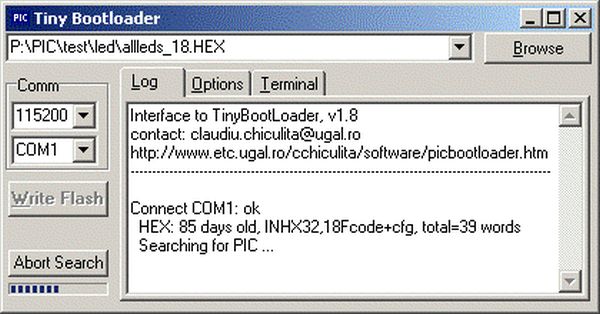
Features of the firmware
- Size of only 100 words; (all versions, for 16F,18F,dsPIC occupy less than 100 words);
- Can write flash, eeprom and configuration bytes(18F);
- On reset, waits 1 second (adjustable) for a message from the PC, if not received, launch user application;
- The .asm file can be easily modified and adapted for any frequency (or baudrate);
Features of the PC software
- Can upload programs into flash (in current version eeprom and cfg bytes can be modified only manually, depending on the device type);
- Works with PIC16F,PIC18F and dsPIC types; automatically detects HEX content and PIC model;
- Remembers last settings;
- In case of errors, performs retransmissions or tries to resynchronize with pic;
- The communication settings are editable so you can write any COM number or desired baud;
- If a filename is specified as a command line parameter, it will automatically try to write it;
Supported/Tested Devices
| Device | Devices of the same type | Flash | ram | EE | ser | adc | osc | pin | ||
|
PIC 16F Family |
||||||||||
| PIC16F876 | 877, 873, 874 | |||||||||
| PIC16F876A | 877A, 873A, 874A | 8k | .3 | .2 | 1 | y | dD | |||
| PIC16F887 | PIC16F886 | |||||||||
| PIC16F88 | 87 | 4k | .3 | .2 | 1 | y | y | d | ||
|
PIC 18F Family |
||||||||||
| PIC18F252 | 452, 242, 442; 2420, 2520, 4420, 4520 | 16k | 1.5k | .2 | 1a | y | dD | |||
| PIC18F258 | 458, 248, 448; 2480, 2580, 4480, 4580 | 16k | 1.5k | .2 | 1a | y | dD | CAN | ||
| PIC18F2620 | 4620, 2525, 4525 | 32k | 3.9k | 1k | 1e | y | y | dD | ||
| PIC18F1320 | 1220, 2220, 2320 | 4k | .2 | .2 | 1e | y | y | d | ||
| PIC18F8720 | 6520, 8520, 6620, 8620, 6720; 6621 | 64k | 3.8k | 1k | 2 | y | Q | ext.mem. | ||
| PIC18F2550 | 4550, 2455, 4455 | 16k | 1.5k | .2 | 1e | y | Y | dD | usb | |
| PIC18F4431 | 2331, 2431, 4331 | 8k | .7 | .2 | 1e | Y | dD | advPWM | ||
| PIC18F4680 | 2585,2680,4585 | 32k | 3.3 | 1k | 1 | y | dD | ECAN | ||
| PIC18F4580 | 2480,2580,4480 | 16k | 1.5 | .2 | 1 | y | dD | ECAN | ||
| PIC18F4620 | 2525,2620,4525 | 32k | 3.9 | 1 | 1 | y | dD | |||
| PIC18F4320 | 2220,2320,4220 | 4k | .5 | .2 | 1 | y | dD | |||
|
dsPIC Family |
||||||||||
| Device | Devices of the same type | Flash | ram | EE | ser | adc | osc | pin | ||
| dsPIC20F2010 | 4k | .5 | 1k | 1 | y | y | d | 6pwm | ||
| dsPIC30F6014 | 6012, 6013, 6011, 6012A | 44k | 8k | 4k | 2 | yy | y | Q | 2CAN | |
| dsPIC30F3013 | 3012, 2012, 2011 | 8k | 2k | 1k | (2) | yy | YY | d | ||
| dsPIC30F4012 | 4011 | 16k | 2k | 1k | (2) | y | Y | dD | 6pwm, CAN | |
| dsPIC30F3011 | 3010 | 8k | 1k | 1k | (2) | y | Y | dD | 6pwm | |
| dsPIC30F6010 | 44k | 8k | 4k | 2 | y | y | Q | 8pwm, 2CAN | ||
| blue – tested for longer periods blue – verified (or user source provided) navy – reported to work (may require modifications!) |
Flash, RAM, EEprom: max. amount ser: a=addr.; e=enh.(brg/lin) adc: yy=12bit osc: internal+features pin: d<=dip28; D=dip40; Q>=tqfp |
|||||||||
For more detail: Tiny PIC bootloader using PIC16F microcontroller
- How small is the Tiny Bootloader?
The bootloader takes less than 100 words of program space. - Can the bootloader write to EEPROM and configuration bytes?
Yes, it can write flash, EEPROM, and configuration bytes, though manual modification may be required for EEPROM and CFG bytes depending on the device type. - Does the bootloader wait for a message from the PC upon reset?
Yes, it waits one second (adjustable) for a message; if none is received, it launches the user application. - What PIC families are supported by this bootloader?
It supports 16F, 18F, and dsPIC30 families that allow self-programming. - Can I modify the .asm file for different frequencies?
Yes, the .asm file can be easily modified and adapted for any frequency or baudrate. - Does the PC software automatically detect the PIC model?
Yes, the software automatically detects HEX content and the specific PIC model. - Is the communication baud rate editable?
Yes, communication settings including COM number and desired baud rate are editable. - What happens if an error occurs during upload?
In case of errors, the software performs retransmissions or tries to resynchronize with the PIC.

