
Summary of TSL2540 DIGITAL AMBIENT LIGHT SENSOR
The TSL2540 from ams is a 4th-generation digital ambient light sensor with an integrated on-chip photopic filter, providing near-photopic responsiveness behind inked glass. It is a highly sensitive light-to-digital converter with a fast I²C interface, 1M:1 dynamic range, and operation from mLux to 50k lux. The device is low power, uses 0.18 µm process technology with 1.8 V I²C, supports automatic zero/dark count control, and comes in a compact 2.0 mm x 2.0 mm x 0.5 mm optical QFN package for space-constrained designs and display backlight control.
Parts used in the TSL2540 Digital Ambient Light Sensor Project:
- TSL2540 digital ambient light sensor (integrated on-chip photopic filter)
- Microprocessor or MCU (to read I²C output and compute lux)
- I²C interface connection (1.8 V compatible)
- Optical QFN package footprint (2.0 mm x 2.0 mm x 0.5 mm)
- Power supply (1.8 V for I²C and device operation)
- Inked glass or touch panel cover (for hidden placement)
- PCB and mounting hardware for QFN package
- Firmware implementing empirical formula for lux conversion
ams’ digital ambient light sensor features an integrated on-chip photopic filter
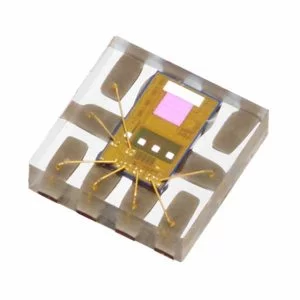
The TSL2540 from ams was developed as the 4th generation ambient light sensor (ALS) and includes an integrated on-chip photopic filter which provides near photopic responsiveness for operation behind the inked glass of a touch panel display. The TSL2540 is a highly sensitive light-to-digital converter that transforms light intensity into a digital signal output through a fast-mode direct I²C digital interface. This digital output can be input to a microprocessor where illuminance (ambient light level) in lux is derived using an empirical formula to provide accurate metering of light intensity that approximate the sensitivity of the human-eyes response, regardless of the light source (sunlight, incandescent, halogen, fluorescent, CFL, LED, etc.). The 1M-to-1 dynamic range of the device, coupled with the integrated silicon photopic filter, makes this ALS suitable for industrial designs that hide behind dark inked glass for aesthetic purposes.
The TSL2540 is part of the ALS product offering and features very high sensitivity with low power consumption in a small 2 mm x 2 mm x 0.5 mm optical QFN package making it ideal for space-constrained designs. The TSL2540 is capable of operation from mLux to 50k lux environments, allowing it to operate in small and deeply buried sub-system applications.
Features
- Integrated on-chip photopic filter
- High sensitivity down to mLux levels
- 0.18 µm process technology with 1.8 V I²C
- 1M:1 dynamic range
- Automatic AUTO zero/dark count control
- Area efficient 2.0 mm x 2.0 mm x 0.5 mm QFN package
- Ambient light sensing
- Display backlight control
Read more: TSL2540 DIGITAL AMBIENT LIGHT SENSOR
- What is the main purpose of the TSL2540?
To convert ambient light intensity into a digital signal with near-photopic responsiveness for accurate lux metering. - Can the TSL2540 work behind inked glass?
Yes, it includes an integrated on-chip photopic filter suitable for operation behind inked glass of touch panel displays. - How does the TSL2540 communicate with a microprocessor?
Via a fast-mode direct I2C digital interface operating at 1.8 V. - What illuminance range can the TSL2540 handle?
It can operate from mLux levels up to 50k lux. - What is the dynamic range of the TSL2540?
The device has a 1M:1 dynamic range. - Does the TSL2540 include any automatic calibration or compensation?
Yes, it features automatic AUTO zero/dark count control. - Is the TSL2540 suitable for space-constrained designs?
Yes, it is packaged in an area-efficient 2.0 mm x 2.0 mm x 0.5 mm optical QFN. - What process technology does the TSL2540 use?
It uses 0.18 µm process technology.