


Summary of PIC Programmer Using USB-Serial Converter for 18F4550
This article describes a DIY method to program PIC microcontrollers (specifically the 18F4550) using a standard USB-serial converter when the hardware lacks BREAK functionality. The solution involves a specific resistor hack to manage signal levels between DTR, PGD, and CTS pins, enabling the use of Python-based software like burnLVP instead of expensive commercial programmers.Parts used in the PIC Programmer Using USB-Serial Converter:
- USB-Serial converter (Bafo Db9)
- PIC Microcontroller (18F4550)
- Resistor (1-5K ohm)
- Python software (burnLVP)
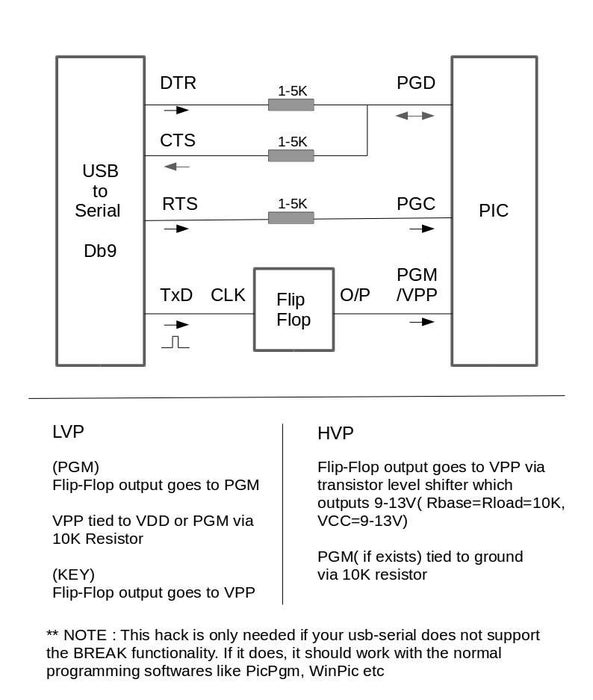
Usually the DIY programmers like JDM do not work for usb-serial converters. Voltage levels, timings, and missing functionality like setbreak() causes issues. And some require a microcontroller that has to be programmed first, a chicken-or-egg problem. This hack provides a way to program the PIC using a usb-serial converter. Note that i have tested it only for the 18F4550. I found that a resistor of 1-5K is a must between DTR and PGD, it prevents a near short between DTR and PGD, when PGD is HIGH and ensures proper signal to CTS.(Thanks Darron from kewl.org for pointing this out). For safety, one might add the resistors to CTS and RTS as well.
Step 1: Details
Nowadays, computers do not have serial/parallel ports. Neither has my
laptop. Since my interest in PIC programming was temporary and for hobby purposes, i did not want to get a commercial USB based PIC programmer. Besides, where's the fun in that ? I decided to get a cheap USB-Serial converter, and see if it could make it work.
i used a Bafo Db9 USB-serial converter for around 200 Rs. and a python software for PIC programming at
https://github.com/danjperron/burnLVP
i have blogged about it at :
http://chaukasalshi.blogspot.in/2014/12/pic-progra...
It also works in HVP mode with changes to provide the high voltage.
See http://chaukasalshi.blogspot.in/2015/01/pic-programmer-using-usb-to-serial.html
Source: PIC Programmer Using USB-Serial Converter for 18F4550
Quick Solutions to Questions related to PIC Programmer Using USB-Serial Converter:
- Why is this hack needed for USB-serial converters?
The hack is required if the USB-serial does not support the BREAK functionality, which causes issues with voltage levels and timings. - What specific resistor value is required between DTR and PGD?
A resistor of 1-5K ohms is mandatory between DTR and PGD to prevent near shorts and ensure proper signals. - Can this setup work without a dedicated microcontroller programmer first?
Yes, this hack solves the chicken-or-egg problem by allowing programming via a USB-serial converter without pre-programmed hardware. - Which software is recommended for programming the PIC in this project?
The article recommends using python software available at https://github.com/danjperron/burnLVP. - Does this method support High Voltage Programming mode?
Yes, it works in HVP mode provided there are changes made to provide the necessary high voltage. - Is it safe to add resistors to other pins besides DTR and PGD?
For safety, one might add resistors to CTS and RTS as well as DTR and PGD. - What was the cost of the USB-serial converter mentioned in the article?
The Bafo Db9 USB-serial converter used in the project cost around 200 Rs. - Does this solution work for all PIC microcontroller models?
The author notes they have tested it only for the 18F4550 model.
Related projects
Calculator Test using PIC24FJ64GA006 with Proteus Simulation
Introduction The Calculator Test using EASYHDL is a practical microcontroller project built on the PIC24FJ64GA006 and simulated in Proteus. This project demonstrates...
Programmers & ICSPPID Controlled Oven using TMS320F28027PT with Proteus Simulation
IntroductionThis project demonstrates a PID controlled oven implemented using a PICCOLO TMS320F28027PT microcontroller and verified through Proteus simulation.It is a practical microcontroller...
Programmers & ICSPPICCOLO Motor Controller Sample Design using TMS320F28023PT with Proteus Simulation
IntroductionThis project demonstrates a PICCOLO motor controller sample design implemented using the TMS320F28023PT Piccolo microcontroller and tested through Proteus simulation. It focuses...
Programmers & ICSP · PIC16F84APIC Musical Doorbell using PIC16F84A with Proteus Simulation
IntroductionThis microcontroller project demonstrates a musical doorbell built around a PIC16F84A and a simple piezo sounder.Using two push buttons, the system allows...
Programmers & ICSP · PIC16F877AEPE PIC/LCD Demo using PIC16F877 with Proteus Simulation
IntroductionThe EPE PIC/LCD Demo is a classic microcontroller project that demonstrates how a PIC16F877 can fully control a PG12864F graphical LCD.Designed as...
Programmers & ICSP · PIC16F628ADHT11 Low Cost Humidity Sensor using PIC16F628A with Proteus Simulation
IntroductionThis microcontroller project demonstrates how to interface a low-cost DHT11 temperature and humidity sensor with a PIC16F628A using a Proteus simulation environment.The...

Muhammad Bilal
I am a highly skilled and motivated individual with a Master's degree in Computer Science. I have extensive experience in technical writing and a deep understanding of SEO practices.