
Summary of MORE FLEXIBILITY AND HIGHER I/O SPEEDS? MEET THE NEW USB2IO INTERFACE EXPLORER
USB2IO is a USB-powered FPGA-based multi-I/O interface built around an STMicro STM32H7 MCU and an Intel Cyclone 10 FPGA. It provides 300 MHz I/O speed, supports 1.8V–3.3V signaling, includes 32 MB RAM and 64 MB ROM, a 20-pin I/O port (single-ended or 8 differential high-speed pairs), and a USB 2.0 high-speed port. It functions as a protocol analyzer, data logger, communication interface, embedded test platform, and basic signal generator, with upgradable MCU/FPGA firmware, a failsafe bootloader, and Python and C++ SDKs for developers.
Parts used in the USB2IO:
- STMicro STM32H7 MCU
- Intel Cyclone 10 FPGA
- USB 2.0 high-speed port
- 20-pin I/O port (single I/O or 8 differential high-speed pairs)
- 32MB RAM
- 64MB ROM
- Power delivery via USB
- Upgradeable MCU and FPGA firmware (bootloader)
- Python SDK
- C++ SDK
USB2IO is a high-tech interface device that is fully powered by USB and totally dependent on STMicro STM32H7 MCU and Intel Cyclone 10 FPGA. It is an FPGA-based multi-I/O device that offers ease of working with various electronic devices using common interfaces. It is designed towards helping engineers and embedded developers communicate with various breakout boards and functional hardware blocks.
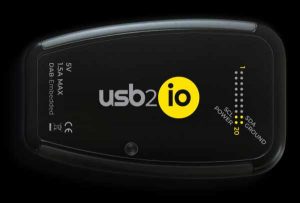
USB2IO comes with an I/O speed of 300 MHz, I/O voltage level support of 1.8V – 3.3V, 32MB RAM, 64MB ROM, a 20-pin I/O port (single I/O or 8-differential high-speed pairs), and a USB 2.0 high-speed port.
USB2IO is a USB to IO interface that combines the functionality of a protocol analyzer, a data logger, a communication interface, an embedded functional test platform, and a basic signal generator.
KEY FEATURES:
- Upgradable FPGA and MCU firmware for control modules
- Failsafe bootloader for safe firmware upgrade
- Python and C++ SDKs for developer’s support (invade you need to implement automated testing for instance)
Read more: MORE FLEXIBILITY AND HIGHER I/O SPEEDS? MEET THE NEW USB2IO INTERFACE EXPLORER
- What MCU does USB2IO use?
It uses the STMicro STM32H7 MCU. - What FPGA does USB2IO rely on?
It relies on an Intel Cyclone 10 FPGA. - What I/O speed does USB2IO offer?
USB2IO offers an I/O speed of 300 MHz. - What voltage levels are supported by USB2IO I/O?
It supports I/O voltage levels from 1.8V to 3.3V. - How much RAM and ROM does USB2IO have?
It includes 32MB RAM and 64MB ROM. - What kinds of ports does USB2IO provide?
It provides a USB 2.0 high-speed port and a 20-pin I/O port configurable as single I/O or 8 differential high-speed pairs. - What functions does USB2IO combine?
It combines a protocol analyzer, data logger, communication interface, embedded functional test platform, and a basic signal generator. - Can the FPGA and MCU firmware be upgraded?
Yes, the FPGA and MCU firmware are upgradable. - Is there a failsafe for firmware upgrades?
Yes, it includes a failsafe bootloader for safe firmware upgrades. - Are there developer SDKs available for USB2IO?
Yes, Python and C++ SDKs are provided for developer support.
