
Summary of INA190-Q1, 40V, BI-DIRECTIONAL, ULTRA-PRECISE CURRENT SENSE AMPLIFIER
The INA190-Q1 is an automotive, low-power, voltage-output current-shunt monitor for sensing across shunts at common-mode voltages from −0.2 V to +40 V (input pins max 42 V). It operates from 1.7 V to 5.5 V, has very low offset and bias currents enabling microamp-range measurements, low shutdown current, multiple fixed gains (25–500 V/V), excellent accuracy and drift specs, 50 µA quiescent current, and comes in a 1.8 mm × 1.4 mm UQFN-10 package.
Parts used in the INA190-Q1 Project:
- INA190-Q1 current-shunt monitor IC
- Current-sense resistor (value depends on desired measurement range)
- Supply voltage source (1.7 V to 5.5 V)
- Shunt resistor connected to monitored load and battery
- Automotive 12-V battery or system (common-mode up to +40 V)
- PCB footprint for 1.8 mm × 1.4 mm UQFN-10 package
- Bypass and decoupling capacitors for supply stability
- Connections/wiring rated for up to 42 V at inputs
The INA190-Q1 is an automotive, low-power, voltage-output, current-shunt monitor (also called a current-sense amplifier). This device is commonly used for monitoring systems directly connected to an automotive 12-V battery. The INA190-Q1 can sense drops across shunts at common-mode voltages from –0.2 V to +40 V, independent of the supply voltage. In addition, the input pins have an absolute maximum voltage of 42 V.
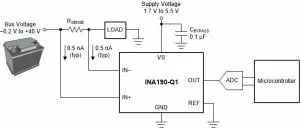
Features
- Low Supply Voltage, VVS: 1.7V to 5.5V
- Wide Common-Mode Voltage: –0.2V to +40V
- Low Shutdown Current: 100nA (Max)
- Low Input Bias Currents: 500pA (Typ) (Enables Microamp Current Measurement)
- Low Offset Voltage, VOS: ±15 µV (Max)
- Accuracy:
- Gain Error: ±0.2% (A1 Devices)
- Offset Drift: 0.13µV/°C (Max)
- Gain Drift: 5ppm/°C (Max)
- Gain Options:
- INA190A1: 25V/V
- INA190A2: 50 V/V
- INA190A3: 100V/V
- INA190A4: 200V/V
- INA190A5: 500V/V
- Quiescent Current: 50µA at 25°C (Typ)
- Package: 1.8mm x 1.4mm UQFN-10
The low input bias current of the device permits the use of larger current-sense resistors, thus providing accurate current measurements in the microamp range. The low offset voltage of the zero-drift architecture extends the dynamic range of the current measurement. This feature allows for smaller sense resistors with lower power loss, while still providing accurate current measurements.
Read more: INA190-Q1, 40V, BI-DIRECTIONAL, ULTRA-PRECISE CURRENT SENSE AMPLIFIER
- What common-mode voltage range can the INA190-Q1 sense?
The INA190-Q1 can sense common-mode voltages from −0.2 V to +40 V, with input pins absolute maximum of 42 V. - What supply voltage range does the INA190-Q1 support?
The device supports supply voltages from 1.7 V to 5.5 V. - Can the INA190-Q1 measure microamp currents accurately?
Yes; its low input bias current (typical 500 pA) permits use of larger sense resistors for accurate microamp current measurement. - What are the available gain options for the INA190-Q1?
The available gains are 25 V/V (A1), 50 V/V (A2), 100 V/V (A3), 200 V/V (A4), and 500 V/V (A5). - How low is the shutdown current for the INA190-Q1?
The shutdown current is specified as a maximum of 100 nA. - What is the typical quiescent current of the INA190-Q1?
Typical quiescent current is 50 µA at 25°C. - What is the offset voltage specification of the INA190-Q1?
The low offset voltage is specified as ±15 µV maximum. - What package does the INA190-Q1 come in?
The device is available in a 1.8 mm × 1.4 mm UQFN-10 package. - Does the INA190-Q1 allow lower power loss in current sensing?
Yes; low offset voltage allows use of smaller sense resistors, reducing power loss while maintaining accuracy.