
Summary of VISHAY INTERTECHNOLOGY HIGH SPEED PIN PHOTODIODE ENABLES IMPROVED BIO SENSOR PERFORMANCE
Vishay’s VEMD8081 is a high-speed silicon PIN photodiode in a 4.8 mm × 2.5 mm SMD top-view package with a 0.48 mm profile. It provides 33 µA typical reverse light current (15% higher than the VEMD8080), a 5.4 mm² radiant-sensitive area, spectral response from 350 nm to 1100 nm, low capacitance (50 pF), and fast switching—targeted at improved biosensor performance in wearables and medical SpO2/heart-rate monitors.
Parts used in the VEMD8081 Photodiode Device:
- Vishay Semiconductors VEMD8081 high-speed silicon PIN photodiode (4.8 mm × 2.5 mm SMD package, 0.48 mm profile)
- Two pulsing green LEDs (for heart rate measurement example)
- Red and infrared emitters (for SpO2 measurement example)
- Wearable device PCB for mounting SMD photodiode and LEDs
- Supporting circuitry for reverse bias and signal conditioning
Device Offers Increased Photocurrent of 33 µA in 4.8 mm by 2.5 mm SMD Package With Industry-Low 0.48 mm Profile.
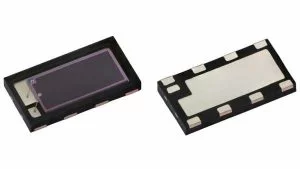
Vishay Intertechnology, Inc. today broadens its optoelectronics portfolio with the introduction of a new high-speed silicon PIN photodiode with enhanced sensitivity to visible and infrared light. Featuring a rectangular 4.8 mm by 2.5 mm top-view, surface-mount package with an industry-low 0.48 mm profile, the Vishay Semiconductors VEMD8081 offers an increased typical reverse light current of 33 µA for improved biosensor performance in wearable devices and medical applications.
The VEMD8081 offers 15 % greater reverse light current than its predecessor, the VEMD8080, while maintaining the same package dimensions. For designers, this provides a drop-in replacement that can improve performance by increasing signal output or extend battery life by reducing LED current.
For heart rate measurement in wearable devices such as fitness trackers and smartwatches, the VEMD8081 is placed between two pulsing green LEDs. The light reflected off the skin is received by the photodiode and converted to an output current, with the device’s increased sensitivity enabling more accurate measurements. The VEMD8081’s rectangular shape maximizes the area of the photodiode receiving reflected light, eliminating the wasted area typically found in square photodiodes. When combined with red and infrared emitters, the device is ideal for SpO2 measurement in medical monitors.
With its high sensitivity and a radiant-sensitive area measuring 5.4 mm², the VEMD8081 utilizes Vishay’s proven wafer technology to detect visible and near infrared radiation over a wide spectral range from 350 nm to 1100 nm. For high sampling rates, the device offers fast switching times and low capacitance of 50 pF.
Read more: VISHAY INTERTECHNOLOGY HIGH SPEED PIN PHOTODIODE ENABLES IMPROVED BIO SENSOR PERFORMANCE
- What package size and profile does the VEMD8081 use?
The VEMD8081 uses a rectangular 4.8 mm by 2.5 mm top-view SMD package with an industry-low 0.48 mm profile. - What is the typical reverse light current of the VEMD8081?
The typical reverse light current is 33 µA. - How does the VEMD8081 compare to the VEMD8080?
The VEMD8081 offers 15% greater reverse light current than the VEMD8080 while maintaining the same package dimensions. - What spectral range does the VEMD8081 detect?
It detects visible and near infrared radiation over a spectral range from 350 nm to 1100 nm. - What is the radiant-sensitive area of the photodiode?
The radiant-sensitive area measures 5.4 mm². - Is the VEMD8081 suitable for heart rate measurement in wearables?
Yes; the device is used between two pulsing green LEDs to receive reflected light from the skin for heart rate measurement. - Can the VEMD8081 be used for SpO2 measurement?
Yes; when combined with red and infrared emitters, it is ideal for SpO2 measurement in medical monitors. - What are the electrical performance characteristics relevant to high sampling rates?
The device offers fast switching times and low capacitance of 50 pF.