
Summary of TINY MEMS RESONATORS INTEGRATE LOAD CAPACITORS
SiTime Corporation launched the ApexMEMS family, third-generation MHz resonators targeting the $2 billion precision market. These devices offer 85% space savings and high reliability for mobile IoT, Bluetooth wearables, asset tracking, and microcontrollers. Available as silicon dies for co-packaging with semiconductors, they support system-in-package integration to meet growing connectivity demands in automotive and industrial sectors by 2024.
Parts used in the ApexMEMS Project:
- ApexMEMS family of MHz resonators
- Silicon die
- Bluetooth chips
- Microcontrollers
- High-performance semiconductors
- System-in-packages
- Modules
SiTime Corporation announced that it has entered the $2 billion precision resonator market with the ApexMEMS family of MHz resonators. These new devices are the third-generation of SiTime silicon ctechnology and are available in a variety of MHz frequencies for high-volume electronics. Mobile and IoT applications such as Bluetooth wearables and wearables, high-speed connectivity interfaces, asset-tracking, as well as microcontrollers, can take advantage of the 85% space savings, integration, consistent performance, resilience, and reliability that are offered by ApexMEMS resonators.
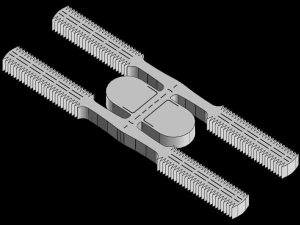
According to estimates by Dedalus Consulting and SiTime, the resonator market is $3 billion in size and consists of three product categories – approximately $2 billion of precision resonators, $400 million of ceramic resonators, and $600M of SAW resonators. By 2024, industry analysts and SiTime estimate that 25 to 30 billion precision resonators will be sold, driven by the growth of connectivity in mobile-IoT, industrial-IoT, automotive, and industrial electronics. It is expected that up to 30% of these resonators will need to be very small, offer higher performance, and be easily integrated into system-in-packages and modules. This high-value market is one use case for ApexMEMS resonators.
For integration into standard IC packages and modules, ApexMEMS resonators are available as a silicon die. Co-packaging these resonators with high-performance semiconductors such as Bluetooth chips and microcontrollers gives customers a significant system and development advantage.
Read more: TINY MEMS RESONATORS INTEGRATE LOAD CAPACITORS
- What is the size of the precision resonator market?
The precision resonator market is estimated at $2 billion. - How much space do ApexMEMS resonators save?
They offer 85% space savings compared to previous technologies. - Can ApexMEMS resonators be integrated into standard IC packages?
Yes, they are available as a silicon die for integration into standard IC packages and modules. - Which applications benefit from these new resonators?
Mobile and IoT applications such as Bluetooth wearables, asset-tracking, and microcontrollers can take advantage of them. - How many precision resonators are expected to be sold by 2024?
Industry analysts estimate that 25 to 30 billion precision resonators will be sold by 2024. - What percentage of resonators need to be very small by 2024?
Up to 30% of these resonators will need to be very small, offer higher performance, and be easily integrated. - What type of technology is used in the ApexMEMS family?
These devices represent the third-generation of SiTime silicon technology. - Why is co-packaging with semiconductors advantageous?
Co-packaging with high-performance semiconductors gives customers a significant system and development advantage.