


Home Alarm System
PIC16F84A Alarm Clock
Analog data recording and playback unit
Animated LED Signboard
Capacitance measurement
Capaciter meter
Microcontroller PIC16F877A is one of the PICMicro Family microcontroller which is popular at this moment, start from beginner until all professionals. 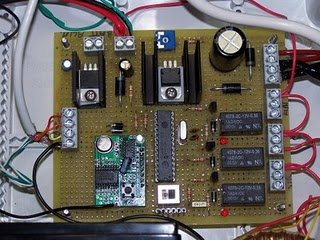 Because very easy using PIC16F877A and use FLASH memory technology so that can be write-erase until thousand times. The superiority this Risc Microcontroller compared to with other microcontroller 8-bit especially at a speed of and his code compression. PIC16F877A have 40 pin by 33 path of I/O.
PIC16F877A perfectly fits many uses, from automotive industries and controlling home appliances to industrial instruments, remote sensors, electrical door locks and safety devices. It is also ideal for smart cards as well as for battery supplied devices because of its low consumption. EEPROM memory makes it easier to apply microcontrollers to devices where permanent storage of various parameters is needed (codes for transmitters, motor speed, receiver frequencies, etc.). Low cost, low consumption, easy handling and flexibility make PIC16F877A applicable even in areas where microcontrollers had not previously been considered (example: timer functions, interface replacement in larger systems, coprocessor applications, etc.).In System Programmability of this chip (along with using only two pins in data transfer) makes possible the flexibility of a product, after assembling and testing have been completed. This capability can be used to create assembly-line production, to store calibration data available only after final testing, or it can be used to improve programs on finished products.
A PIC16F84A Alarm Clock
Here is a simple PIC16F84A alarm clock. This page summarizes this discussion (in french) in my forum, where Samir (aka numerique1) requested for help to build a weekly alarm clock for his school. Many thanks to him for his tests and patience.
This clock counts seconds, minutes, hours and day of the week.
Time is displayed on 4 seven segment LED displays, and is adjustable with three buttons at start time (up, down, enter).
You can program the day of the week, hour, minute and duration of the alarms.
The number of alarms are limited by ROM space only.
The alarm is on the RA4 open collector output of the PIC, and is repeated on a decimal point of the display.
For once, the program is in BASIC (mikroBasic) and I hope it will make a good start for beginners.
Note that you can build it either for common cathod or common anode LED display
Knight Rider Chasing Lights
PIC LED flasher
picoBAT, an ultrasonic bat detector with 3 components
Pic Delay Code
Digital Capacitance Meter
Autorange Capacitance Meter
Control Up to 8 Devices with IR Remote
Stepper Motor Controller
Led Clock
For more detail: pic-microcontroller
Related projects
PIC16F877 Driving LCD in 4-Bit Mode using PIC16F877 with Proteus Simulation
Introduction This microcontroller project shows how a PIC16F877 can drive an LCD display using 4-bit mode inside a Proteus simulation.The project demonstrates...
Beginner Tutorials · PIC16F84APIC Stepper Motor Controller using PIC16F84A with Proteus Simulation
Introduction Stepper motors are widely used in embedded systems and DIY electronics projects where precise position control is required. This PIC Stepper...
Programmers & ICSP · PIC16F84APIC Musical Doorbell using PIC16F84A with Proteus Simulation
IntroductionThis microcontroller project demonstrates a musical doorbell built around a PIC16F84A and a simple piezo sounder.Using two push buttons, the system allows...
Programmers & ICSPCalculator Test using PIC24FJ64GA006 with Proteus Simulation
Introduction The Calculator Test using EASYHDL is a practical microcontroller project built on the PIC24FJ64GA006 and simulated in Proteus. This project demonstrates...
Programmers & ICSPPID Controlled Oven using TMS320F28027PT with Proteus Simulation
IntroductionThis project demonstrates a PID controlled oven implemented using a PICCOLO TMS320F28027PT microcontroller and verified through Proteus simulation.It is a practical microcontroller...
Programmers & ICSPPICCOLO Motor Controller Sample Design using TMS320F28023PT with Proteus Simulation
IntroductionThis project demonstrates a PICCOLO motor controller sample design implemented using the TMS320F28023PT Piccolo microcontroller and tested through Proteus simulation. It focuses...

Ibrar Ayyub
I am an experienced technical writer holding a Master's degree in computer science from BZU Multan, Pakistan University. With a background spanning various industries, particularly in home automation and engineering, I have honed my skills in crafting clear and concise content. Proficient in leveraging infographics and diagrams, I strive to simplify complex concepts for readers. My strength lies in thorough...