


Summary of DC motor control with PIC16F84A and L293D
Summary: This project controls a 12V DC motor’s speed and direction using a PIC16F84A microcontroller and an L293D half H-bridge driver. Five buttons adjust speed, direction, and stop; three LEDs indicate direction and maximum speed. Software PWM at 500 Hz (via CCS C PWM library using Timer0) varies duty cycle to change motor speed. L293D V S = motor supply (12V) and V SS = +5V.Parts used in the DC motor control with PIC16F84A and L293D:
- PIC16F84A microcontroller
- L293D motor driver IC (half H-bridge)
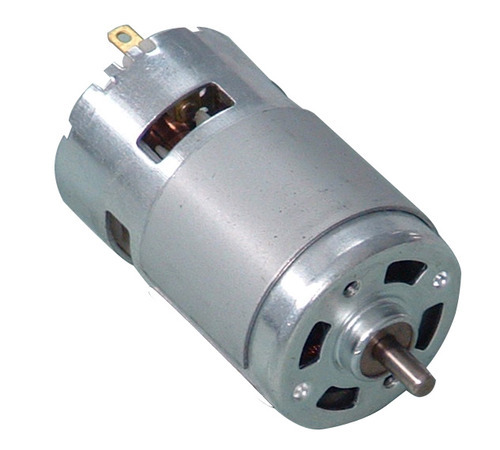
- 12V DC motor (nominal 12V)
- Five push-button switches (speed up, speed down, direction1, direction2, stop)
- Three LEDs (LED1 direction, LED2 direction, LED3 maximum speed)
- Resistors for LEDs and button pull-ups/pull-downs as required
- 5V regulator or 5V supply for VSS
- 12V supply for motor and L293D VS
- Breadboard or PCB and interconnect wiring
Related topics:
The following topic shows how to control a DC motor with PIC16F84A and H-bridge circuit.
DC Motor speed and direction control with PIC16F84A using H-bridge
DC motor control with PIC16F84A and L293D circuit:
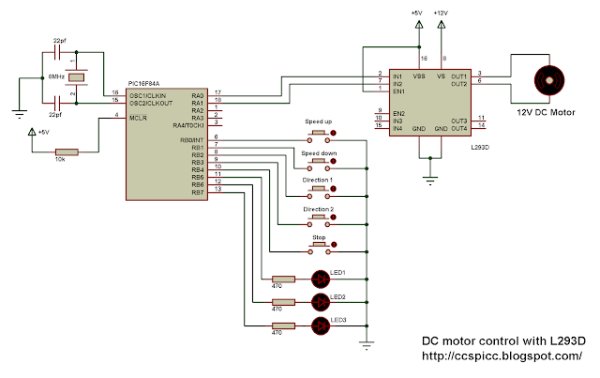
Project circuit schematic is shown below
The nominal voltage of the motor is 12V as well as L293D VS input voltage. Always L293D VS voltage is the same as the DC motor voltage and L293D VSS voltage is +5V.
In the circuit there are 5 buttons, the first button which is connected to RB0 pin is used to speed up the motor, and speed down button to decrease motor speed. Third and fourth buttons are used to choose direction rotation of the motor (direction 1 or direction 2). The last button stops the motor no matter what speed or direction.
There are 3 LEDs, LED1 and LED2 are used to indicate motor direction, and the other LED indicates maximum speed, which means when it is on the motor is running at maximum speed.
When speed up button is pressed the PWM duty cycle increases which causes the motor to increase its speed and when the duty cycle = 100 LED 3 turned on. In the other hand if speed down button is pressed the duty cycle decreases and the motor speed also decreases.
If the stop button pressed the motor stops and the 3 LEDs are off.
Software PWM is used wih frequency of 500Hz.
DC Motor control with PIC16F84A and L293D CCS C code:
The full C code is shown below. Official software PWM library which comes with CCS PIC C compiler is used, this library uses Timer0 to generate the PWM signal.
Read more: DC motor control with PIC16F84A and L293D
Quick Solutions to Questions related to DC motor control with PIC16F84A and L293D:
- What motor supply voltage should be used?
The nominal motor voltage is 12V and L293D VS should be the same as the motor voltage. - What voltage is applied to L293D VSS?
L293D VSS voltage is +5V. - How many buttons are used and what do they do?
Five buttons are used: speed up, speed down, direction 1, direction 2, and stop. - How many LEDs are used and what do they indicate?
Three LEDs: two indicate motor direction and one indicates maximum speed when on. - How is motor speed controlled?
Motor speed is controlled by changing the PWM duty cycle; increasing duty cycle increases speed. - What PWM frequency is used?
Software PWM is used with a frequency of 500 Hz. - Which timer does the software PWM use in this project?
The official CCS C software PWM library uses Timer0 to generate the PWM signal. - What happens when the stop button is pressed?
If the stop button is pressed the motor stops and all three LEDs are off. - When does the maximum speed LED turn on?
The maximum speed LED turns on when the PWM duty cycle reaches 100%.
Related projects
PIC Stepper Motor Controller using PIC16F84A with Proteus Simulation
Introduction Stepper motors are widely used in embedded systems and DIY electronics projects where precise position control is required. This PIC Stepper...
Programmers & ICSP · PIC16F84APIC Musical Doorbell using PIC16F84A with Proteus Simulation
IntroductionThis microcontroller project demonstrates a musical doorbell built around a PIC16F84A and a simple piezo sounder.Using two push buttons, the system allows...
Beginner Tutorials · PIC16C84Exploring the World of PIC Microcontrollers: An Architectural Overview
A Peripheral Interface Microcontroller (PIC), developed by General Instruments Microcontrollers in 1993, operates under software control and is programmed to execute various...
Motors & RoboticsReal-Time CAN-Based Vehicle Monitoring System with PIC MCU
INTRODUCTION The Controller Area Network (CAN) is a robust vehicle communication bus standard that was primarily developed for automobile applications but has...
Motors & RoboticsEasy Way to Learn Robotics Using Microcontrollers: A Beginner’s Guide
The title, "Easy Way to Learn Robotics Using Microcontrollers," promises an accessible entry point for those curious about the exciting world of...
Motors & Robotics · PIC16F877AEfficient Sun-Following Robot: A Solar Tracker with Microcontroller Control
Abstract The impending global challenge of dwindling non-renewable fuel resources underscores the urgency of transitioning towards renewable energy alternatives like solar power....

Ibrar Ayyub
I am an experienced technical writer holding a Master's degree in computer science from BZU Multan, Pakistan University. With a background spanning various industries, particularly in home automation and engineering, I have honed my skills in crafting clear and concise content. Proficient in leveraging infographics and diagrams, I strive to simplify complex concepts for readers. My strength lies in thorough...