
Summary of ACME SYSTEMS ROLLS OUT SAMA5D27 BASED SOMS
Acme Systems launched the RoadRunner SOM series based on the Microchip SAMA5D27 MPU, targeting extreme-low-power Linux-capable applications. The ten-layer modules offer industrial temperature operation, 10 mW freeze mode with ~1 s wake, extensive memory and security features, rich I/O including Ethernet, RGB LCD, audio, CAN-FD, USB, multiple UARTs, ADCs, and cryptographic accelerators, and connect to carrier boards via dual 100-pin Hirose connectors.
Parts used in the RoadRunner:
- Microchip SAMA5D27 microprocessor (Arm Cortex-A5)
- Optimized PMIC (Power Management Integrated Circuit)
- Low-power RAM (including internal scrambled SRAM)
- Quad-SPI (QSPI) flash memory
- DDR3L memory (up to 256MB)
- e.MMC flash (supported)
- Hirose 100-pin connectors (two)
- Stereo audio amplifier
- Peripheral touch controller
- PDM microphone interface (PDMIC)
- CAN-FD MCAN controller
- GPIO lines (up to 128)
- 12-bit ADCs (up to 12 channels)
- USART interfaces (five)
- UART serial ports (five plus one receive-only)
- USB High Speed hosts/device and HSIC interface
- SDIO/SD/MMC host interfaces
- Image sensor controller
- Timers and PWM modules
- Programmable clocks (up to three)
- JTAG port
- Serial debug port
- Battery input for real-time clock
- Arm NEON coprocessor and hardware FPU
- Hardware crypto accelerators: AES, TRNG, SHA
Acme Systems recently launched a series of systems-on-modules (SOMs) based on the Microchip SAMA5D27 microprocessor, which is ideal for extreme-low-power projects that still require a full Linux kernel and operating system, dubbed the RoadRunner. At the core of the RoadRunner is a Microchip MPU, which is designed for low power consumption, and it features an optimized PMIC [Power Management Integrated Circuit], a low-power RAM, and the Quad-SPI [flash] memory. The module is designed for even heavy industrial use, that is why the ten-layer board operates between -40 and 85°C (around -40 to 185°F) and boasts of a 10mW “freeze mode” sleep with full wake-up clocking around a second.
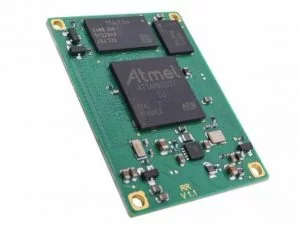
The SAMA5D27 microprocessor is a high-performance, low-power Arm cortex-A5 CPU embedded microprocessor running up to 500MHZ with the integration of multiple memories such as DDR2, DDR3L, LPDDR2, LPDDPR3, e.MMC Flash and QSPI. This microchip offers advanced security functions like Arm Trust Zone, tamper detection, secure boot, and secure data storage with full integration of robust peripherals for connectivity and user interface applications as well as high-performance crypto accelerators AES, TRNG, and SHA. The SAMA5D2 series is packaged with free Linux distributions, MPLAB X IDE, MPLAB Harmony v3, and bare-metal C examples. The SAMA5D27 has an added industrial temperature range operation (-40°C to 105°C external temperature).
The SAMA5D27 features 128kB L2 cache which can be configured as an internal 32-bit single-cycle static RAM (SRAM), 5kB of internal scrambled SRAM of which 4kB are automatically erasable on tamper detection, and 256 bits of scrambled and erasable registers. It also enables 256MB of DDR3L memory, up to 128MB of QSPI flash, an Arm NEON coprocessor, hardware floating-point unit, and hardware cryptographic acceleration including a FIPS-compliant true random number generator. The module is connected to a carrier board via two Hirose 100-pin connectors which relays signals including 10/100 Ethernet, an 24-bit RGB LCD interface, resistive and capacitive touch interfaces, SSC/I2S, I2C, SPI, QSPI.
It also features a stereo audio amplifier, peripheral touch controller, PDMIC, CAN-FD MCAN, up to 128 GPIO lines, and up to 12 12-bit analogue-to-digital converters (ADCs). it enables five USART, five UART serial ports and an additional receive-only UART, and two USB High Speed hosts or one host and one device. Additional features include; USB High-Speed Inter-Chip HSIC interface, SDIO, SD, or MMC hosts, image sensor controller, timers, PWM, up to three programmable clocks, a JTAG port, serial debug port, and a battery input for the internal real-time clock.
Read more: ACME SYSTEMS ROLLS OUT SAMA5D27 BASED SOMS
- What processor is the RoadRunner SOM based on?
The RoadRunner SOM is based on the Microchip SAMA5D27 Arm Cortex-A5 microprocessor. - Does the RoadRunner support full Linux?
Yes, the SAMA5D2 series is packaged with free Linux distributions and supports a full Linux kernel and operating system. - What temperature range can the module operate in?
The ten-layer module operates between -40 and 85°C, and the SAMA5D27 supports industrial external temperatures up to -40 to 105°C. - How low is the RoadRunner sleep power consumption?
The module offers a 10 mW freeze mode sleep with full wake-up clocking around one second. - What memory and storage options are available?
It supports DDR3L memory up to 256MB, up to 128MB QSPI flash, and e.MMC flash. - What connectivity and interfaces does it provide to a carrier board?
Signals exposed via two 100-pin Hirose connectors include 10/100 Ethernet, 24-bit RGB LCD, touch interfaces, SSC/I2S, I2C, SPI, QSPI, USB, SDIO/SD/MMC, CAN-FD, and more. - Does the SAMA5D27 include hardware security and crypto features?
Yes, it includes Arm TrustZone, tamper detection, secure boot, secure data storage, AES, TRNG, and SHA accelerators. - What audio and sensor interfaces are available?
The module features a stereo audio amplifier, PDMIC, peripheral touch controller, and an image sensor controller. - How many UART and ADC channels are supported?
It provides five USART, five UART plus one receive-only UART, and up to twelve 12-bit ADC channels. - What development and software tools are provided?
The SAMA5D2 series is packaged with free Linux distributions, MPLAB X IDE, MPLAB Harmony v3, and bare-metal C examples.