Summary of 18650 LIPO BATTERY MANAGER FOR REMOTE APPLICATIONS
The 18650 LiPo Battery Manager is an all-in-one single-cell LiPo battery add-on featuring a dual-rail power supply (5V and 3.3V), a fuel gauge, and battery management functions suitable as a power bank for projects. It uses TI bq24075 for charging with DIP-switch selectable charge currents (1A, 500mA, 100mA), supports Dynamic Power Path Management to supply load while charging, and integrates a BQ27441-G1A Impedance Track fuel gauge for accurate capacity reporting; the gauge wakes from sleep in a few seconds to show correct data and idle MCU/OLED consumption when no load is present.
Parts used in the 18650 LiPo Battery Manager:
- 18650 single-cell battery (form factor)
- bq24075 battery management IC (Texas Instruments)
- BQ27441-G1A fuel gauge IC
- Dual-rail power supply providing 5V rail
- 3.3V rail for microcontroller and display
- DIP switch for selecting charge current (1A, 500mA, 100mA)
- Microcontroller (MCU)
- OLED display
- USB input connector
- OUT power output pins
The 18650 LiPo battery manager comes with a fuel gauge and a dual-rail power supply. The dual-rail power provides a 5V rail along with a 3.3V rail dedicated to powering the microcontroller and the display ports of the system. It is termed as an “all-in-one single-cell LiPo battery manager” by Manuel Alfonso for its flexible compatibility with all types of single cells and its various functionalities for battery monitoring operations. However, the 18650 LiPo Battery Manager is dedicated to a form factor that can act as an add-on at the back of the 18650 battery box. Hence, it can be used as a power bank for various projects.
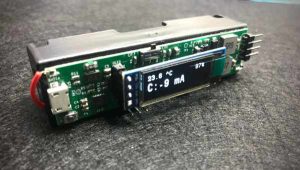
18650 LiPo battery manager features a bq24075 IC from Texas Instruments for battery management and monitoring functionality. The maximum charge current can be controlled via the DIP switch, which outputs 1A, 500mA, and 100mA current readings. The combination of the pin status determines the maximum current value is shown in the table below:
The bq24075 chip’s Dynamic Power Path Management (DPPM) makes the output active “whenever a source is connected to USB or BAT, guaranteeing power to the project even if the battery has died. The input current from USB is shared and balanced between charging the battery and powering the system load at OUT.” In Battery Supplement Mode, if the output current exceeds the limit configured by the DIP switch during the charging process, then the battery provides the system load without any regulation. Hence, the maximum current can be drawn in any condition.
The 18650 LiPo battery manager supports the BQ27441-G1A fuel gauge featuring the Impedance Track Technology. It efficiently predicts battery capacity and other operational characteristics with utmost accuracy. There is a delay of a few seconds for the display of accurate data after powering the board because the IC is in sleep mode and it takes some time to wake up. When there is no load on the output pins, the actual consumption by the MCU and OLED display is shown on the display.
Read more: 18650 LIPO BATTERY MANAGER FOR REMOTE APPLICATIONS
- What charge currents can I select with the DIP switch?
The DIP switch configures maximum charge current to 1A, 500mA, or 100mA based on pin status. - Does the manager provide power while charging?
Yes, bq24075 Dynamic Power Path Management makes the output active whenever USB or BAT is connected, supplying the project even if the battery is dead. - Can the system draw maximum current during charging?
Yes, in Battery Supplement Mode if output current exceeds the DIP-selected limit during charging the battery provides the system load, allowing maximum current draw. - Which fuel gauge IC does it use?
It uses the BQ27441-G1A fuel gauge featuring Impedance Track Technology. - Why does the display take a few seconds to show accurate data?
Because the fuel gauge IC is in sleep mode and needs a few seconds to wake up and report accurate data. - What rails does the dual-rail power supply provide?
The dual-rail provides a 5V rail and a 3.3V rail dedicated to the microcontroller and display ports. - Is the board compatible with all single-cell LiPo types?
The project is described as flexible and compatible with all types of single cells as an all-in-one single-cell LiPo battery manager. - Will the display show MCU and OLED consumption when idle?
Yes, when there is no load on the output pins the actual consumption by the MCU and OLED display is shown.