


Summary of PIC18F2550 DEVELOPMENT BOARD CIRCUT USB BOOTLOADER PCB
This article describes a PIC18F2550 application/development board with USB bootloader support, featuring USB communication, 24Cxx I2C EEPROM, ICSP programming with LVP option, 5V/1A regulated supply, 20 MHz crystal, and configurable pinheaders for I/O and peripheral selection. It highlights jumpers for routing B6/B7, B0/B1, and USB-related pins, power/reset functions, and on-board terminals for easy PCB or perfboard mounting. Files (Proteus ISIS/ARES and project ZIP) are provided by the author.Parts used in the PIC18F2550 Application Board:
- PIC18F2550 microcontroller
- 24Cxx EEPROM (I2C)
- 20 MHz crystal
- 6-15V power supply input (connector)
- 7805 5V voltage regulator (1A)
- USB connector
- ICSP header
- Pin header I/O terminal system
- Jumpers J1, J2, J3, J4, J5, J6, J7
- Capacitors C4 and C5
- Power LED
- Reset (MCLR) circuit/pull-down or pull-up
- Power out terminal (GND and +V, +5V output)
Unlike other applications that attempt PIC18F2550 development board “USB bootloader” option for the project for which you want to apply with the PIC18F2550 keep a circuit will provide great convenience for. PIC18F2550 Application Board... Electronics Projects, PIC18F2550 Development Board Circut USB Bootloader PCB "pic development board, pic18f2550 projects, "

Unlike other applications that attempt PIC18F2550 development board “USB bootloader” option for the project for which you want to apply with the PIC18F2550 keep a circuit will provide great convenience for.
PIC18F2550 APPLICATION BOARD PCB
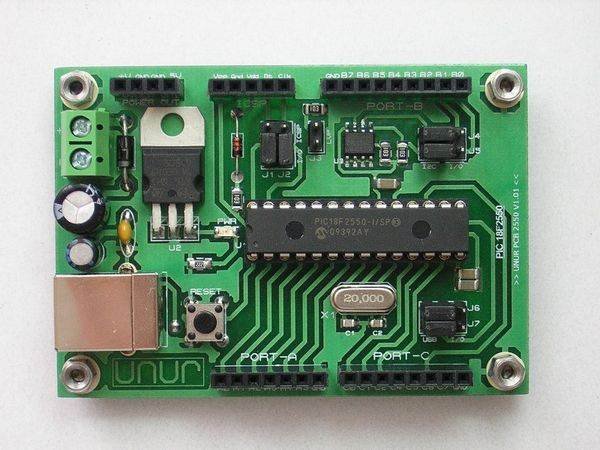
Hardware; PIC 18f2550 I/SP microcontroller., 24Cxx EEPROM (I2c communication with), 20 MHz crystal., 6-15V power supply input., 5V 1A regulated output., USB support., ICSP programming, Pin header I/O terminal system
General features and usage
1-USB: USB support is the most important feature of self PIC 18f2550 aygün surgical instruments carried out. In this way, you can have a quick communication with your computer via USB.
2-24Cxx EEPROM with I2c serial communication protocol, communicate with each other on the card: an eeprom.
3-ICSP programmer with ICSP support from microdenetleyicinizi over a: removing the card on the program.
4-5V regulated: regulate the IC Card on the 7805 5v supply is provided through microdenetleyicinizin.
5-ICSP-jumpers J1 and J2 I/O with B6 and B7: ports on demand for ICSP programming or I/O port allows you the choice of using.
6-LVP: J3 jumper is inserted ICSP programming with low voltage mode programming. (Supports Low voltage programming for programmers.)
7-I2c – I/O: J4 and J5 jumpers B0 and B1 ports on demand through the I2c communication is the use of the eeprom or I/O port allows you the choice of using.
8-USB-I/O: J6 and J7 thanks to C4 and C5 ports on demand USB communication jumpers or the ability to use selection as I port.
9. Power Led: indicates whether the + 5v supply.
10-Reset: old Microdenetliyicinin foot pulls MCLR pulls back. Reset the reset is activated from the program.
11-Power Out Terminal: terminal 4 output. One of these 2 GND (negative), and others;
+ V is the same as the voltage is entered into clips on the card:.
+ 5V output voltage circuit is: (max. 1A)
12-Port I/O Terminal: terminal system in all ports with active Mikrodenetliyicinin pinheader is available.
PIC18F2550 BOARD ICSP CONNECTION
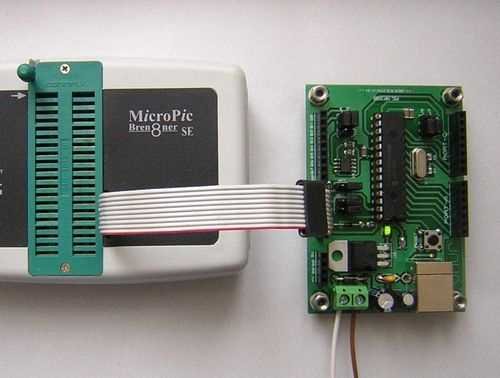
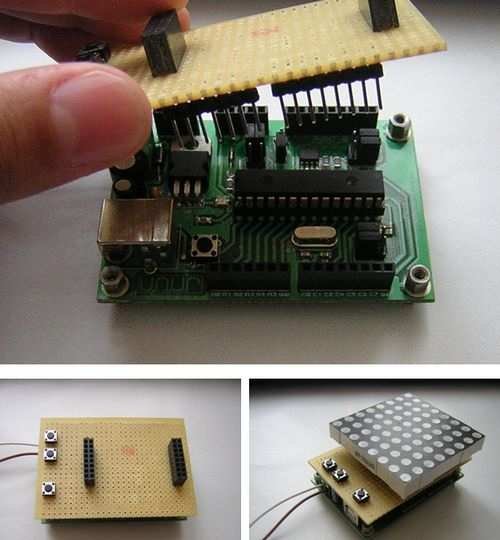
On-board supply and the I / O terminals to the top pcb mounting system is designed as a pinhead, according to the template established on their drawings printed circuit boards or perforated plate circuits that can operate easily.
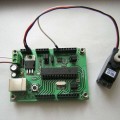
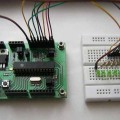
author: Cenk Cemil UNUR [email protected] – Bootloader PIC18F2550 Circuit of the proteus isis, ares files and microchip software: pic18f2550-development-board-circut-usb-bootloader-pcb.ZIP
- What is the main communication feature of the PIC18F2550 application board?
USB support provides quick communication with a computer. - Does the board support external EEPROM?
Yes, it includes a 24Cxx EEPROM communicating via I2C. - How is the board programmed?
The board supports ICSP programming and has jumpers for ICSP use. - Can the board use low voltage programming?
Yes, inserting jumper J3 enables low voltage programming mode. - How is the microcontroller powered and regulated?
The board accepts 6–15V input and uses a 7805 regulator to provide 5V up to 1A. - Are I/O pins accessible for external connections?
Yes, all microcontroller pins are available on a pinheader I/O terminal system for easy mounting. - What do jumpers J1 and J2 do?
J1 and J2 select between ICSP programming or using B6 and B7 as I/O ports. - What do jumpers J4 and J5 control?
J4 and J5 allow choosing B0 and B1 for I2C communication with EEPROM or as general I/O. - How are USB pins used as I/O?
Jumpers J6 and J7 with C4 and C5 enable selecting USB communication or using those pins as I/O ports. - Is there an indicator for power status?
Yes, a Power LED indicates the presence of the +5V supply.
Related projects
Pinguino Project: A PIC Microcontroller Based Arduino
This is a complete tutorial to make a PIC Microcontroller based Arduino. This is a complete tutorial to make PIC microcontroller based...
Audio, Sound & Radio · PIC18F2550LM386 based stereo audio amplifier with digital volume control using PIC18F2550
Due to its simplicity (requires minimum external components) and high availability, LM386 is very popular among hobbyists for use in low-voltage audio...
Meters & Test Instruments · PIC18F2550Harmonic Distortion Meter using PIC18F2550
The 3rd harmonic distortion meter has been designed for measuring the quality of AC supply. The meter is built with a PIC18F2550...
Communication & Interfacing · PIC18F4520CAN FD Node based on a PIC18 Microcontroller
The introduction sets the stage for an embedded systems project that involves developing a Embedded C CAN FD project using the MCP2517FD...
Communication & InterfacingLAN9662 Gigabit Switch: Optimized for Industrial Ethernet
Introduction It should come as little surprise therefore that one element of what is now more commonly referred to in some circles...
Communication & InterfacingPIC Microcontroller: Fundamentals & Applications for Students
Introduction Microcontrollers are the key components in the embedded systems market. A variety of embedded systems was formed and developed after the...

Ibrar Ayyub
I am an experienced technical writer holding a Master's degree in computer science from BZU Multan, Pakistan University. With a background spanning various industries, particularly in home automation and engineering, I have honed my skills in crafting clear and concise content. Proficient in leveraging infographics and diagrams, I strive to simplify complex concepts for readers. My strength lies in thorough...