


Summary of PIC 16F84 Serial Programmer
Summary: The article describes a simple RS232-powered serial programmer for the PIC 16C84/16F84 microcontroller. It highlights the programmer's compatibility with laptops, lack of ZIF socket (use an open IC socket), available PCB layout (pic16f84.pdf), and references MPLAB and online resources for programming software and examples.Parts used in the PIC 16F84 Serial Programmer:
- 9-pin female RS232 connector (CON1)
- Open IC socket (for PIC 16C84 / 16F84)
- PCB (1:1 layout, pic16f84.pdf)
- Passive components for RS232 power extraction (resistors, capacitors as per circuit)
- Transistors or level-shifting components as per published circuit
- Wiring to connect PIC to programmer
- Optional laptop/PC serial port (provides power)
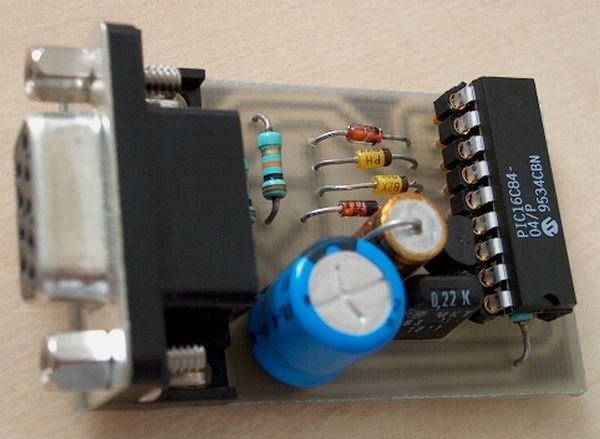
Despite its somewhat unusual design - like the 128 byte page RAM/Register direct/indirect memory mapping - it is a popular microcontroller, easily available and programmable now as flash microcontroller 16F84. The developer environment MPLAB from Microchip is free of charge and many application examples are available.
I prefer a serial programmer. It does not require an external power supply, it extracts power from the PC RS232 connection. The circuit below also works fine with laptop computers, despite their often too low RS232 voltages. The 9-pin female connector (CON1) connects directly to the PC serial output. It is not designed as a production programmer, so it lacks a ZIF-socket. Use an open IC-socket instead. The 1:1 PCB layout is available as PDF formatted file: pic16f84.pdf.

The PCB package I use locates the layout at the bottom of the page. View the PCB etching page to produce the PCB. Programming software and application examples could be found for example at the links of www.mikrocontroller.net,
For more detail: PIC 16F84 Serial Programmer
Quick Solutions to Questions related to PIC 16F84 Serial Programmer:
- Does the programmer require an external power supply?
No, it extracts power from the PC RS232 connection according to the article. - Is the programmer compatible with laptop serial ports?
Yes, the article states it works fine with laptop computers despite often low RS232 voltages. - Is this programmer intended for production use?
No, it is not designed as a production programmer and lacks a ZIF socket. - What socket should be used for the PIC on this programmer?
Use an open IC socket instead of a ZIF socket as recommended in the article. - Where can I find the PCB layout?
The 1:1 PCB layout is available as a PDF file named pic16f84.pdf per the article. - Where can I find programming software and examples?
The article suggests MPLAB (free) and online resources such as the links on www.mikrocontroller.net for software and examples. - Does the article mention support for PIC 16F84 flash versions?
Yes, it notes the PIC 16C84 is popular and available as the flash microcontroller 16F84.
Related projects
PIC Stepper Motor Controller using PIC16F84A with Proteus Simulation
Introduction Stepper motors are widely used in embedded systems and DIY electronics projects where precise position control is required. This PIC Stepper...
Programmers & ICSP · PIC16F84APIC Musical Doorbell using PIC16F84A with Proteus Simulation
IntroductionThis microcontroller project demonstrates a musical doorbell built around a PIC16F84A and a simple piezo sounder.Using two push buttons, the system allows...
Beginner Tutorials · PIC16C84Exploring the World of PIC Microcontrollers: An Architectural Overview
A Peripheral Interface Microcontroller (PIC), developed by General Instruments Microcontrollers in 1993, operates under software control and is programmed to execute various...
Programmers & ICSPCalculator Test using PIC24FJ64GA006 with Proteus Simulation
Introduction The Calculator Test using EASYHDL is a practical microcontroller project built on the PIC24FJ64GA006 and simulated in Proteus. This project demonstrates...
Programmers & ICSPPID Controlled Oven using TMS320F28027PT with Proteus Simulation
IntroductionThis project demonstrates a PID controlled oven implemented using a PICCOLO TMS320F28027PT microcontroller and verified through Proteus simulation.It is a practical microcontroller...
Programmers & ICSPPICCOLO Motor Controller Sample Design using TMS320F28023PT with Proteus Simulation
IntroductionThis project demonstrates a PICCOLO motor controller sample design implemented using the TMS320F28023PT Piccolo microcontroller and tested through Proteus simulation. It focuses...

Ibrar Ayyub
I am an experienced technical writer holding a Master's degree in computer science from BZU Multan, Pakistan University. With a background spanning various industries, particularly in home automation and engineering, I have honed my skills in crafting clear and concise content. Proficient in leveraging infographics and diagrams, I strive to simplify complex concepts for readers. My strength lies in thorough...