
Summary of New Earth Time digital clock in recycled retro-modern case using PIC16F627A
This article guides readers in building a New Earth Time (NET) digital clock using a PIC16F627A microcontroller. The project features a unique time standard counting in degrees and minutes, housed in a recycled retro-modern case from an old thermostat. The build involves assembling 7-segment displays, transistors, resistors, capacitors, and a custom-made Degrees LED indicator using heatshrink and a marker. A 32.768kHz crystal ensures accurate timekeeping, while pushbuttons allow for setting adjustments.
Parts used in the New Earth Time Digital Clock:
- PIC16F627A Microcontroller
- 32.768kHz Crystal
- 22pF Ceramic Capacitor
- 10k Resistor
- 100 Ohm Resistor
- 4.7k Resistor
- 1k Resistor
- 2n3904 Transistor
- Common Cathode 7-segment Display
- SPST Momentary pushbutton switch
- Round LED
- 5V Power source or LM7805 Regulator
- Recycled Case
- Breadboard or Perfboard
- Hookup Wire
- Heatshrink tubing
- Sharpie Marker
New Earth Time (NET) digital clock in recycled retro-modern case
Ever get confused by GMT, or just wish you had a cooler way to keep track of time? Build a New Earth Time clock! Using a PIC microcontroller, some code, and a couple discrete parts, you too can have a unique timekeeping device to keep on your desk.
New Earth Time (NET) is an idea for a global time standard. Like Greenwich Mean Time (GMT), it is the same “New Earth Time” everywhere on the globe at any instant. Unlike GMT, NET counts time in Degrees and Minutes so as to not be confused with your local time (which is still counted the same way you’re used to). You can read all about how New Earth Time works at their website, newearthtime.net .
It seems like a cool idea to me, and what better way to support the idea than to build a clock and start using New Earth Time!
Step 1
Parts
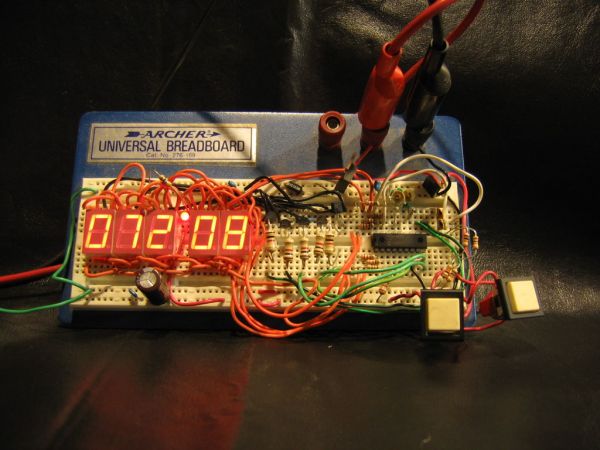
You can see my prototype NET clock in the picture to get an idea of what’s involved.
Electronics:
1x – PIC16F627A Microcontroller
1x – 32.768kHz Crystal (Mouser 815-AB26T-32.768KHZ or equivalent)
2x – 22pF Ceramic Capacitor (or 1x 22pF and 1x 0-56pF Variable capacitor for tuning)
4x – 10k Resistor
7x – 100 Ohm Resistor
1x – 4.7k Resistor
5x – 1k Resistor
5x – 2n3904 Transistor
5x – Common Cathode 7-segment Display (Mouser 512-MAN6980 or equivalent)
2x – SPST Momentary pushbutton switch
1x – Round LED, modified as described in Step 2 (Making the degrees LED)
5V Power source (Wall adapter, or 9V battery regulated down with an LM7805 Regulator)
Other:
Case (My case came from an old electric blanket thermostat. I love the cool retro-modern look about it)
Breadboard or Perfboard to construct the circuitry
Hookup Wire
A little bit of Heatshrink (the size of your LED) and a Sharpie Marker.
Tools:
PIC Programmer
Step 2
Making the Degrees LED
Because NET counts in Degrees, it is only appropriate to add a Degrees symbol after the Degrees display.
To make your own Degrees indicator, press a piece of un-shrunk heatshrink tubing onto the LED, so that the end of the tubing is about even with the top of the LED lens. Don’t shrink the tubing! Leave it just like it is.
Next, take a sharpie marker and color in the center of the LED lens. It usually works best to do this with the LED on, so you can see where you need more ink. It may take several coats of ink to get it dark enough that it blocks light. I find that a “dabbing” motion of the sharpie deposits the ink better that a “dragging” or writing motion.
When you’re done, you’ll have an LED that only lets light out from the edges – just like a Degrees symbol!
Step 3
Electronic Schematic
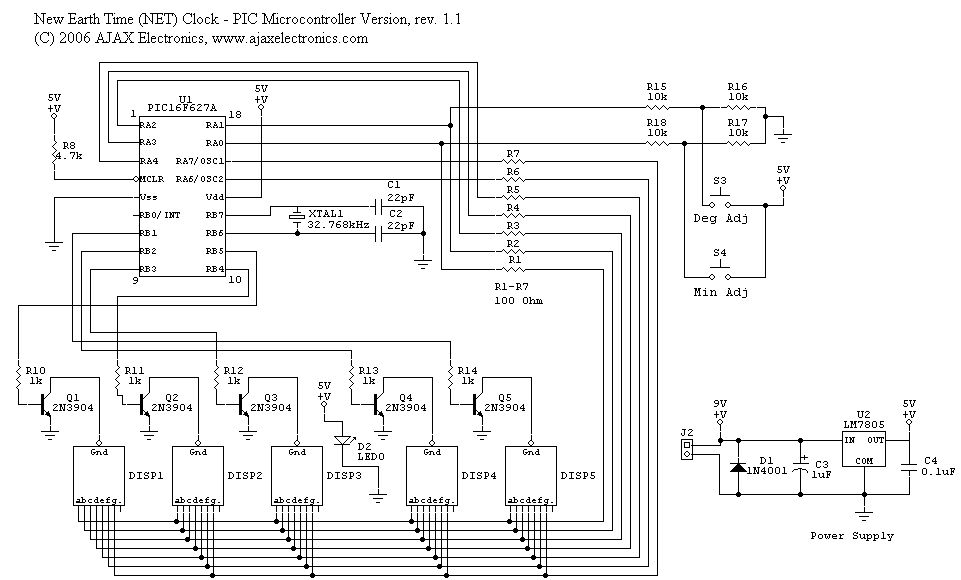
The schematic diagram (see picture) and electronic assembly are fairly straightforward since most of the “magic” happens in the microcontroller code.
Just like any digital clock, the microcontroller uses time-division multiplexing to control five 7-segment displays from only 12 I/O pins. You can look up this scheme on the internet, but the basic idea is that only one display is on at any given time but our eye perceives all displays to be on simultaneously due to persistence of vision. The displays are driven by 2N3904 transistors, since the PIC I/O ports can’t sink enough current for 7 LEDs.
In addition to the displays, there are two buttons multiplexed into the display outputs for the clock setting functions. One button sets NET Degrees, the other sets NET Minutes.
The 32.768kHz crystal is the main timekeeping device for the clock. You want to make sure you get a high-accuracy crystal, but even then you may need to adjust the value of C1 and C2 to keep time accurately.
I have included a small 5V regulator circuit in the lower corner. If you have a 5V source already, this isn’t needed.
For more detail: New Earth Time digital clock in recycled retro-modern case using PIC16F627A
- What is New Earth Time?
New Earth Time is a global time standard that counts time in Degrees and Minutes so it is not confused with local time. - How does the microcontroller control the displays?
The microcontroller uses time-division multiplexing to control five 7-segment displays from only 12 I/O pins. - Why are 2N3904 transistors used in this project?
The PIC I/O ports cannot sink enough current for seven LEDs, so the displays are driven by 2N3904 transistors. - Can I use a variable capacitor for tuning?
Yes, you can use one 22pF ceramic capacitor and one 0-56pF variable capacitor for tuning instead of two fixed 22pF capacitors. - How do you make the Degrees symbol LED?
Press un-shrunk heatshrink tubing onto the LED and color the center of the lens with a Sharpie marker until light only exits from the edges. - What components are used for setting the clock?
Two SPST momentary pushbutton switches are multiplexed into the display outputs to set NET Degrees and NET Minutes. - Is a 5V regulator circuit always required?
No, the small 5V regulator circuit is only needed if you do not already have a 5V power source available. - What is the main timekeeping device for the clock?
The 32.768kHz crystal serves as the main timekeeping device for the clock.
