
Summary of NANO: SPOT WELDING JUST GOT EASY AND AFFORDABLE
The Nano Ultra-Compact Spot Welder by RePowered Batteries aims to make welding accessible and affordable for hobbyists. It features a cordless design with supercapacitors, a custom PCB, and a 3D-printed housing. The device can weld up to 0.15mm solid nickel and offers multiple power options including USB, a single 18650 cell, or a 9V external supply. Currently funding on Kickstarter, it is available as a kit or individual parts.
Parts used in the Nano Ultra-Compact Spot Welder:
- DC-DC power regulator
- High-quality supercapacitors
- Welding control board on a PCB with 15x more copper
- 3D-printed housing
- Selection of welding tips
- Air-cooled electrodes
- Single 18650 battery cell (optional power source)
- 9v external power supply (optional power source)
One of the major focuses of the maker movement since time immemorial has been the development of a makeshift version of tools with the goal of making them cheaper and more accessible. This focus has been more pronounced in recent times with several tools like CNC and 3Dprinters being all open-source, decentralized, and affordable to regular folks. To take things further to more machine tools, Canada-based battery refurbishing company; RePowered Batteries, recently announced the launch of their Nano Ultra-Compact Spot welder, which is aimed at making welding more accessible to hobbyists.
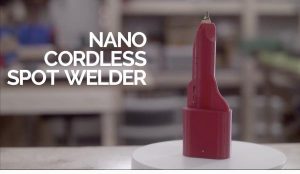
Sharing the reason behind the development of the Spot Welder, the team at RePowered Batteries said that the primary “goal is to make a no-hassle and affordable welder” that surpasses the current welders in the market by being both cordless (no external power supply required) and more efficient and safe compared to similar devices on the market.
The Ultra-Compact Spot Welder is comprised of a small built-in DC-DC power regulator, high-quality supercapacitors, and a welding control board on a PCB with 15x more copper than standard PCB, all packaged in a 3D-printed housing, with a selection of welding tips and air-cooled electrodes as consumables.
Built with versatility in mind, unlike other similar solutions in the market, the Spot Welder allows users to weld up to 0.15mm solid nickel. A table showing how the weather further compares with similar devices in the market is shown below:
While the goal is to make the device handy and untethered, one way to power the device is via the use of a 9v external power supply which could be useful, when you need to get things done, fast. However, if you are not in a hurry and not out of battery power, there are several other ways to power the devices including; power over USB or by hooking up a single 18650 battery cell to it.
The Kickstarter campaign for the device was launched a few days back and with just 21 days left, the project has raised up to $12,400 surpassing its initial goal of $3,047 by up to 400%. The device was designed in a modular form and the crowdfunding campaign provides users with the opportunity to buy them in parts, separately, or as a kit.
Read more: NANO: SPOT WELDING JUST GOT EASY AND AFFORDABLE
- What is the primary goal of the Nano Ultra-Compact Spot Welder?
The goal is to create a no-hassle and affordable welder that is cordless, efficient, and safe. - Can the spot welder be powered without an external power supply?
Yes, it is designed to be cordless using built-in supercapacitors. - How thick of solid nickel can this device weld?
The device allows users to weld up to 0.15mm solid nickel. - What are the alternative ways to power the device if not using the internal battery?
You can use a 9v external power supply, power over USB, or hook up a single 18650 battery cell. - Does the project offer the option to buy components separately?
Yes, the crowdfunding campaign provides users the opportunity to buy them in parts, separately, or as a kit. - How much funding has the Kickstarter campaign raised so far?
The project has raised up to $12,400, surpassing its initial goal by 400%.