


Summary of Life Size Operation Game using PIC16F877 microcontroller
This article details the creation of a life-size "Operation" game for a church Trunk or Treat event, featuring a Bible Armor of God theme. The 5ft tall board uses cardboard and wood framing with printed banner paper. A PIC16F877 microcontroller detects contact between salad tongs and aluminum foil-lined pockets, triggering a red LED nose and buzzer when players touch the metal sides.Parts used in the Life Size Operation Game:
- Digital picture of original Operation game board
- Photo editing software (Photoshop)
- Clipart
- Cardboard project display boards (Michaels Crafts, 36in x 48in)
- Banner paper
- 3M Super 77 spray glue
- Wood strips (1in by 2in)
- White duct tape
- Thumb tacks
- 120VAC red light bulb (filament and socket removed)
- Four white LEDs
- Paper template
- Hot glue gun
- Aluminum foil strips (1 inch)
- Disposable aluminum oven liners
- Salad tongs
- Candy
- PIC16F877 microcontroller
Life Size Operation Game
As a child I loved the Milton Bradley Operation game, the buzzer always scared me when it went off, but it was fun. The object of the Operation game is to remove a body part with out touching the tweezers to the metal sides that surround the object for removal. If you touch any metal sides you make his nose light up and a buzzer will sound and startle you.
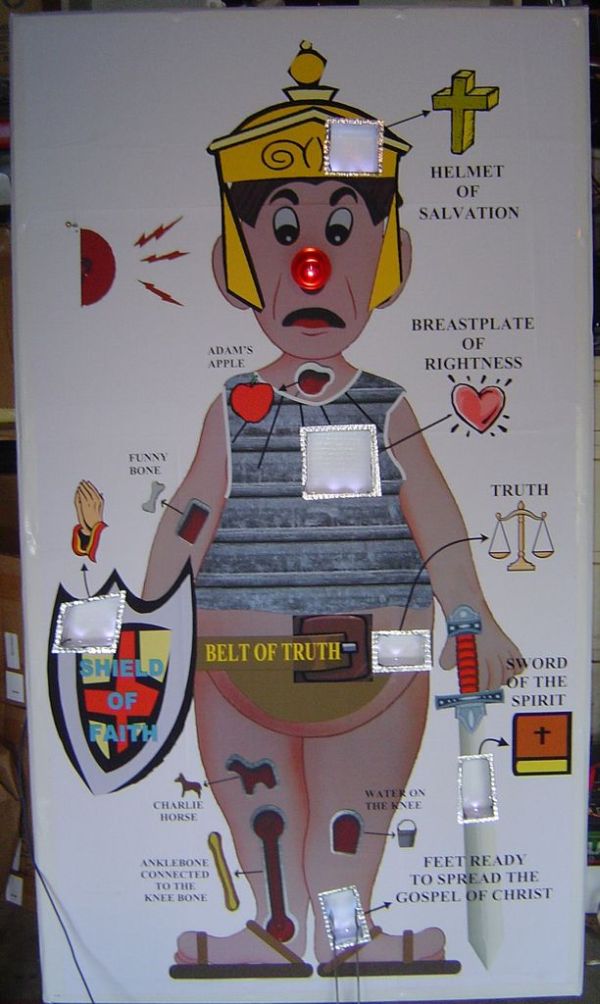
This year the Church I attend was having a new Harvest Festival or Halloween function this year called Trunk O Treat. Truck O Treat is where you play a game or activity out the trunk of your car. For my life size Operation game I would put candy in the pockets for the kids to pick out with salad tongs and put a Bible Armor of God theme for the pockets. I used a microcontroller to detect when the tongs come in contact with the metal sides and flash the red nose and make the buzzer sound.
Step 1
The Picture
To build the life size over 5ft tall game board. I took a digital picture of the original Operation game board and in a photo shop edited the picture to add clipart and removed the yellow background to save on printer ink. The picture is glued down on cardboard front and a wood frame is made to give it a structure. I printed out the picture on banner paper to make it easier to assemble it in strips. The picture is overlapped about half inch when printed out so you can align and glued down the image. I taped together two the cardboard project display boards with a white background. I used the display boards from Michaels Crafts and there size is 36in wide by 48in long. To glue down the picture I used 3M Supper# 77 spray glue to adherer the picture (banner paper) to the cardboard and trimmed the cardboard to size. The finished Operation board size was 34in wide by 62in long and 4in thick.
Step 2
Wood Frame and Red Nose
Step 3
Red Nose
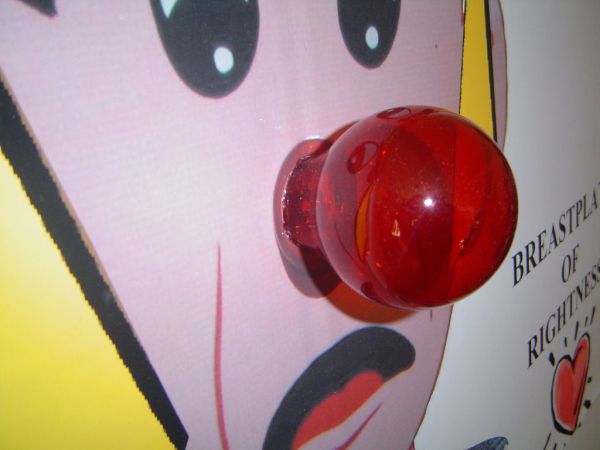
The light bulb used for the nose was a 120VAC bulb that is red color. I removed the filament and socket base and glued it to the front poster board with four white LED's for illuminating the inside the nose.
Step 4
Make Boxes
Boxes
The size for the pockets and constructed them out of cardboard and taped together. The pocket sizes are all two inches deep; Sword 2in x 3.50in, Feet 1.75in x 3.50in, Shield 3inx 3in, Belt 1.75in x 2.75in, Breastplate 3.75in x 3.75in, and Helmet 2.75in x 2.75in. I made a template out of paper to fit inside the box so I can use it for cutting out the correct size hole on the picture. I cut out all the pockets on the picture and hot glued wings to the pocket boxes so they will sit flush with the bottom and hot glued them to the back of the picture cardboard.
Step 5
Aluminum Foil in Boxes
I glued 1 inch strips of aluminum foil on the front edge of all the boxes. I took the cutout cardboard pieces and used it as a template for the front aluminum metal pieces. I cut out a disposable aluminum oven liners for the front mount seen metal. This was used for better lower resistance to detect contact with tongs. I glued the aluminum to the front 1/8in to 1/4in to go around the opening on the front picture and bent it inside the boxes 1/4 inch to 1 inch.
For more detail: Life Size Operation Game using PIC16F877 microcontroller
Quick Solutions to Questions related to Life Size Operation Game:
- How was the large image prepared for printing?
A digital photo was edited in Photoshop to add clipart and remove the yellow background, then printed on banner paper in overlapping strips. - What materials were used to construct the wood frame?
The frame was built using 1in by 2in wood strips found around the house, stapled to cardboard, and covered with white duct tape. - How is the red nose illuminated in the game?
A 120VAC red bulb had its filament removed and was replaced with four white LEDs glued inside to illuminate it. - Can you list the specific dimensions for the armor pockets?
Dimensions include Sword at 2in x 3.50in, Feet at 1.75in x 3.50in, Shield at 3inx 3in, Belt at 1.75in x 2.75in, Breastplate at 3.75in x 3.75in, and Helmet at 2.75in x 2.75in. - Why were disposable aluminum oven liners used for the metal pieces?
They were used to provide better lower resistance for detecting contact with the tongs. - How does the game detect when a player touches the metal sides?
A PIC16F877 microcontroller detects contact between the tongs and the aluminum foil lining the boxes. - What happens when the metal sides are touched during gameplay?
The red nose flashes and a buzzer sounds to startle the player. - What is the final size of the finished Operation board?
The finished board measures 34in wide by 62in long and is 4in thick.
Related projects
PIC16F877 Driving LCD in 4-Bit Mode using PIC16F877 with Proteus Simulation
Introduction This microcontroller project shows how a PIC16F877 can drive an LCD display using 4-bit mode inside a Proteus simulation.The project demonstrates...
Programmers & ICSP · PIC16F877AEPE PIC/LCD Demo using PIC16F877 with Proteus Simulation
IntroductionThe EPE PIC/LCD Demo is a classic microcontroller project that demonstrates how a PIC16F877 can fully control a PG12864F graphical LCD.Designed as...
Motors & Robotics · PIC16F877AEfficient Sun-Following Robot: A Solar Tracker with Microcontroller Control
Abstract The impending global challenge of dwindling non-renewable fuel resources underscores the urgency of transitioning towards renewable energy alternatives like solar power....
Games, Toys & CalculatorsExploring Leon’s Mini Random Number Generator (mRNG)
Sales Pitch Feeling overwhelmed by choices? Who isn't? Decision-making can be a maze. White, rye, or wheat? Pinstripes or polka dots? Feast...
Games, Toys & Calculators · PIC16F628ATIC TAC TOE game using PIC16F628
This project is not to introduce Tic Tac Toe. Everyone knows this game. It's to introduce two features. Bi-coloured LEDs, microcontrollers and...
Games, Toys & CalculatorsInteractive Blitz Chess: A Physical Blitz Chess Board Powered with PIC32
Introduction We created a companion system for physical chess boards to help players enjoy their fast paced blitz game with a chess...

Ibrar Ayyub
I am an experienced technical writer holding a Master's degree in computer science from BZU Multan, Pakistan University. With a background spanning various industries, particularly in home automation and engineering, I have honed my skills in crafting clear and concise content. Proficient in leveraging infographics and diagrams, I strive to simplify complex concepts for readers. My strength lies in thorough...