


Summary of LED fireflies prototype using PIC12f683 microcontroller
This project is a low-power RGB LED firefly prototype that combines LED throwie aesthetics with LED-as-sensor and entropy techniques. A PIC12F683 microcontroller drives a common-cathode RGB LED, using the LED itself as a light sensor to avoid daytime power use, harvesting random entropy from the LED to create unique, varied blink colors and rates, and occasionally playing organic-looking flash patterns while minimizing battery consumption.Parts used in the LED fireflies prototype:
- Common cathode tri-color (RGB) LED
- PIC12F683 microcontroller
- Coin cell battery holder
LED fireflies prototype
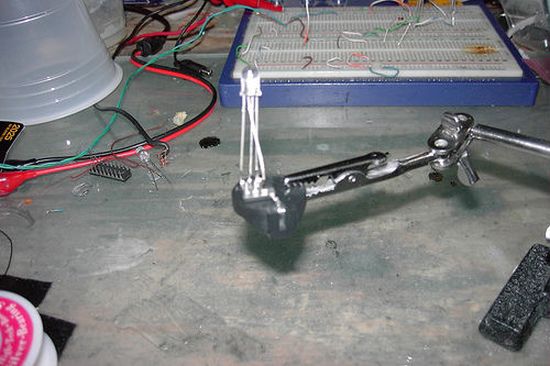
first you have to accept the premise that your willing to spend a bit more for the tradeoff..
the inspiration for this came from some of my other projects, and of course the "LED as a sensor" concept as well as the "LED throwie"
so the parts list:
1 common cathode, tri-color (RGB) LED
1 12f683 pic micro
1 coin cell battery holder
(cheap plug) http://www.makenyc.org/
Step 1: So whats it do?
the idea here is to use the led throwie/graffiti concept, to add a little life to my neighborhood that ive been missing for a long time now... fireflies..
the software is designed to use the LED as a light sensor (so as not to waste power during the day)
the led as an entropy source (to make each firefly unique moments after switching it on) to vary blink color, and rate.
and of course to play a flash pattern every so often in a way that seems "organic" and isnt just an "on/off" blink
and of course use as little power as possible!
(apologies for the darkness of the video, but the light had to be dim enough not to trip the fireflies daylight sensor)
For more detail: LED fireflies prototype using PIC12f683 microcontroller
- What is the main function of this LED fireflies project?
To create low-power, organic-looking LED fireflies that sense daylight, vary behavior using LED-derived entropy, and minimize battery use. - Which microcontroller is used in the prototype?
The PIC12F683 microcontroller is used. - What type of LED is used?
A common cathode tri-color (RGB) LED is used. - How does the device avoid wasting power during the day?
It uses the LED itself as a light sensor to detect daylight and reduce power use. - How are unique blink patterns and colors generated?
Random entropy is gathered from the LED to vary blink color, rate, and create unique behavior after power-up. - Does the project include occasional flash patterns?
Yes, the software occasionally plays an organic-looking flash pattern rather than simple on/off blinks. - What power source component is listed?
A coin cell battery holder is listed as the power component.
Related projects
Automotive Voltage Monitor using PIC12F683
Description Recently I got a new motorbike and on my second trip out, with only 50 miles on the clock the rectifier/regulator...
Communication & Interfacing · PIC12F683EnvStick USB Temperature Sensor using PIC12F683
The EnvStick is cheap, homemade temperature sensor that plugs into a USB port. It provides a simple way to collect a room’s...
Sensors & Temperature · PIC12F683Metal detector robot using pic microcontroller
This project describes hardware and software I have developed which allows a small 8 bit PIC microprocessor to function as a single...
LED ProjectsAn Application-Driven Microcontroller Curriculum
Understanding how to apply microcontrollers lies at the core of modern embedded systems education. This student project takes an experiential approach to...
LED ProjectsBuild this microcontroller controlled rainbow flying disc – and then throw it!
Hello all and welcome to this super simple and inexpensive instructable. If you like throwing frisbees AND you like flashing lights AND...
LED ProjectsLED Scrolling Display Project Working With Circuit Diagram
We normally use a simple static LED display screen to convey a message. Earlier, when we want to display large data, we...

Ibrar Ayyub
I am an experienced technical writer holding a Master's degree in computer science from BZU Multan, Pakistan University. With a background spanning various industries, particularly in home automation and engineering, I have honed my skills in crafting clear and concise content. Proficient in leveraging infographics and diagrams, I strive to simplify complex concepts for readers. My strength lies in thorough...