
Summary of INSTRUMENTATION AMPLIFIER FOR PRESSURE SENSOR
This article details a general-purpose differential amplifier circuit designed for pressure sensor applications, specifically using piezo-resistive sensors like the MPXV2010DP. The circuit amplifies low-voltage differential signals (25-50 mV) to a 0.75V–4.75V range compatible with microcontroller ADCs. It utilizes an LM358 dual operational amplifier configured as an instrumentation amplifier with trimmer potentiometers for gain and offset adjustments, featuring dual sensor footprints and external interface headers.
Parts used in the General Purpose Differential Amplifier Project:
- LM358 dual operational amplifier
- Multiple resistors
- Capacitors
- PR1 Trimmer Potentiometer
- PR2 Trimmer Potentiometer
- MPXM2010GS sensor footprint
- MPXV2010DP sensor footprint
- MPXV2010DP sensor
- 4 pin Header connector
- 0E resistor (for single supply configuration)
General purpose differential amplifier project has been designed for various pressure sensor amplifier applications. Circuit provided with multiple resistors, capacitors, dual sensor options and 4 pin Header connector to interface other external sensors. Schematic is an example from NXP application AN1318 Figure 2.
The most popular silicon pressure sensors are piezo-resistive bridges that produce a differential output.
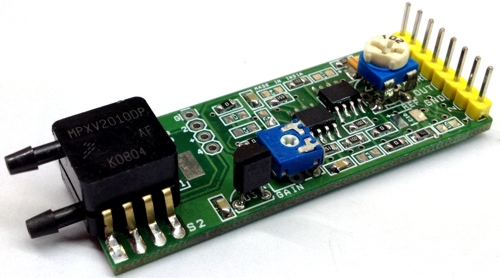
Voltage output is in response to pressure applied to a thin silicon diaphragm. Output voltage for these sensors is generally 25 to 50 mV full scales. Interface to microcomputers, therefore, generally involves gaining up the relatively small output voltage, performing a differential to single-ended conversion, and scaling the analog signal into a range appropriate for analog to digital conversion. The circuit published here is a simple solution which amplifies low voltage differential signal and provides single output voltage which can be directly fed to ADC of micro-controller. Instrumentation amplifiers are by far the most common interface circuits that are used with pressure sensors. An example of an inexpensive instrumentation amplifier based interface circuit uses an LM358 dual operational amplifier and several resistors that are configured as a classic instrumentation amplifier with one important exception. PR2 Trimmer potentiometer provided to set the offset voltage 0.75V. Setting the offset voltage to 0.75 V results in a 0.75 V to 4.75 V output that is directly compatible with microprocessor A/D inputs. Over a zero to 50° C temperature range, combined accuracy for the MPX2000 series sensor and this interface is on the order of ± 10%. Trimmer potentiometer PR1 helps to set the gain. PCB provided with MPXM2010GS and MPXV2010DP dual footprint options, for testing purpose MPXV2010DP sensors has been used.
The MPXV2010 series silicon Piezo-Resistive pressure sensors provide a very accurate and linear voltage output directly proportional to the applied pressure. These sensors house a single monolithic silicon die with the strain gauge and thin film resistor network integrated. The sensor is laser trimmed for precise span, offset calibration and temperature compensation.
Note : Board is designed for multiple applications and has dual supply input option, Use 0E resistor instead of C8 or short the two terminals since circuit works on single supply.
Features
- Supply 10V DC Single Supply
- MPXV2010DP Pressure Range 0 to 10 kPa (0 to 1.45 psi)
- Output 0.75V to 4.75V Approx. (Adjustable)
- PR1 Trimmer Potentiometer Gain Adjust
- PR2 Trimmer Potentiometer Offset Adjust
Read More: INSTRUMENTATION AMPLIFIER FOR PRESSURE SENSOR
- What is the primary function of this circuit?
The circuit amplifies low voltage differential signals from pressure sensors and provides a single output voltage directly fed to a micro-controller ADC. - How does the PR2 Trimmer Potentiometer affect the output?
It sets the offset voltage to 0.75V, resulting in a 0.75V to 4.75V output range compatible with microprocessor A/D inputs. - Which specific pressure sensor series is mentioned for testing?
The MPXV2010DP sensor has been used for testing purposes on the PCB. - Can this circuit operate on a single supply?
Yes, by using a 0E resistor instead of C8 or shorting the two terminals since the circuit works on a single supply. - What is the approximate accuracy over a zero to 50° C temperature range?
The combined accuracy for the MPX2000 series sensor and this interface is on the order of ± 10%. - What is the purpose of the PR1 Trimmer Potentiometer?
PR1 helps to set the gain of the amplifier circuit. - What is the typical full scale output voltage for the silicon pressure sensors used?
The output voltage for these sensors is generally 25 to 50 mV full scales. - Does the board support multiple sensor options?
Yes, the PCB is provided with MPXM2010GS and MPXV2010DP dual footprint options. - What supply voltage is recommended for this project?
The features list specifies a 10V DC Single Supply option. - How are the strain gauges calibrated in the MPXV2010 series sensors?
The sensor is laser trimmed for precise span, offset calibration and temperature compensation.