
Summary of EZ-PD PMG1: A PORTFOLIO OF HIGH-VOLTAGE MCUS WITH USB-C POWER DELIVERY
Infineon Technologies has introduced the EZ-PD PMG1, the first 28V high-voltage microcontroller family supporting USB Power Delivery 3.1 for up to 140 W. Targeting consumer, industrial, and communications applications, PMG1 integrates an ARM Cortex-M0+ core (up to 256 KB Flash, 32 KB SRAM), USB full-speed, GPIOs, gate drivers, LDOs, HV protection, and programmable analog/digital blocks. It includes hardware/firmware protections, secure boot, signed firmware updates, and supports ModusToolbox SDK, prototyping kits, and quick start guides to streamline firmware development and reduce time-to-market.
Parts used in the EZ-PD PMG1:
- EZ-PD PMG1 high-voltage microcontroller family (28V, USB PD 3.1)
- ARM Cortex-M0+ controller core (integrated in PMG1)
- Up to 256 KB Flash memory (on-chip)
- 32 KB SRAM (on-chip)
- USB full-speed interface (on-chip)
- Programmable general purpose input/output (GPIO) pins
- Gate drivers (integrated)
- Low drop out (LDO) regulators (integrated)
- High-voltage protection circuits (integrated)
- Programmable analogue and digital blocks (on-chip)
- ModusToolbox integrated development environment (software)
- PMG1 software development kit (SDK) (software)
- Prototyping kits and quick start guide (supporting hardware and documentation)
Infineon Technologies has launched the industry’s first 28V high-voltage microcontroller with USB Power Delivery (USB PD) 3.1 support.
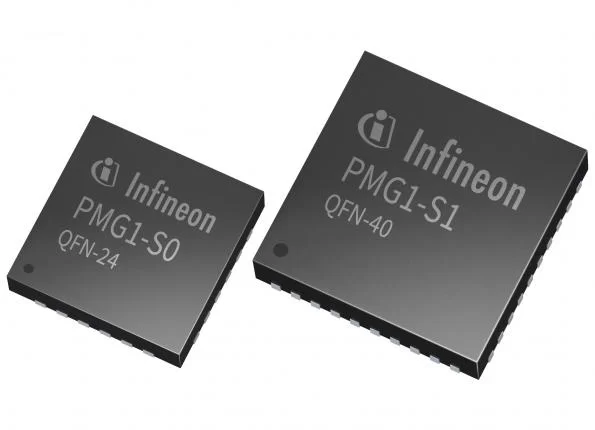
The EZ-PD PMG1 (Power Delivery Microcontroller Gen1) supports any embedded system that provides or consumes power up to 28 V and 140 W in consumer, industrial and communications markets for applications such as smart speakers, routers, power and garden tools.
This follows the latest update to the USB PD standard to support higher voltages and power levels.
The PMG1 family supports higher power capabilities defined in the USB PD 3.1 specification and uses the MCU to provide additional control capability. It integrates an established USB PD stack to enable reliable performance and interoperability, supported by an ARM Cortex-M0+ controller core with up to 256 KB Flash memory and 32 KB SRAM. It also has a USB full-speed interface, programmable general purpose input/output (GPIO) pins, gate drivers, low drop out (LDO) regulators and high-voltage protection circuits.
The MCU also provides hardware and firmware protection, including over-voltage and over-current protection, short circuit and reverse current protection, secure firmware boot and signed firmware update.
To increase ease-of-use for designers, the new devices include programmable analogue and digital blocks to easily customize and integrate intelligent analogue sensors into the application. The PMG1 MCU is also field programmable to allow signed firmware updates for improved efficiency.
Programming is supported by the ModusToolbox integrated development environment with the PMG1 software development kit along with prototyping kits and quick start guide. They make the firmware development and testing simple and easy to further reduce the overall development time and time-to-market.
Source: EZ-PD PMG1: A PORTFOLIO OF HIGH-VOLTAGE MCUS WITH USB-C POWER DELIVERY
- What voltage and power levels does the EZ-PD PMG1 support?
It supports systems providing or consuming power up to 28 V and 140 W per USB PD 3.1. - Which processor core does the PMG1 use?
The PMG1 uses an ARM Cortex-M0+ controller core. - How much on-chip memory is available in the PMG1?
The PMG1 provides up to 256 KB Flash memory and 32 KB SRAM. - Does the PMG1 include USB connectivity?
Yes, it includes a USB full-speed interface. - What protection features are provided by the PMG1?
It provides over-voltage, over-current, short circuit, reverse current protection, secure firmware boot, and signed firmware update support. - Can designers customize analogue sensors with the PMG1?
Yes, the PMG1 includes programmable analogue and digital blocks to customize and integrate intelligent analogue sensors. - Is the PMG1 field programmable?
Yes, the PMG1 is field programmable and supports signed firmware updates. - What tools support development for the PMG1?
Programming is supported by the ModusToolbox IDE with the PMG1 SDK, plus prototyping kits and a quick start guide.