Summary of SPARKFUN QUICKLOGIC THING PLUS FEATURING EOS S3 MCU AND EFPGA IS NOW AVAILABLE AT $45.95
SparkFun QuickLogic Thing Plus is a Feather-footprint FPGA development board based on the QuickLogic EOS S3 MCU + eFPGA SoC. It features an Arm Cortex-M4F at up to 80 MHz, 512 KB RAM, 16 Mbit SPI flash, onboard accelerometer and PDM microphone with Wake-on-Sound, and supports TensorFlow Lite and SensiML for ML as well as SymbiFlow and Renode for eFPGA workflows. The board is breadboard-compatible, USB-C or Li-Po powered with onboard charging, and targets low-power rapid prototyping and power-sensitive applications.
Parts used in the SparkFun QuickLogic Thing Plus:
- QuickLogic EOS S3 MCU + eFPGA SoC (Arm Cortex-M4F)
- 2,400 effective logic cell eFPGA
- 512 KB RAM (on SoC)
- 16 Mbit SPI NOR flash
- STMicro LIS2DH12TR accelerometer
- Vesper VM3011-U1 PDM microphone with Wake-on-Sound
- Microchip MCP73831/2 Li-Po charging IC
- Li-Po JST connector
- USB Type-C connector
- Breadboard-compatible 0.1 inch (2.54 mm) pitch headers (pre-soldered)
- SWD programming connector
- UART interface
- I²C interface
- I²S interface
- SPI interface
SparkFun QuickLogic Thing Plus was originally crowdfunded on CrowdSupply that raised around $4500. If you did not back the product back then, no worries, you can buy it now on the SparkFun product page. SparkFun QuickLogic Thing Plus is a powerful FPGA board that comes with a Feather-footprint. The product from the collaboration of SparkFun and QuickLogic makes it a rapid prototyping open-source hardware with ultra-low power SoC for power-sensitive applications.
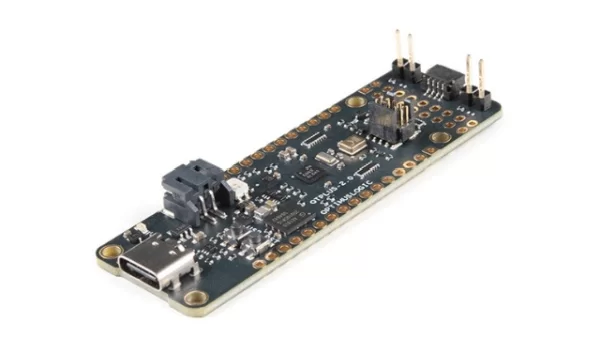
This FPGA board is built around QuickLogic’s EOS S3 MCU + eFPGA SoC featuring embedded FPGA (eFPGA) technology with 2,400 effective logic cells. The Arm Cortex-M4F MCU provides 512 KB of RAM. One of the important features to note is the out of the box support for machine learning algorithms with TensorFlow Lite and SensiML. However, since it has eFPGA, the software support in that regard is SymbiFlow and Renode.
Specification Of SparkFun QuickLogic Thing Plus:
- CPU: QuickLogic EOS S3 MCU + eFPGA SoC featuring Arm Cortex-M4F MCU running at up to 80 MHz
- Form factor: Breadboard-compatible 0.1″ (2.54 mm) pitch headers – all headers are pre-soldered
- Dimensions: 2.75″ x 0.9″ (70 mm x 22.9 mm) footprint
- Storage: 16 Mbit SPI NOR flash
- Sensors: Accelerometer, Digital pulse density modulation (PDM) microphone
- Interfaces: SWD programming connector, UART, I²C, I²S, SPI
- Power supply: USB Type-C connector or via Li-Po battery
As mentioned earlier, the QuickLogic EOS S3 SoC is an ultra-low-power chip, so the board can be powered using a Li-Po battery as well with onboard charging circuitry using the Microchip MCP73831/2 and has a standard Li-Po JST connector. When it comes to ML applications, it is always an added advantage when there are sensors onboard. So, to solve this the designer has provided the board with an accelerometer with STMicro LIS2DH12TR and digital pulse density modulation (PDM) microphone with Wake-on-Sound (WoS) feature through the Vesper VM3011-U1.
Source: SPARKFUN QUICKLOGIC THING PLUS FEATURING EOS S3 MCU AND EFPGA IS NOW AVAILABLE AT $45.95
- Can I buy the SparkFun QuickLogic Thing Plus now if I missed the CrowdSupply campaign?
Yes, you can buy it now on the SparkFun product page. - What MCU and FPGA features does the board use?
The board uses the QuickLogic EOS S3 MCU + eFPGA SoC with an Arm Cortex-M4F MCU and a 2,400 effective logic cell eFPGA. - Does the board support machine learning frameworks out of the box?
Yes, it has out of the box support for TensorFlow Lite and SensiML. - What software tools support the eFPGA?
eFPGA software support includes SymbiFlow and Renode. - How is the SparkFun QuickLogic Thing Plus powered?
It can be powered via USB Type-C or a Li-Po battery and includes onboard charging circuitry. - Which charging IC and battery connector are used for Li-Po support?
The board uses the Microchip MCP73831/2 charger and a standard Li-Po JST connector. - What onboard sensors are included for ML applications?
It includes an STMicro LIS2DH12TR accelerometer and a Vesper VM3011-U1 PDM microphone with Wake-on-Sound. - What storage is available on the board?
The board includes 16 Mbit SPI NOR flash storage. - Is the board breadboard compatible?
Yes, it has breadboard-compatible 0.1 inch (2.54 mm) pitch headers that are pre-soldered.