
Summary of CATL RELEASING THEIR FAST-CHARGING FIRST GENERATION OF SODIUM-ION BATTERIES
CATL unveiled its first-generation sodium-ion battery and an AB battery pack that integrates sodium-ion and lithium-ion cells. The batteries use Prussian white cathodes and porous hard carbon anodes, achieving up to 160 Wh/kg, 15-minute charge to 80% at room temperature, >90% capacity retention at -20°C, >80% system integration efficiency, and thermal stability above national traction battery safety standards. They target transportation electrification and energy storage, particularly in extremely low-temperature regions.
Parts used in the CATL Sodium-ion Battery Project:
- Prussian white cathode material
- Redesigned bulk cathode structure (electron rearranged)
- Hard carbon anode material with porous structure
- Sodium-ion cells
- Lithium-ion cells
- AB battery pack solution (integrating sodium-ion and lithium-ion cells)
- Battery system integration components achieving >80% efficiency
(CATL) successfully held its first online launch event “Tech Zone” on July 29. Dr. Robin Zeng, chairman of CATL, unveiled the company’s first-generation sodium-ion battery, together with its AB battery pack solution – which is able to integrate sodium-ion cells and lithium-ion cells into one pack – at the event. As another milestone of CATL in the exploration of basic science and technology, sodium-ion batteries will provide a new solution for the use of clean energy and transportation electrification, thus promoting the early realization of the goal of carbon neutrality.
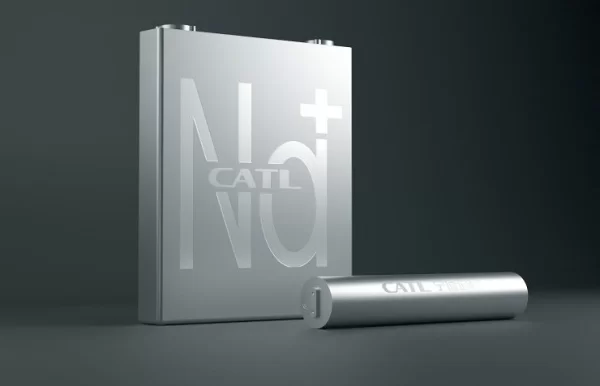
Breaking through the bottleneck of sodium-ion battery technology
As carbon neutrality has become a global consensus, the new energy industry has entered a complex and diversified development stage. The increasingly segmented markets have raised differentiated requirements for batteries. At the same time, the worldwide research and development of basic materials for batteries is accelerating, which opens a two-way window for the industrialization of sodium-ion batteries.
The sodium-ion battery has a similar working principle to the lithium-ion battery. Sodium ions also shuttle between the cathode and anode. However, compared with lithium ions, sodium ions have a larger volume and higher requirements regarding structural stability and the kinetic properties of materials. This has become a bottleneck for the industrialization of sodium-ion batteries.
CATL has been dedicated to the research and development of sodium-ion battery electrode materials for many years. In terms of cathode materials, CATL has applied Prussian white material with a higher specific capacity and redesigned the bulk structure of the material by rearranging the electrons, which solved the worldwide problem of rapid capacity fading upon material cycling. In terms of anode materials, CATL has developed a hard carbon material that features a unique porous structure, which enables the abundant storage and fast movement of sodium ions, and also an outstanding cycle performance.
Based on a series of innovations in the chemistry system, CATL’s first generation of sodium-ion batteries has the advantages of high-energy density, fast-charging capability, excellent thermal stability, great low-temperature performance and high-integration efficiency, among others. The energy density of CATL’s sodium-ion battery cell can achieve up to 160Wh/kg, and the battery can charge in 15 minutes to 80% SOC at room temperature. Moreover, in a low-temperature environment of -20°C, the sodium-ion battery has a capacity retention rate of more than 90%, and its system integration efficiency can reach more than 80%. The sodium-ion batteries’ thermal stability exceeds the national safety requirements for traction batteries. The first generation of sodium-ion batteries can be used in various transportation electrification scenarios, especially in regions with extremely low temperatures, where its outstanding advantages become obvious. Also, it can be flexibly adapted to the application needs of all scenarios in the energy storage field.
Source: CATL RELEASING THEIR FAST-CHARGING FIRST GENERATION OF SODIUM-ION BATTERIES
- What did CATL unveil at the Tech Zone event?
CATL unveiled its first-generation sodium-ion battery and an AB battery pack solution that integrates sodium-ion and lithium-ion cells. - What cathode material does CATL use for its sodium-ion battery?
CATL uses Prussian white cathode material with a redesigned bulk structure by rearranging electrons. - What anode material does CATL use?
CATL developed a hard carbon anode material featuring a unique porous structure. - What is the energy density of CATL’s sodium-ion battery cell?
The energy density can achieve up to 160 Wh/kg. - How fast can the sodium-ion battery charge?
The battery can charge to 80% state of charge in 15 minutes at room temperature. - How does the battery perform at low temperatures?
At -20°C the sodium-ion battery has a capacity retention rate of more than 90%. - What is the system integration efficiency of the sodium-ion battery?
The system integration efficiency can reach more than 80%. - Does the sodium-ion battery meet safety requirements?
Yes, its thermal stability exceeds the national safety requirements for traction batteries. - Which applications are targeted by CATL’s sodium-ion batteries?
They are targeted at transportation electrification and various energy storage scenarios, especially in extremely low-temperature regions.