
Summary of EASILY SCALE ACROSS MULTIPLE PROCESSORS WITH AEON’S GENE-CML5 SUBCOMPACT BOARD
AAEON launched the GENE-CML5 3.5 embedded board for rugged Edge AI and industrial applications, featuring an LGA1200 socket supporting 10th Gen Intel Core i3/i5/i7, Pentium, and Celeron processors, up to 4.4 GHz. It offers up to 64 GB DDR4, Intel vPro and iAMT remote management, multiple I/O (USB3.2 Gen2, USB2.0, dual Gigabit LAN), DP++, VGA, LVDS display outputs, M.2 2280 M-Key for NVMe or AI modules, PCIe 3.0 x4 expansion via FPC, and two SATA III ports for storage and expansion.
Parts used in the GENE-CML5:
- LGA1200 socket (supports 10th Gen Intel Core i3/i5/i7, Pentium, Celeron)
- 64GB DDR4 memory
- Intel vPro and Intel Active Management Technology (iAMT)
- Two USB3.2 Gen 2 ports
- Four USB2.0 ports
- Dual Gigabit LAN ports
- DisplayPort++ (DP++) connector
- VGA connector
- LVDS connector
- M.2 2280 M-Key slot (for NVMe storage or AI expansion modules)
- PCIe 3.0 x4 expansion with FPC connector
- Two SATA III (6.0 Gbps) slots
Embedded Boards manufacturer, AAEON, some days ago announced the launch of a new embedded development board, the GENE-CML5 3.5, a subcompact board designed for next-generation industrial, and general Edge AI applications where robustness, ruggedness, and increased processing capacity are required.
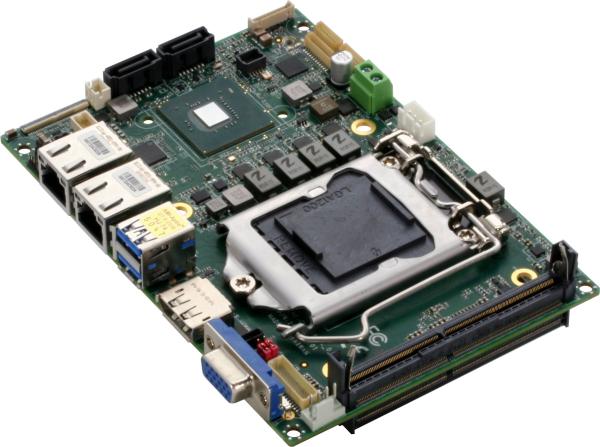
Designed with an understanding of flexibility and need for scale, unlike the usual fixed, soldered down processor style deployed in most 3.5″ form factor boards, the GENE-CML5 comes with an LGA1200 socket which enables the board to support all sorts of 10th Generation Intel Core i3/i5/i7 processors, as well as Intel® Pentium® and Celeron® processors with up to 4.4 GHz CPU frequency. This flexibility provides developers, solution providers, and end-users with the ability to easily maintain, scale, and upgrade the platform based on their changing requirements.
Designed to bring portability to the edge, the GENE-CML5 comes with 64GB DDR4 memory, which combined with the high CPU frequency it supports, allows users to perform computations at a speed that is on par with what is obtainable in bulkier desktop systems. Asides from processing capabilities, one other key feature for Edge solutions is a remote monitoring and management system and the GENE-CML5 allows users to do this without fuss, leveraging the many advantages of the Intel vPro and Intel Active Management Technology (iAMT).
For easy integration, deployment, and general usage, the GENE-CML5 comes with a broad I/O layout that features; two USB3.2 Gen 2 ports, four USB2.0 ports, and dual Gigabit LAN ports. Display options include DP++, VGA, and LVDS connectors. For storage and expansion/extension of processing capabilities, the board also features an M.2 2280 M-Key slot that can support AI expansion modules snd as well be used for NVMe storage, a PCIe 3.0 (x4) expansion with FPC connector and two SATA III (6.0 Gbps) slots.
Read more: EASILY SCALE ACROSS MULTIPLE PROCESSORS WITH AEON’S GENE-CML5 SUBCOMPACT BOARD
- What processors does the GENE-CML5 support?
The board supports 10th Generation Intel Core i3/i5/i7 processors, as well as Intel Pentium and Celeron processors via the LGA1200 socket. - Can the processor be upgraded on the GENE-CML5?
Yes, the LGA1200 socket allows users to maintain, scale, and upgrade the processor. - How much memory does the GENE-CML5 come with?
The GENE-CML5 comes with 64GB DDR4 memory. - Does the GENE-CML5 support remote management?
Yes, it supports Intel vPro and Intel Active Management Technology for remote monitoring and management. - What display outputs are available on the GENE-CML5?
Display options include DP++, VGA, and LVDS connectors. - What expansion and storage options does the GENE-CML5 offer?
It offers an M.2 2280 M-Key slot for NVMe or AI modules, a PCIe 3.0 x4 expansion with FPC connector, and two SATA III (6.0 Gbps) slots. - How many USB and network ports does the GENE-CML5 have?
It has two USB3.2 Gen 2 ports, four USB2.0 ports, and dual Gigabit LAN ports. - Is the GENE-CML5 intended for Edge AI applications?
Yes, it is designed for next-generation industrial and Edge AI applications requiring robustness and increased processing capacity.
